The landscape of search engine optimization (SEO) has fundamentally shifted. Gone are the days when digital marketers could rely on static, manually updated weekly spreadsheets to gauge their organic visibility. In an era defined by hyper-dynamic search engine results pages (SERPs), AI-driven search experiences (such as AI Overviews), real-time algorithm updates, and complex multi-device user journeys, precision is everything.
Accurately tracking keyword movements, competitors, and SERP features across multiple global markets, localized zip codes, and distinct search engines is no longer a luxury—it is a core business necessity. Without granular, real-time data, validating SEO investments and tying ranking metrics directly to revenue, traffic, and conversions is virtually impossible.
This comprehensive guide investigates the top SERP tracking solutions available for 2025. We evaluate both specialized, standalone trackers and comprehensive all-in-one SEO platforms. By examining essential core features, real-world utility, and pricing structures, this report provides marketing leaders, enterprise agencies, and in-house SEO professionals with the authoritative insights needed to select the ideal SERP tracking software for their operations.
Detailed Chronology & Evolution of SERP Tracking
To understand where rank tracking stands in 2025, it is vital to trace how the industry evolved from crude data extraction methods to sophisticated cloud-based intelligence systems.
The Early 2000s (The Manual Era): In the infancy of search engines, webmasters tracked performance by manually typing keywords into search boxes, flipping through pages of results, and updating local Excel sheets. Data was sporadic, highly prone to human error, and completely detached from broader business analytics.
The 2010s (The Rise of Automated Trackers): As search algorithms grew more complex and personalized, desktop-based scraping tools emerged. Agencies and enterprises began using software that ran on local machines to scrape search results daily or weekly. However, these tools suffered from IP blocking, proxy management headaches, and a lack of scalability.
The Late 2010s to 2020s (Cloud-Based SaaS & API Integration): The industry pivoted rapidly toward cloud-native Software-as-a-Service (SaaS) models. Platforms like AccuRanker and ProRankTracker introduced scalable, on-demand data refreshes and robust API connectivity. Furthermore, rank trackers began integrating deeply with Google Analytics and Google Data Studio (now Looker Studio), allowing marketers to map keyword positions directly to user behavior and revenue metrics.
2025 and Beyond (AI Integration & Multi-Engine Complexity): Today, SERP tracking encompasses much more than a simple numbered list. With the proliferation of AI Overviews, People Also Ask (PAA) boxes, video carousels, and localized map packs, modern SERP tracking tools must ingest and analyze over 50 distinct SERP features. Today’s tools simulate genuine user behavior across diverse global locations, offering predictive analytics, content gap identification, and real-time visibility into non-Google engines like Bing, Baidu, Yandex, and YouTube.
Supporting Context & Essential Metrics: 9 Must-Have Features
When evaluating SERP tracking software for enterprise or agency use, decision-makers must look beyond surface-level pricing and check for nine non-negotiable features.
1. On-Demand Ranking Updates
SERP positions fluctuate faster than ever. Waiting days for scheduled batch updates is unacceptable in modern digital marketing. Top-tier tools offer real-time, on-demand data refreshes. For instance, AccuRanker automates daily checks while allowing users to force a fresh data pull across their entire keyword set instantly with a single click.
2. Multi-SERP Feature Monitoring
Ranking in position #1 is only half the battle; capturing "Position #0" via featured snippets, knowledge cards, or AI Overviews dictates true organic dominance. The ideal SERP tracker monitors 50+ distinct SERP features simultaneously, identifying which keywords trigger them and what actions are required to steal them from competitors.
3. Multi-Engine Search Support
While Google commands global market share, international campaigns often require visibility across Bing, Baidu, Yandex, and YouTube. Enterprise-grade tools support multiple search engines to ensure comprehensive global coverage.
4. Granular Geographic and Device Segmentation
National averages can be deceiving. Modern campaigns require hyper-local rank tracking—down to the state, city, or even zip code level—coupled with strict segmentation between mobile and desktop user experiences.
5. Revenue and Conversion Attribution
Visibility without ROI is a vanity metric. Advanced trackers integrate seamlessly with Google Analytics and Adobe Analytics, linking keyword movements and landing page performance directly to organic traffic, bounce rates, and bottom-line revenue.
6. Comprehensive Historical Performance Data
Point-in-time snapshots are insufficient for trend analysis. Leading platforms maintain deep historical archives, allowing teams to visualize ranking trajectories over months and years, mapping long-term growth against algorithmic volatility.
7. Competitor Intelligence & Gap Analysis
SEO is a zero-sum game. Trackers must group keywords into performance brackets (e.g., positions 1–3, 4–10, 11–50) and track competitor movement to spot emerging market threats and content vulnerabilities before competitors do.
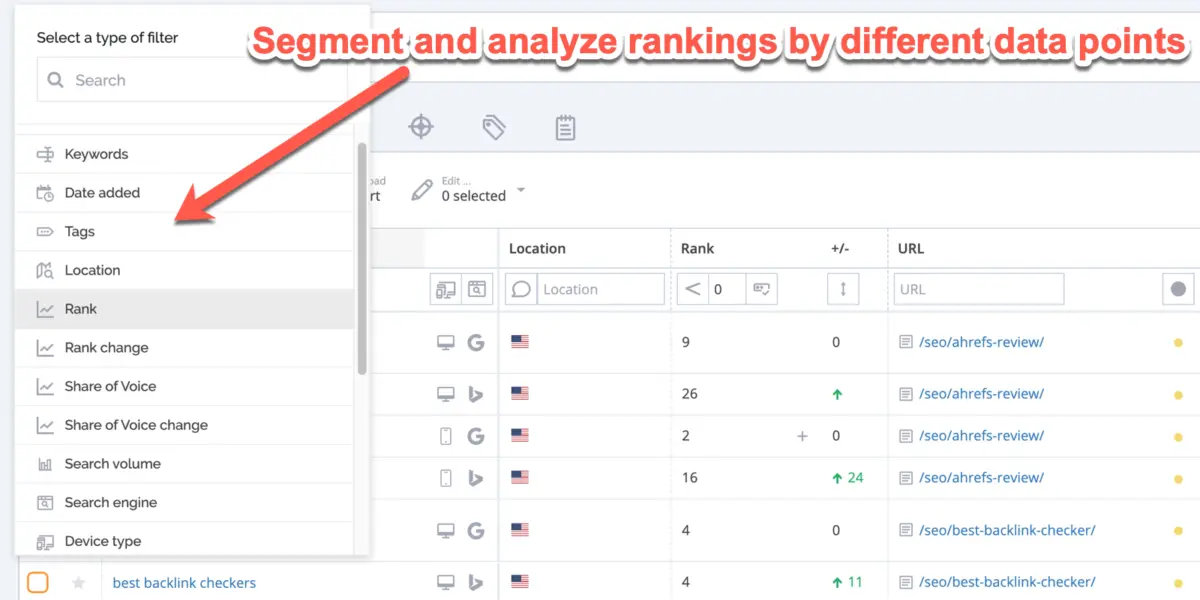
8. Advanced Tagging and Segmentation
Managing thousands of keywords requires robust taxonomy. The best tools enable keyword tagging by topic, buyer funnel stage, content asset type, and device, allowing for agile filtering of Share of Voice (SoV).
9. White-Label Reporting and BI Integration
Agency success relies on transparent, professional communication. Native white-label reporting combined with robust connectors for Looker Studio and Databox ensures stakeholders receive digestible, visually compelling progress reports.
The 7 Best SERP Tracking Tools for 2025
The market features countless options, but the following seven tools represent the pinnacle of SERP tracking performance—split between specialized standalone solutions and robust all-in-one SEO suites.
1. AccuRanker (Best Standalone Tracker)
Overview: AccuRanker is widely recognized as the gold standard for speed and accuracy in standalone SERP tracking. Trusted by over 32,000 companies—including enterprise giants like HubSpot, IKEA, and Kinsta—it is engineered specifically for agencies and brands that demand instant data.
Key Strengths: Lightning-fast on-demand updates, deep integration with Google and Adobe Analytics, sophisticated Landing Pages reports, and native Looker Studio connectors that make agency reporting effortless.
Pricing: Subscription tiers scale based on keyword volume, starting at approximately $116/month for up to 1,000 keywords.
2. Semrush (Best All-in-One Suite & Position Tracker)
Overview: Used by over 10 million digital marketing professionals from brands like Samsung, Vodafone, and Booking.com, Semrush offers a powerhouse Position Tracking Tool that rivals the accuracy of any standalone software.
Key Strengths: Beyond standard daily rank tracking across devices and hyper-local coordinates, Semrush offers unique add-ons like the SERP Gap Analyzer (available via the Semrush App Center). This tool scans SERPs to uncover under-optimized content, integrates with Google Search Console, and provides actionable optimization recommendations to save hours of manual research.
Pricing: Comprehensive SEO platform plans start at $139.95/month.
Overview: Trusted by over 60,000 customers, ProRankTracker delivers robust, highly scalable SERP tracking, analysis, and reporting without breaking the budget.
Key Strengths: Comprehensive multi-language and multi-device support, excellent international location tracking, and affordable entry-level pricing tailored for growing agencies and ecommerce brands.
Pricing: Entry-level plans begin at $39/month.
4. Advanced Web Ranking – AWR (Best for Enterprise Scalability)
Overview: AWR is a veteran standalone SERP tracker utilized by thousands of SEO professionals and major global brands like Microsoft.
Key Strengths: Renowned for handling massive enterprise keyword inventories with high reliability, flexible data sharing, and completely customizable white-label reporting suites.
Pricing: Subscription plans start at $99/month.
5. SERPWatcher by Mangools (Best for Simplicity & Usability)
Overview: SERPWatcher is the dedicated rank-tracking component of the Mangools SEO ecosystem, favored by brands like Airbnb and Adidas for its clean, intuitive interface.
Key Strengths: The proprietary Performance Index metric calculates organic traffic potential instantly across all tracked terms. Paired with Mangools’ SERPChecker, it offers an exceptionally user-friendly experience for small businesses and startups.
Pricing: Bundled Mangools plans start at $29.90/month.
6. SE Ranking (Best Hybrid All-in-One Tracker)
Overview: SE Ranking is a feature-rich, all-in-one SEO platform whose Position Tracking Tool simulates genuine user behavior across precise local coordinates and major search engines.
Key Strengths: Highly accurate localized data capture, robust competitor matrix tracking, and comprehensive reporting capabilities wrapped in a flexible, modular pricing model.
Pricing: Plans start at $52/month based on daily tracking for 500 keywords.
7. Nightwatch (Best for Hyper-Local & Global Scale)
Overview: Trusted by brands like Shopify and Coinbase, Nightwatch is celebrated for its exceptional data accuracy and massive global footprint, tracking search engine performance across more than 107,000 distinct worldwide locations.
Key Strengths: Advanced data visualization, flexible segmentation, and robust API capabilities tailored for freelancers, SMBs, and enterprise agencies alike.
Pricing: Offers a 14-day free trial, with paid plans starting at $32/month for 250 keywords.
Official Statements & Industry Perspectives
Industry leaders continue to emphasize the evolving role of advanced analytics in proving SEO ROI.
Matthew Howells-Barby, Co-Founder of TrafficThinkTank, notes:
"It’s by far the best keyword ranking tracker in the market and has a ton of great reporting functions. If you want visibility on large volumes of keywords housed within a nice dashboard—this is for you."
Echoing the importance of modern BI integrations, Ian Howells, Co-Founder of Traffic Think Tank, adds:
"The thing that really got me using them heavily in the last month or two is their Google Data Studio [Looker Studio] connector. Combining the tag feature, as well as the Share of Voice metric… has been a big help in making these reports immediately digestible."
Future Outlook
As we look toward the remainder of the decade, the evolution of search engine architecture will continue to redefine how businesses measure visibility. The integration of generative AI within search results means traditional ten-blue-link tracking is rapidly becoming obsolete.
Future SERP trackers must evolve into predictive intelligence engines that not only record where a brand ranks, but also decode how AI-generated snippets, intent shifts, and zero-click searches impact user acquisition. Marketers who invest in robust, agile, and accurate tracking software today will be best positioned to interpret these algorithmic shifts, protect their organic market share, and drive sustainable revenue growth in the years ahead.


![7 Best SERP Tracking Tools for 2022 [In-Depth Review]](https://www.robbierichards.com/wp-content/uploads/2020/05/Best-SERP-Trackers.jpg)
![7 Best SERP Tracking Tools for 2022 [In-Depth Review]](https://www.robbierichards.com/wp-content/uploads/2020/04/image16-2.png)
![7 Best SERP Tracking Tools for 2022 [In-Depth Review]](https://www.robbierichards.com/wp-content/uploads/2020/04/image2-3.png)
![7 Best SERP Tracking Tools for 2022 [In-Depth Review]](https://www.robbierichards.com/wp-content/uploads/2020/04/image6-2.png)
![7 Best SERP Tracking Tools for 2022 [In-Depth Review]](https://www.robbierichards.com/wp-content/uploads/2020/04/image15.jpg)
![7 Best SERP Tracking Tools for 2022 [In-Depth Review]](https://www.robbierichards.com/wp-content/uploads/2020/04/image12-1.png)
![7 Best SERP Tracking Tools for 2022 [In-Depth Review]](https://www.robbierichards.com/wp-content/uploads/2020/04/image13-2.png)
![7 Best SERP Tracking Tools for 2022 [In-Depth Review]](https://www.robbierichards.com/wp-content/uploads/2020/04/image3.jpg)
![7 Best SERP Tracking Tools for 2022 [In-Depth Review]](https://www.robbierichards.com/wp-content/uploads/2018/08/rj-employee_Robbie-color-new.png)
![7 Best SERP Tracking Tools for 2022 [In-Depth Review]](https://www.robbierichards.com/wp-content/uploads/2020/05/Databox-SEO-dashboard-1.jpg)
![7 Best SERP Tracking Tools for 2022 [In-Depth Review]](https://www.robbierichards.com/wp-content/uploads/2020/04/image4-2.png)
![7 Best SERP Tracking Tools for 2022 [In-Depth Review]](https://www.robbierichards.com/wp-content/uploads/2020/04/image5.jpg)
![7 Best SERP Tracking Tools for 2022 [In-Depth Review]](https://www.robbierichards.com/wp-content/uploads/2020/05/AccuRanker-Google-Data-Studio-integration.jpg)
![7 Best SERP Tracking Tools for 2022 [In-Depth Review]](https://www.robbierichards.com/wp-content/uploads/2018/11/Ian-Howells2.png)
![7 Best SERP Tracking Tools for 2022 [In-Depth Review]](https://www.robbierichards.com/wp-content/uploads/2019/01/Google-Data-Studio-KW-rankings-dashboard.png)
![7 Best SERP Tracking Tools for 2022 [In-Depth Review]](https://www.robbierichards.com/wp-content/uploads/2025/01/AccuRanker-home-page.jpg)
![7 Best SERP Tracking Tools for 2022 [In-Depth Review]](https://www.robbierichards.com/wp-content/uploads/2015/01/matthew-barby.jpg)
![7 Best SERP Tracking Tools for 2022 [In-Depth Review]](https://www.robbierichards.com/wp-content/uploads/2022/06/image1-1.png)
![7 Best SERP Tracking Tools for 2022 [In-Depth Review]](https://www.robbierichards.com/wp-content/uploads/2025/01/Semrush-SERP-Gap-Analyzer-1024x447.png)
![7 Best SERP Tracking Tools for 2022 [In-Depth Review]](https://www.robbierichards.com/wp-content/uploads/2025/01/Semrush-SERP-Gap-Analyzer-Search-Console-integration.png)
![7 Best SERP Tracking Tools for 2022 [In-Depth Review]](https://www.robbierichards.com/wp-content/uploads/2020/04/image10-2.png)