

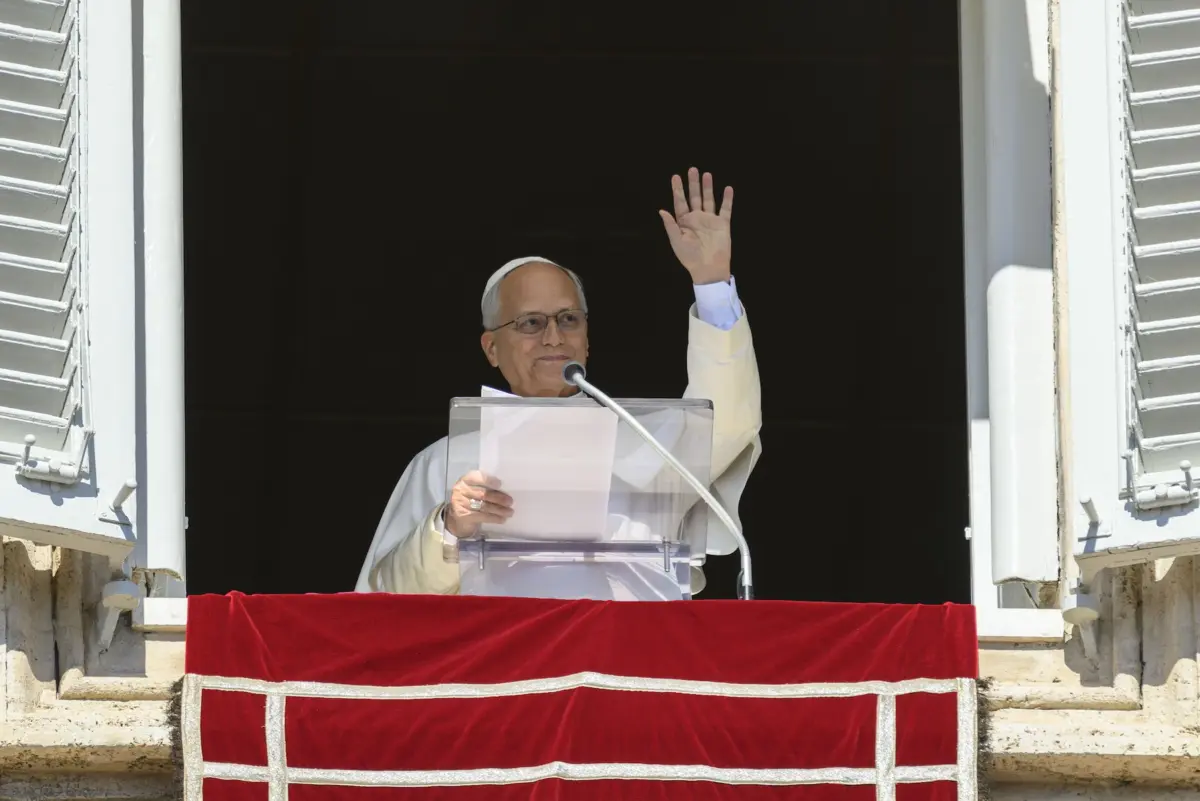
VATICAN CITY — In a direct and personal announcement that caught the global Catholic community by surprise, Pope Leo XIV revealed on Sunday that he will undergo scheduled surgery in the coming days to remove a localized nodule discovered in his lung.
Speaking to thousands of the faithful gathered in St. Peter’s Square for the traditional Sunday Angelus prayer, and simultaneously broadcasting the message across his official social media channels, the pontiff sought to project calm and transparency. Addressing the crowd with characteristic candor, Pope Leo XIV emphasized that the condition was diagnosed at an exceptionally early stage, giving medical teams a favorable window for intervention.
While the Vatican has confirmed that the upcoming procedure will necessitate a hospital stay of approximately one week—likely at Rome’s historic Gemelli Hospital—questions immediately arise regarding the broader implications for the Holy See’s governance, the pope’s demanding travel itinerary, and the state of papal health management in the modern era.
Executive Overview
The announcement on Sunday marks a significant moment for the pontificate of Pope Leo XIV, blending personal vulnerability with administrative transparency. According to statements released by both the Vatican Press Office and the pontiff himself, routine medical screenings recently flagged a small, highly localized mass within the pope’s lung tissue.
Following comprehensive evaluations by a team of specialists, the medical consensus strongly favored surgical intervention as a preventative and definitive measure.
- The Procedure: Scheduled to take place early this week, the surgery aims to completely excise the pulmonary nodule.
- The Prognosis & Pathology: As of Sunday afternoon, the Vatican has not disclosed whether the nodule is malignant (cancerous) or benign. Medical experts note that the vast majority of incidentally discovered lung nodules are non-cancerous masses of dense tissue; however, early-stage removal remains standard medical protocol to mitigate long-term risks.
- The Recovery Period: Pope Leo XIV is expected to remain hospitalized for approximately seven days for post-operative monitoring and initial recuperation. While day-to-day administrative operations of the Holy See will continue uninterrupted, matters requiring direct papal assent or signature will be temporarily paused.
- Travel Implications: The upcoming procedure casts a veil of uncertainty over an ambitious 11-day apostolic journey to South America currently slated for November 6, during which the pontiff is scheduled to visit Uruguay, Argentina, and Peru.
Detailed Chronology of Events
The sequence of events leading up to Sunday’s public announcement unfolded over the course of several weeks, characterized by routine preventative healthcare measures and subsequent specialist consultations.
Phase 1: Routine Screening and Discovery
Pope Leo XIV, maintaining a rigorous schedule of pastoral duties and administrative oversight, underwent standard scheduled medical examinations in late September and early October. During these diagnostic evaluations, physicians identified an anomaly—a small pulmonary nodule—located within the lung parenchyma.
Phase 2: Specialist Consultation and Decision-Making
Upon identifying the mass, a multidisciplinary medical team conducted further imaging and diagnostic tests. They determined that because the growth was detected at an exceptionally early stage and remained strictly localized, surgical intervention offered the safest and most definitive path forward.
Consulted on the medical recommendations, Pope Leo XIV accepted the advice of his physicians. Plans were quietly set in motion to schedule the operation for early the following week, ensuring minimal disruption while prioritizing the pontiff’s long-term health.
Phase 3: The Public Announcement
Choosing direct communication over traditional, formal press releases alone, Pope Leo XIV integrated the news into his Sunday Angelus address. Standing before the assembled crowds in St. Peter’s Square, and publishing identical sentiments via the official @Pontifex X (formerly Twitter) account, the pope stated:
"Dear friends, during some recent medical examinations, the doctors found a small, localized nodule in my lung. It was detected at a very early stage and is well-localized. The doctors believe that it is best to intervene, so, following their advice, I have decided to undergo surgery to remove it. The operation is already scheduled to take place in the coming days."
He concluded his message with a personal appeal to the global faithful: "I thank you for your spiritual closeness and entrust myself to your prayers."
Supporting Context & Medical Metrics
To better understand the medical decisions guiding the Vatican’s approach, it is essential to examine the clinical nature of pulmonary nodules and the specific logistical framework of papal healthcare in Rome.
Understanding Pulmonary Nodules
Pulmonary nodules—often colloquially referred to as "spots" on the lung—are relatively common findings in modern diagnostic imaging, frequently discovered incidentally during routine chest X-rays or computed tomography (CT) scans performed for unrelated reasons.
- Benign vs. Malignant: According to epidemiological data from organizations such as the American Thoracic Society, the vast majority of small, isolated pulmonary nodules are benign. They can be the result of prior localized infections, benign scar tissue (granulomas), or non-cancerous tumors.
- The Rationale for Early Intervention: Even when a nodule has a high statistical probability of being benign, thoracic surgeons frequently recommend resection when a patient’s overall health permits, particularly if imaging suggests changing characteristics or if definitive diagnosis requires histological examination. By intervening at an early, well-localized stage, medical teams minimize the risk of metastasis or complex invasive procedures should the mass prove problematic over time.
The Gemelli Hospital Connection
Pope Leo XIV is expected to recover at Rome’s Agostino Gemelli University Hospital, an institution with a profound historical and logistical relationship with the papacy.
- The Papal Suite: Gemelli Hospital houses a dedicated, highly secure papal apartment on its tenth floor, specifically designed and maintained to host pontiffs during medical treatments and recovery periods.
- Historical Precedent: The hospital has served as the primary medical facility for modern popes, most notably during the numerous hospitalizations of Pope John Paul II and subsequent medical stays for Pope Francis. The presence of specialized medical infrastructure and a trusted team of Vatican-approved clinicians ensures that the pontiff will receive world-class care while remaining in direct communication with key aides.
Official Statements and Global Reactions
The revelation of the pope’s impending surgery immediately elicited an outpouring of solidarity, prayer, and official responses from religious leaders, heads of state, and international organizations.
The Vatican Press Office Briefing
In a comprehensive follow-up statement released shortly after the Angelus address, the Holy See Press Office provided logistical clarity regarding the upcoming days:
- The surgical procedure will be performed by a team of leading Italian thoracic surgeons early in the week.
- The expected hospital stay of approximately one week will be dedicated entirely to recovery and monitored rehabilitation.
- The Roman Curia and the various dicasteries of the Holy See will maintain standard operations during the pope’s hospitalization. However, in accordance with canon law and administrative precedent, legislative or executive decisions requiring the direct signature or explicit authorization of the Supreme Pontiff will be deferred until his return to the Apostolic Palace.
Ecumenical and International Response
Religious leaders from across the global Christian spectrum, as well as representatives of other major world religions, quickly conveyed messages of support. Cardinals, bishops, and local parishes around the world have announced special prayer vigils and intentions during Mass for the success of the surgery and a swift, uncomplicated recovery.
Political figures from Europe, the Americas, and beyond also transmitted official diplomatic wishes for the pontiff’s health, underscoring the universal moral and geopolitical significance attached to the papacy.
Future Outlook and Pastoral Schedule
While the immediate focus remains squarely on the success of the upcoming pulmonary surgery and the subsequent week of hospital recovery, the medium-term papal calendar faces significant questions regarding upcoming international commitments.
The South American Apostolic Journey
On November 6, Pope Leo XIV is officially scheduled to embark on a demanding 11-day apostolic journey to South America, with planned stops in Uruguay, Argentina, and Peru. The itinerary is traditionally rigorous, involving multiple cross-country flights, high-energy public masses, youth encounters, diplomatic meetings, and demanding daily schedules.
- Logistical Dilemma: Vatican officials have noted that it remains premature to determine whether the surgery and subsequent recovery period will force a postponement or cancellation of the South American tour.
- Medical Cautiousness: Post-operative recovery from thoracic surgery—even minimally invasive or early-stage interventions—typically requires several weeks of convalescence, breathing exercises, and restricted physical exertion. Medical advisors will closely evaluate the pontiff’s rate of healing during his week at Gemelli Hospital and his subsequent return to the Vatican before rendering a final recommendation on whether the November travel schedule is viable.
Governance and Continuity
The temporary pause on decisions requiring direct papal approval highlights the robust, institutionalized nature of the modern Vatican bureaucracy. While high-level appointments, encyclical promulgations, and major structural decrees will be temporarily suspended, the daily administrative machinery of the Church—ranging from pastoral dispensations to diplomatic communications—will function without interruption under the coordination of the Cardinal Secretary of State.
As Rome prepares for the procedure in the coming days, the overarching sentiment among both the medical team and the faithful remains one of cautious optimism, anchored by the early detection of the condition and the robust healthcare infrastructure awaiting the pontiff at Gemelli Hospital.