

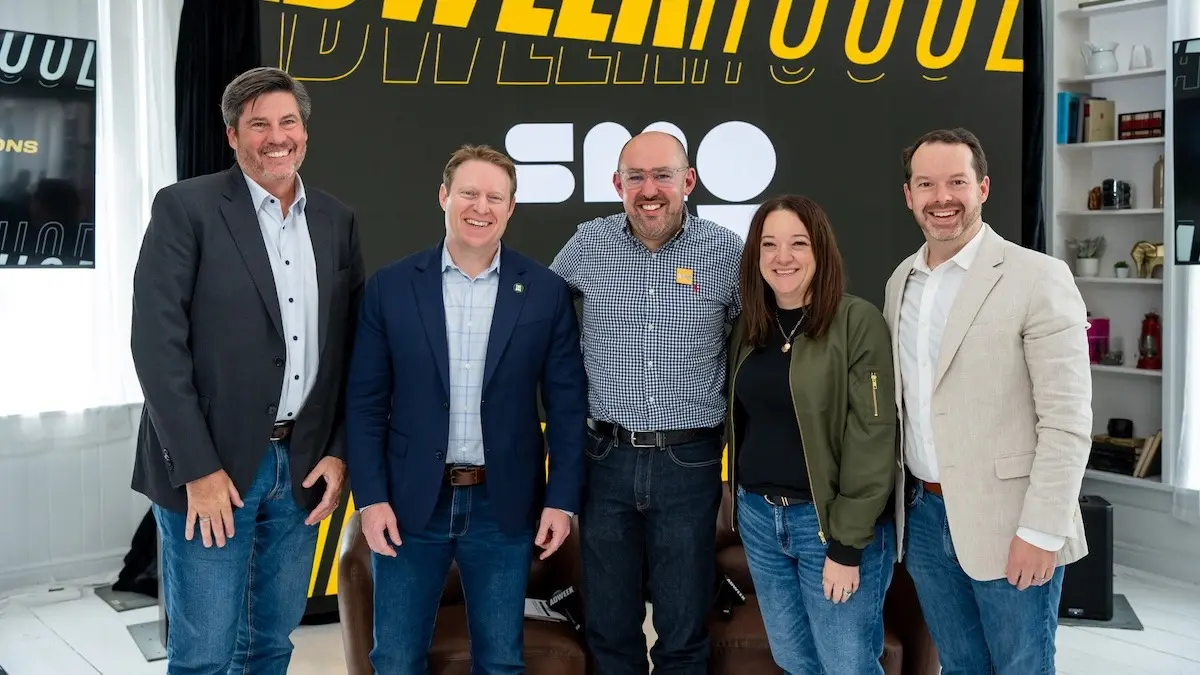
This special industry report is created in partnership with SMG.
As the digital marketing ecosystem undergoes structural maturation, retail media networks (RMNs) have firmly established themselves as the ultimate battleground for consumer attention and brand growth. No longer confined to the digital real estate of e-commerce homepages, retail media has broken physical barriers, expanding aggressively into brick-and-mortar aisles, connected living rooms, transit vehicles, and luxury hospitality networks.
This rapid expansion brings both unprecedented opportunities for hyper-targeted consumer engagement and complex operational challenges. Advertisers are no longer asking if they should invest in retail media; rather, they are demanding to know how to measure its true impact across fragmented touchpoints.
To dissect these shifting paradigms, ADWEEK House Advertising HQ recently hosted a trio of immersive commerce connection sessions co-produced with SMG. Bringing together heavyweights from retail, hospitality, ridesharing, and programmatic advertising, these panels explored the evolving strategies required to master in-store media effectiveness, decode the habits of routine grocery shoppers, and unlock the untapped potential of travel media networks.
Executive Overview
The modern consumer journey is rarely linear. It zigzags between digital discovery and physical exploration, blending everyday routines—such as weekly grocery trips—with high-intent, emotionally charged moments like planning a vacation or navigating a bustling airport terminal. Retail media networks have evolved to capture these moments, transforming every physical environment and transit hub into a potential ad-serving display.
However, the breakneck speed of innovation has outpaced standard industry metrics. Advertisers accustomed to the clean, digital attribution of traditional performance marketing are suddenly grappling with the messy realities of physical retail spaces. How do you measure the value of a digital ad displayed on a shopping cart screen when the consumer ultimately pays with cash? How do you isolate the impact of Connected TV (CTV) campaigns on physical supermarket sales? And how do you value an audience that is miles away from home, experiencing the heightened emotional receptivity of travel?
During the ADWEEK House sessions, industry leaders addressed these exact pain points. The consensus was clear: while data infrastructure has become remarkably sophisticated, the future of retail media relies less on chasing a single, elusive metric like Return on Ad Spend (ROAS) and more on holistic, cross-channel measurement frameworks, customer experience curation, and contextual relevance.

Detailed Chronology: The Three Pillars of Modern Commerce Media
The collaborative sessions with SMG were structured around three distinct pillars of the modern consumer ecosystem: the physical retail store, the grocery shopping routine, and the dynamic environment of travel media networks.
Pillar 1: Choose Your Player—The Battle for In-Store Leadership
The opening conversation tackled the renaissance of physical retail spaces as dynamic media channels. Moderated by Ollie Shayer, senior director of global strategy and innovation at SMG, the panel featured Collin Colburn (VP of commerce and retail media at IAB), Chip Harding (EVP of simon media and experiences at Simon Property Group), Austin Leonard (VP and general manager of DG Media Network), and Britt Polihronis (COO of RedMedia at Hy-Vee, Inc.).
The panel focused heavily on the mechanics of scaling in-store commerce media. While digital out-of-home (DOOH) screens, smart shelving, and app-enabled promotions have transformed brick-and-mortar locations into media powerhouses, measurement remains the ultimate frontier.
The speakers highlighted that metrics must be hyper-localized to the physical context of the environment. In massive retail real estate like shopping malls, foot traffic, dwell time, and direct transactional sales serve as vital performance signals. Conversely, in grocery and convenience environments, brands must evaluate immediate micro-behaviors—such as whether a shopper physically picks up a promoted product or interacts with an in-aisle display. Across both retail ecosystems, the overarching demand from brand partners remains consistent: verifiable proof of incremental sales that justifies premium media investments.
Beyond data, the panel stressed that the physical in-store experience cannot be treated merely as a digital billboard. Success requires a delicate balance of curation, ambient design, and targeted engagement that encourages product discovery and sampling without disrupting the natural flow of the shopping trip.
Pillar 2: From Story to Store—Creating Connected Campaigns in Grocery
Moving from general brick-and-mortar retail to the specific, high-frequency environment of grocery shopping, Zoë Ruderman, chief content officer at ADWEEK, sat down for a fireside chat with Liz Roche, VP of media and measurement at Albertsons Media Collective.
Grocery shopping represents one of the few recurring, non-negotiable rituals in a consumer’s life. Because of this frequency, marketing cannot be relegated to the final moments inside the supermarket. Roche emphasized that modern grocery campaigns must meet consumers at every single touchpoint of their daily routines, long before they push a cart down the frozen food aisle.

For instance, leveraging Connected TV (CTV) and precision-targeted digital video campaigns allows brands to plant the seed of consideration upstream. When executed correctly, these upper-funnel digital efforts seamlessly bridge the gap to physical conversion at the point of sale.
Crucially, Roche issued a bold critique of standard industry metrics, warning against blind reliance on ROAS and incremental ROAS (iROAS) calculations. Because retail media network attribution data can fluctuate wildly depending on the underlying methodology and data clean-room architecture, advertisers run the risk of misallocating budgets if they rely on a single metric. Instead, she advocated for deep critical thinking, urging marketers to adopt a panoramic view of performance that factors in category-wide shifts, brand health metrics, and in-store stock performance.
Pillar 3: Media on the Move—Unlocking Travel Media Networks
The final session of the day shifted horizons entirely, exploring the lucrative and emotionally charged world of travel. Moderated by Sean Crawford, managing director for North America at SMG, the panel featured Katie Blackburn (VP of commercial strategy and operations at WHSmith North America), Shane Dwyer (VP of advertiser solutions at Lyft Ads), Chris Norton (SVP of marketing capabilities at Marriott Media), and Steven Paganelli (VP of media and partnerships at Tripadvisor).
Travelers represent a uniquely desirable demographic for advertisers. Statistically, consumers on the move tend to possess higher-than-average disposable income, strong educational backgrounds, and an elevated propensity to spend across diverse categories such as luxury retail, premium alcoholic beverages, and home improvement.
Furthermore, psychological factors play a major role. Travel is inherently associated with positive emotions, anticipation, and relaxation. This emotional state renders consumers significantly more receptive to brand messaging and discovery than they might be during a stressful commute or a routine workday.
However, capturing the attention of a traveler requires specialized touchpoints—ranging from in-flight entertainment screens and rideshare tablets to hotel lobby digital networks and airport retail displays. The panel underscored that measuring success in travel media requires looking beyond standard conversion loops. While brand lift and immediate sales matter, winning campaigns must map the entire travel journey, understanding the emotional highs and lows of transit and delivering the right product or service precisely when the traveler needs it.
Supporting Context & Metrics: The State of the Industry
To understand the urgency behind these discussions, one must look at the broader macroeconomic and digital trends shaping retail media. Industry forecasts project that retail media ad spend will eclipse traditional television advertising within the decade, driven largely by the proliferation of first-party data and the impending deprecation of third-party cookies.

+--------------------------------------------------------------------------+
|                       RETAIL MEDIA ECOSYSTEM MATRIX                      |
+-------------------+----------------------------+-------------------------+
| Media Environment | Primary Audience Signals   | Key Measurement Focus   |
+-------------------+----------------------------+-------------------------+
| In-Store/Malls    | Foot Traffic, Dwell Time   | Incremental Sales,      |
|                   | & Physical Interactions    | Product Lift            |
+-------------------+----------------------------+-------------------------+
| Grocery/Supermarket| Purchase Frequency, CTV    | Category Health,        |
|                   | Exposure & Routine Habits  | Multi-Touch Attribution |
+-------------------+----------------------------+-------------------------+
| Travel/Hospitality| Disposable Income, Transit | Journey-Based Lift &    |
|                   | Data & Emotional State     | Contextual Relevance    |
+-------------------+----------------------------+-------------------------+
As illustrated in the matrix above, the metrics driving success are diversifying rapidly. While early retail media focused almost exclusively on sponsored search results on e-commerce sites, the current generation of networks—spanning physical stores, grocery chains, and travel hubs—requires a multifaceted measurement approach. Advertisers are increasingly utilizing clean rooms to combine retailer first-party data with their own CRM datasets, seeking a unified view of the customer journey that transcends silos.
Official Insights & Industry Perspectives
The thought leaders assembled during the ADWEEK House sessions offered vital guidance for brands attempting to navigate this complex landscape:
- On In-Store Accountability: “Advertisers want evidence of incremental sales to justify their investment… but measurement is only part of the equation. We must create enjoyable shopping experiences that encourage discovery.” Industry panels stressed that digital displays inside brick-and-mortar stores must enhance, rather than clutter, the physical retail environment.
- On Data Complexity: Liz Roche of Albertsons Media Collective challenged conventional thinking by noting that “metrics like ROAS and iROAS can shift depending on the methodology.” Her warning serves as a reminder that quantitative data must always be contextualized with qualitative retail insights and category trends.
- On the Power of Mindset: Speaking on the travel media panel, industry executives highlighted that the psychological state of the consumer is just as valuable as their transactional history. The positive emotions tied to vacations and transit create a fertile ground for brand affinity that digital banner ads alone can rarely replicate.
Future Outlook: Where Retail Media Goes From Here
As we look toward the future of commerce media, several clear trajectories are emerging. The boundaries between digital and physical retail will continue to dissolve. Smart carts, frictionless checkout systems, and augmented reality (AR) in-store displays will soon generate real-time data streams as rich as anything found on the web.
For brands and retailers alike, the winning strategy will belong to those who embrace standardization and transparency. As the IAB and other regulatory bodies work to establish unified measurement guidelines for in-store and off-site retail media, the industry will likely see a move away from walled-garden metric opacity toward interoperable attribution models.
Ultimately, the insights shared at ADWEEK House in partnership with SMG underscore a fundamental truth: retail media is no longer just an advertising channel—it is the connective tissue of modern commerce. Brands that learn to master its physical nuances, respect its grocery routines, and ride its travel momentum will define the next era of consumer engagement.