

Executive Overview
In the high-stakes landscape of modern American politics, the architecture of information warfare has shifted dramatically. Truth has increasingly taken a backseat to speed, volume, and emotional resonance. No event in the 2026 midterm cycle encapsulates this reality quite as vividly as the marquee Texas Senate race between Republican incumbent candidate Texas Attorney General Ken Paxton and Democratic challenger State Representative James Talarico.
For weeks, the two candidates were locked in a fiercely competitive race, tracking neck-and-neck in both voter enthusiasm and public search metrics. However, this competitive equilibrium was violently upended in October 2026 when right-wing influencers and high-profile MAGA surrogates launched a baseless, viral conspiracy theory: that Talarico had secretly checked into an Ohio psychiatric facility.
Though the rumor collapsed under basic journalistic scrutiny with astonishing speed—revealed to be a tissue of manufactured audio and impossible timelines—its political objective had already been secured. The false narrative successfully swallowed the national news cycle, transforming a candidate’s routine, short-lived flu recovery into a national spectacle.
More crucially, while the media apparatus and the public were consumed by the implosion of the "James TalaFREAKo" mental health hoax, a severe, documented financial scandal surrounding Ken Paxton slipped past the broader public consciousness. This report examines the mechanics of the rage economy, tracing how a decentralized ecosystem of conservative influencers, high-powered amplifiers like Elon Musk, and political figures orchestrated a disinformation campaign designed to obscure genuine corruption.
Detailed Chronology: The Rise and Fall of the "Talarico Hoax"
The genesis of October’s extraordinary information failure can be traced to a routine human occurrence: illness. In early October 2026, state Rep. James Talarico stepped away from the campaign trail for nine days to recover from a severe bout of the flu. There was no genuine mystery regarding his whereabouts; Talarico had communicated his diagnosis virtually to an event early in the month.
However, seeing a strategic opening to exploit a rival’s temporary absence, Attorney General Ken Paxton and his political allies seized the narrative.
Weaponizing the Absence
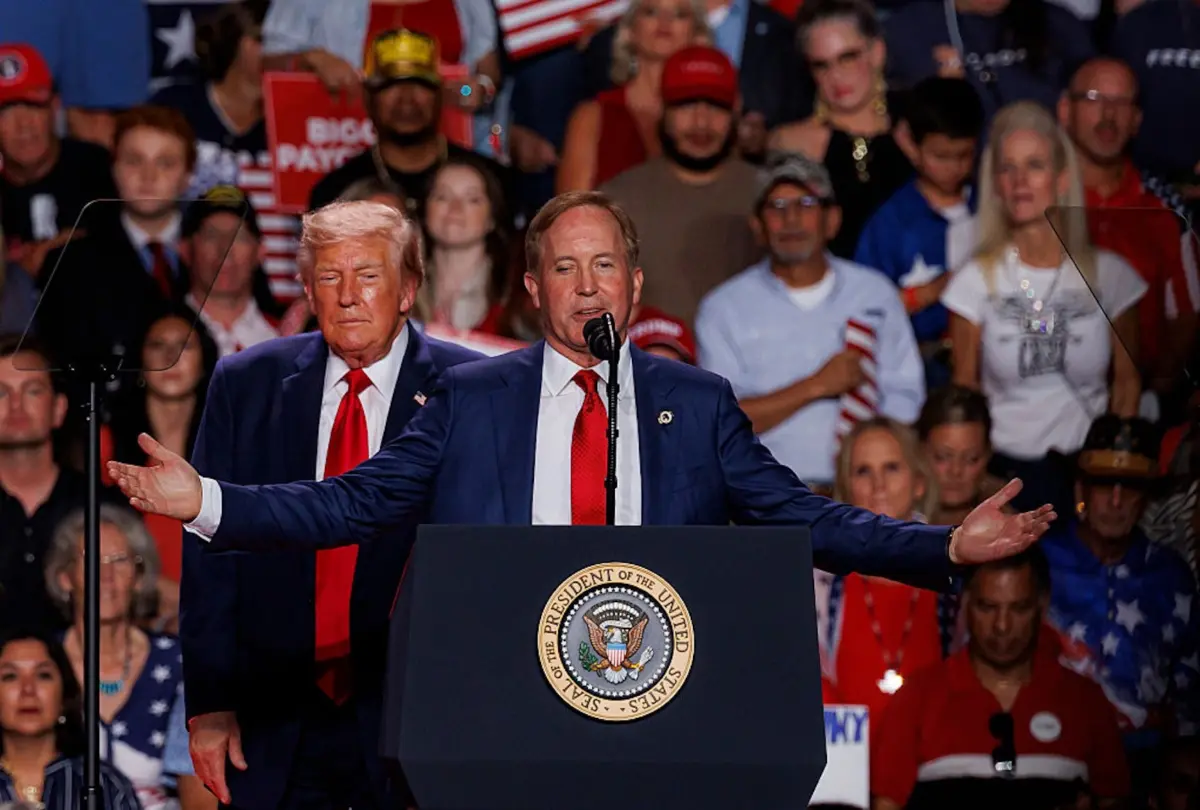
Paxton aggressively exploited Talarico’s medical leave, demanding public "proof of life" from his opponent and setting up a dedicated tip line to solicit information on the Democrat’s whereabouts. During a campaign rally, Paxton personally led chants of "Where is James Talarico?" Amplifying the pressure from Washington, D.C., President Donald Trump took to Truth Social, labeling the candidate "James TalaFREAKo" and declaring him "MISSING IN ACTION."
What began as partisan ribbing rapidly escalated into a coordinated disinformation campaign.
- The Innuendo Phase: Former Los Angeles mayoral candidate Spencer Pratt claimed on social media to have "sources" placing Talarico inside a psychiatric care facility.
- The "Smoking Gun" Fabrication: By Sunday afternoon, the rumor reached its fever pitch. Conservative influencer Nick Sortor—known primarily for filming confrontations outside immigration facilities—and self-described "right-wing provocateur" Rhein Amacher claimed they had secured confirmation from an employee at the Lindner Center of Hope in Mason, Ohio.
- Amplification at Scale: Sortor released a short audio clip. Within moments, Tesla and X owner Elon Musk repeatedly amplified the unverified claims to hundreds of millions of followers. According to network analysis cited in subsequent reporting, 50 coordinated accounts pushed the narrative within a 20-minute window, accumulating 9.3 million views. One single account posted identical text 83 times in under two hours.
The Collapse of the Narrative
The fabrication crumbled almost as quickly as it had been erected. When investigative outlet The Bulwark obtained and reviewed the full, unedited recording of the phone call used as "proof," the reality was starkly revealed: the hospital employee repeatedly and explicitly denied that any individual named James Talarico was within their hospital system.
Furthermore, the physical timeline rendered the conspiracy an absolute impossibility:
- Amacher claimed he placed the verification calls on Saturday evening.
- Timestamped public records, media footage, and security logs showed Talarico performing publicly at the Austin City Limits Music Festival on Friday and attending a Kacey Musgraves concert the following day.
- It was physically impossible for Talarico to be simultaneously discharging from an Ohio psychiatric facility on Saturday while being visibly present in Austin, Texas.
- By Sunday evening, the Lindner Center of Hope issued a definitive, public rebuttal stating unequivocally that Talarico had never been a patient.
Despite these immediate corrections, the self-correcting mechanisms of truth failed to penetrate the insulated right-wing media ecosystem. Figures like Megyn Kelly continued demanding "answers" from Talarico long after the hospital’s official denial, while White House Deputy Chief of Staff Stephen Miller continued posting speculative insinuations even after The New York Times published time-stamped security evidence confirming Talarico was safe inside his Austin home during the disputed window.
Supporting Context & Metrics: The Mechanics of the "Rage Economy"
The Talarico hoax serves as a clinical study in how modern digital propaganda operates. During a CNN town hall address, Talarico diagnosed the phenomenon as the "rage economy"—a systemic ecosystem wherein conspiracy theorists collect algorithmic clicks, social media platform owners monetize user outrage, and the public is left more polarized and less equipped to address systemic problems.
Algorithmic Amplification Metrics
Traditional information ecosystems theoretically reward accuracy, where a claim gains credibility only as supporting evidence accumulates. The modern MAGA media apparatus, by contrast, rewards attention and velocity.
- Speed over Substance: The initial burst demonstrated that a small cadre of high-profile accounts can unilaterally set the national political agenda.
- Volume as Validity: In an attention-based economy, a falsehood becomes influential simply because it achieves mass saturation. The rapid deployment—where 9.3 million views were amassed via automated or semi-coordinated bursts in minutes—bypassed traditional journalistic fact-checking windows.
- Caricature and Othering: The psychiatric hoax was merely the escalation of a broader pattern of attacks deployed against Talarico. Pro-Paxton super PACs had previously run advertisements superimposing the Democrat’s face onto a dress, while Trump allies questioned his masculinity, marital status, and sexuality. Vice President JD Vance openly leaned into these insubstantial smears during a rally in Tyler, Texas, while other surrogates bizarrely attempted to other Talarico by falsely claiming he was a vegan.
These identity-based attacks share a common strategic root: when a political candidate’s substantive platform (focusing on local economic pressures, cost of living, and community infrastructure) proves difficult to refute on the merits, the counter-strategy relies on manufacturing a caricature of strangeness and unfitness.
Official Statements and Media Blindspots: Burying Paxton’s Financial Scandals
While national airwaves and social media feeds were entirely saturated with the fabricated Ohio hospital controversy, a starkly real, high-stakes financial scandal centering on Attorney General Ken Paxton was systematically buried beneath the digital noise.
The Dubai Revelations and Indicted Donors
On the very Monday following the weekend peak of the Talarico hoax, The Wall Street Journal published a blockbuster investigative report detailing Paxton’s questionable financial entanglements:
- The Fugitive Donation: Just days after being formally indicted for embezzlement, a fugitive from justice managed to transfer a $25,000 political donation directly to Ken Paxton’s campaign coffers.
- New Year’s in Dubai: Investigative records revealed that Paxton rang in the year 2025 at an exclusive party in Dubai. The celebration was attended by two individuals who had been federally indicted by prosecutors for allegedly looting and embezzling millions of dollars from an Illinois hospital network.
- The Ahmed Contributions: One of those indicted attendees, Anosh Ahmed, contributed a staggering $190,000 to Paxton between 2022 and 2024, according to filings with the Texas Ethics Commission.
In a normal, functioning political environment, an incumbent state attorney general accepting hundreds of thousands of dollars from individuals accused of looting healthcare systems would dominate the media cycle for weeks. It raises fundamental questions of governance: Does the state’s top law enforcement officer work for the people of Texas, or does he answer to individuals accused of financial crimes?
Instead of facing aggressive journalistic scrutiny over these revelations, Paxton was insulated by the fog of war generated by his own political allies and online influencers. While Paxton did not personally script the Ohio hoax, the structural incentives of his political ecosystem ensured that he heavily profited from the distraction. By leading the "Where is James Talarico?" chants and establishing a theatrical tip line, Paxton fed the beast of manufactured outrage, allowing the resulting media storm to swallow his own documented ethical breaches.
Future Outlook: The Normalization of High-Scale Disinformation
The successful deployment and evasion of consequences in the Talarico hoax signal a troubling precedent for the future of American elections. Following similar failed "gotcha" attempts earlier in the cycle—such as Missouri Senator Eric Schmitt’s botched attacks on special counsel Jack Smith—observers anticipated that political operatives might exercise greater caution regarding unverified online claims.
Instead, the modern political right has fully internalized a dangerous lesson learned from the Trump era: there is virtually no long-term professional or political penalty for being publicly and demonstrably wrong, provided the falsehood is deployed at scale and the perpetrators never look backward.
As the 2026 midterms barrel toward their conclusion, the "rage economy" has proven that smart lies are no longer necessary. Speed, volume, and coordinated platform amplification are more than sufficient to drown out investigative journalism and accountability. For voters navigating this landscape, the primary casualty is not merely truth, but the democratic capacity to hold elected officials accountable for real, documented corruption.