

Executive Overview
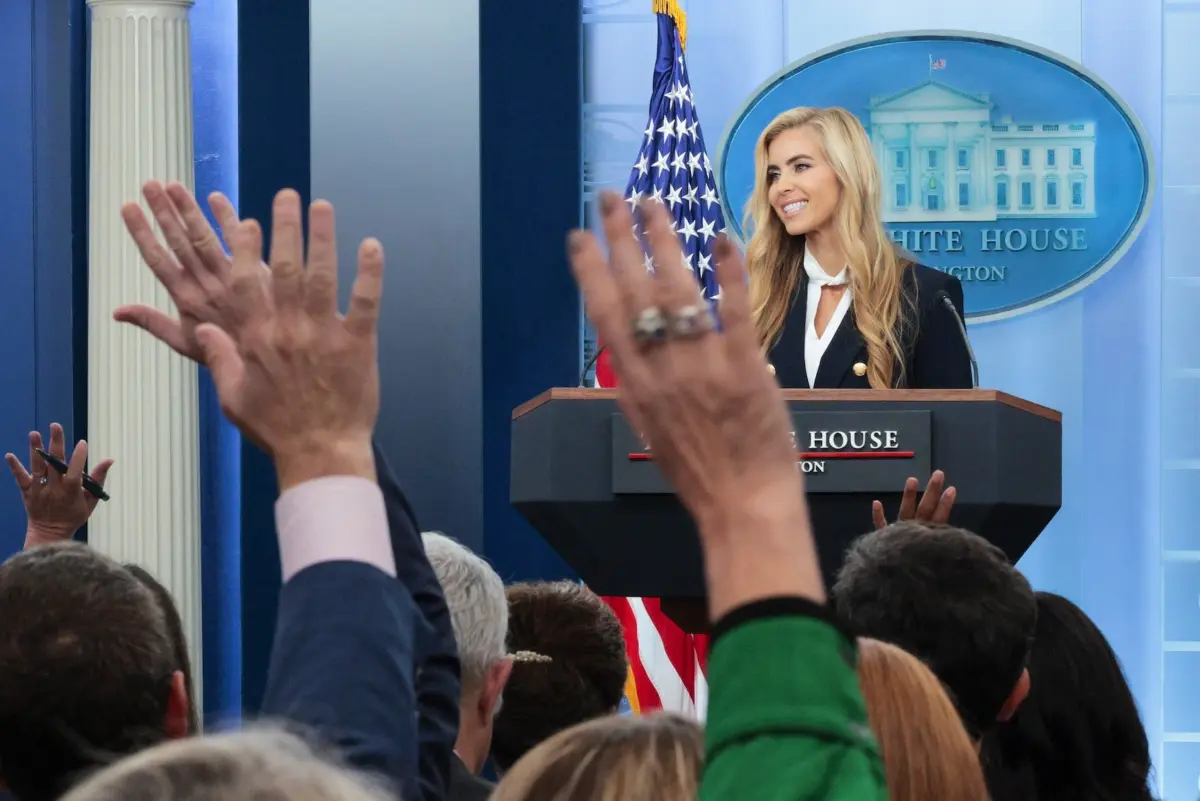
In Washington politics, first impressions are rarely just about the individual stepping up to the microphone; they are a diagnostic of the administration placing them there. When newly minted White House Press Secretary Katie Zacharia stepped into the Brady Briefing Room on October 13, 2026, she was ostensibly tasked with resetting the administration’s public messaging. Instead, her chaotic, truncated, and gaffe-ridden debut became an indelible symbol of a sinking political ship.
Arriving 15 minutes late, visibly nervous, and armed with exaggerated talking points reminiscent of the darkest days of past messaging crises, Zacharia’s performance did little to reassure a skeptical public or an increasingly hostile press corps. Rather than projecting strength and stability, the brief rollout exposed an administration scrambling to deflect from mounting scandals, profound policy contradictions, and legal defeats.
This commentary, informed by decades of White House reporting, examines Zacharia’s rocky entrance not merely as an isolated staffing mishap, but as a symptom of a broader, systemic decay within the current administration. As midterms approach, the spectacle of a hastily thrown-together press secretary underscores an executive branch increasingly isolated, chaotic, and detached from reality.
Detailed Chronology: A 15-Minute Microcosm of Administrative Dysfunction
The sequence of events surrounding Zacharia’s inaugural briefing highlights a total breakdown in foundational administrative protocol. Thrust onto the national stage with less than 24 hours of preparation following a cross-country move from Los Angeles, Zacharia was handed a script that immediately strained credulity.
- The Setup (Oct. 13, 2026): Arriving a quarter-hour past the scheduled time, Zacharia spent the opening minutes of her eight-minute monologue showering praise on President Donald Trump. Deploying tactics reminiscent of Sean Spicer’s infamous inaugural crowd-size assertions a decade prior, she insisted that attendance figures at recent campaign rallies—held largely in high school gymnasiums and small regional arenas—were at "record highs."
- The Q&A Restrictions: When the floor finally opened for questions, the veneer of an open press environment vanished entirely. True to an insular bunker mentality, Zacharia recognized exclusively friendly outlets: Breitbart, Fox News, and the Daily Mail.
- The Sole News Drop: Amid the spin, one legitimate piece of policy news slipped through: the resignation of Kimberly Guilfoyle as U.S. ambassador to Greece, requested by the president himself in the wake of widespread reports of corruption and misconduct. The surreal nature of the administration was underscored moments later when Trump, departing the White House, feigned ignorance of the official he had just ousted, asking reporters, "Kimberly? Kimberly who?"
- The Early Exit: Following her brief remarks, Zacharia abruptly excused herself, citing the need to accompany the president to Alaska to campaign for struggling incumbent Senator Dan Sullivan.
Industry veterans noted that a standard introductory period—involving deep-dives into policy portfolios, meetings with department heads, and briefings with active beat reporters—was entirely discarded. By eschewing preparation and protocol, the administration turned what should have been a standard informational exchange into a low-grade political sideshow.
Supporting Context & Metrics: A Convergence of Crises
While the media briefly fixated on Zacharia’s superficial missteps—including accidentally referring to her husband as "my president" and giggling through her nerves—the real crisis lay in the substantive issues the White House was desperately trying to bury.
The Russian Diesel Paradox
At the core of the administration’s economic headache is the surging cost of fuel, a direct consequence of ongoing geopolitical instability. In a staggering policy reversal aimed at lowering gas prices ahead of the midterms, the administration announced a deal to import diesel fuel from Vladimir Putin’s government.
This move presents a profound contradiction: the U.S. is effectively paying an adversary government that is actively providing intelligence to the Iranian military—forces engaged in targeting American interests. All of this unfolds to counter a security threat that the president claimed to have completely "obliterated" a year prior.
The Judicial Rebukes and Legal Battles
The administration’s credibility took multiple direct hits in the courts during the same week:
- The FEMA Exoneration: A U.S. magistrate judge in Virginia forcefully rebuked the administration over a fabricated smear campaign against Mary Comans, the former chief financial officer of FEMA. Judge William E. Fitzpatrick noted that high-ranking officials knowingly propagated false accusations of money laundering and executive order violations against a career public servant simply to sully her professional integrity.
- The Press Access Lawsuit: In a continuing saga regarding First Amendment freedoms, a federal judge upheld a temporary restraining order preventing the administration from banning mainstream outlets—including CNN, MSNOW, and Politico—from the White House. The court ruled that the administration had engaged in "unlawful viewpoint discrimination" without establishing clear, objective standards for press credentials.
Official Statements and Insider Perspectives
The fallout from Zacharia’s debut generated sharp reactions across the political spectrum, with seasoned observers questioning the strategic competence of the West Wing inner circle.
Veterans of past administrations expressed disbelief at the lack of baseline operational readiness. "The best of them took the time to study policy briefings… and met the most active beat reporters before holding their first briefing," notes observed from decades of municipal and federal reporting. By failing to establish basic rapport, the new press secretary alienated the press corps from day one.
Meanwhile, political insiders have openly questioned whether Zacharia was deliberately set up for failure. Former Trump administration official Anthony Scaramucci publicly mused whether Zacharia would manage to outlast his own notoriously brief 11-day tenure. Some cynical Washington reporters have even joked that learning how to spell her name is a waste of time given the high turnover rate characteristic of the regime’s twilight phase.
The White House Correspondents’ Association, criticized by some for slipping into a passive "go along to get along" posture, faces mounting pressure to demand accountability rather than accepting staged, insular briefings that serve merely as campaign rallies.
Future Outlook: Navigating the Twilight of a Defiant Regime
As the nation barrels toward high-stakes midterm elections, the trajectory of the current administration looks increasingly volatile. The appointment of an unprepared, proxy-messaging press secretary is not an anomaly; it is a tactical retreat by a White House struggling to manage multiple compounding crises.
- Escalating Media Confrontations: With federal courts continually ruling against administration attempts to blacklist critical news organizations, legal battles over press freedom will likely set new constitutional precedents well into the future.
- Erosion of Institutional Integrity: As career public servants are vindicated in court against targeted political smears, morale within federal agencies continues to face unprecedented strain.
- The Scapegoat Cycle: If historical precedent holds, the tenure of Katie Zacharia may be remarkably brief. When a regime reaches a stage of insular panic, communications staffers are often the first thrown into the political crossfire to shield leadership from direct accountability.
Ultimately, the spectacle in the Brady Briefing Room revealed a stark truth: when an administration operates divorced from reality, even the most polished press secretary cannot mask the underlying institutional decay. As the midterms approach, the American public is left watching a high-stakes drama where the staging grows more frantic precisely because the foundation is crumbling beneath it.