

EXECUTIVE OVERVIEW
In the quiet, intensely scrutinized world of pomological evaluation, few figures command the esoteric, hyper-caffeinated reverence of the modern independent fruit reviewer. As the autumn equinox of 2026 yields its heaviest agricultural bounty, the "Apple Snack Gang"—an informal yet fiercely dedicated cohort of heirloom fruit enthusiasts—has released the second installment of its seasonal audit. Building upon the foundational findings of Part One, this latest batch of evaluations dives deep into the arboricultural eccentricities, structural anomalies, and unexpected flavor profiles of obscure cultivar specimens.

This investigation examines the complete catalog of Part Two’s audited varieties. From the nutmeg-heavy density of the Kickapoo Spice to the jaw-shattering, gum-flavored defiance of the Graham, our reporting analyzes the sensory metrics, historical genealogies, and structural integrity of seven distinct apples. Through meticulous documentation of mouthfeel, tannin levels, historical provenance, and subjective scoring metrics, this report provides an authoritative overview of the current state of heritage and obscure pomology.
DETAILED CHRONOLOGY: THE AUDIT SPECIMENS
The evaluation protocol deployed by the evaluation panel relies on immediate organoleptic assessment—testing for bite resistance, skin texture, juice-to-pulp ratios, and lingering aftertastes. Below is the detailed chronological breakdown of the individual specimens reviewed during this latest testing phase.

1. Kickapoo Spice
- Audited Metric: 6.9 / 10
- Structural Profile: Dense, compact, unyielding.
- Sensory Evaluation: The Kickapoo Spice immediately presents as a heavy-hitting aromatic specimen. Dominated by prominent notes of nutmeg, supplemented by secondary undertones of cinnamon and clove, the fruit honors its nomenclature. However, structural and textural deficiencies pulled down its overall score. Testers noted a distinct lack of juiciness, accompanied by an unconventional, herbaceous aftertaste reminiscent of freshly cut lawn grass. Pomological analysts suggest the specimen may have suffered from improper cold-storage timing, noting that certain heritage varieties require exact environmental maturation windows to avoid premature degradation.
2. St Edmunds Pippin
- Audited Metric: 8.3 / 10
- Structural Profile: Rough-skinned, high-tensile crunch.
- Sensory Evaluation: Emerging as an early-season frontrunner, the St Edmunds Pippin delivered exceptional performance across all primary testing vectors. Despite an exterior skin texture described anecdotally as abrasive, the fruit yielded an audible, highly satisfying acoustic pop and crunch upon initial penetration. Internally, the apple balances high juice concentration with a sharp-breaking, bright, and herbal profile. Observers noted distinct aromatic hints of fennel pollen harmonizing seamlessly with an underlying sweet-tart baseline, cementing its status as an elite-tier funky heirloom.
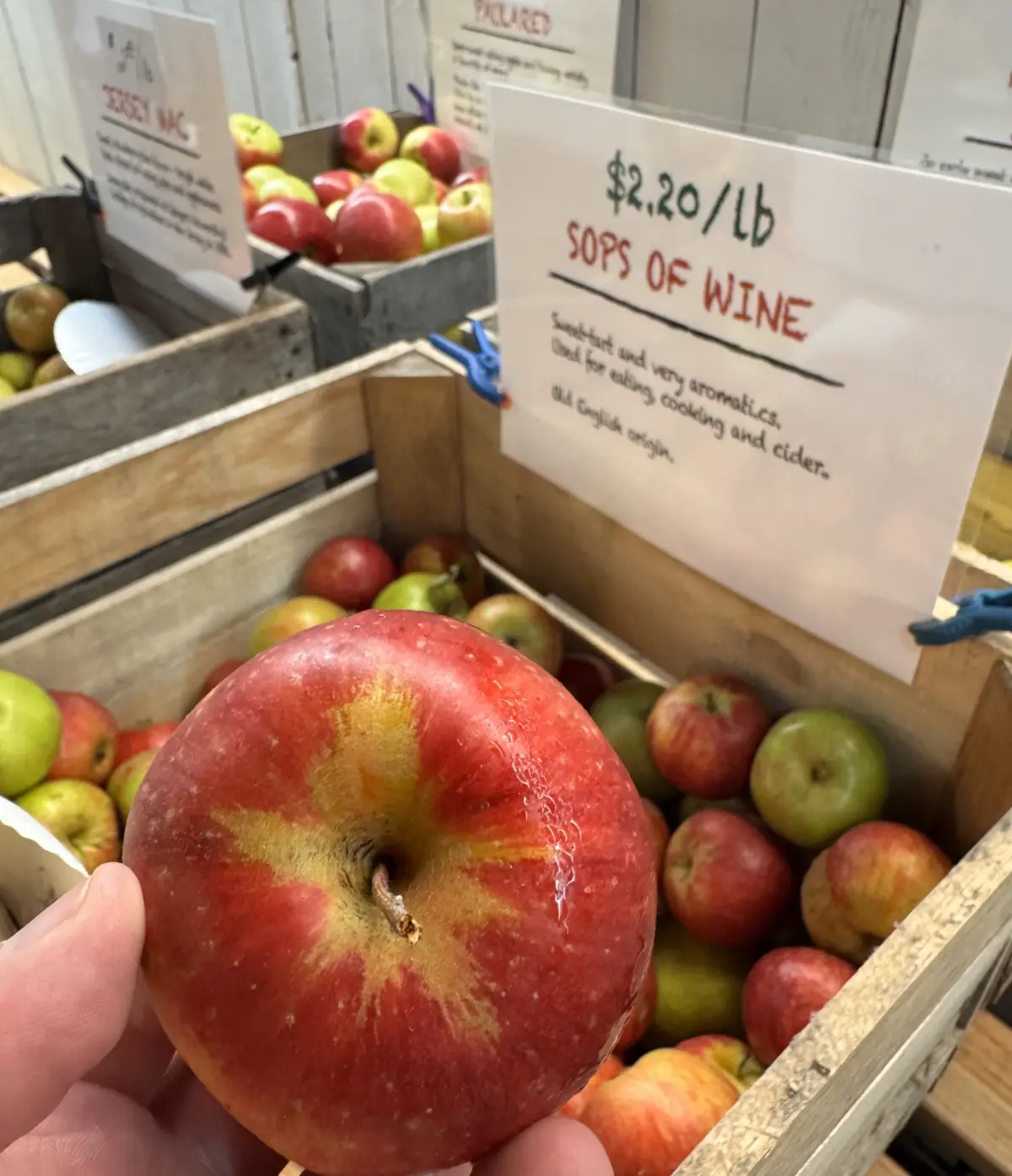
3. Sops of Wine
- Audited Metric: 3.5 / 10
- Structural Profile: Mealy, gritty, structurally degraded.
- Sensory Evaluation: The Sops of Wine represents a classic case of sensory disconnect between historical reputation and physical reality. While expected to display deep red-fleshed interiors or distinct red staining, the audited specimen offered standard white flesh alongside a concerningly mealy and gritty mouthfeel. Flavor notes—featuring mild vanilla and subtle spice—were largely overshadowed by advanced over-ripeness, likely exacerbated by post-harvest shelf time. The specimen leaned heavily into "subacid" territory (sweet over tart), but textural failure severely compromised its viability for raw consumption.
4. Fenceline Surprise
- Audited Metric: 1.0 / 10
- Structural Profile: Bland, sandy, compromised structural integrity.
- Sensory Evaluation: Living aggressively up to the ironic implications of its name, the Fenceline Surprise delivered one of the poorest performances of the 2026 audit cycle. Promoted on retail signage as a "firm apple," the specimen arrived in a state of advanced internal mush. The fleeting presence of a delicate, pear-like mist on the palate vanished instantly, leaving testers with a dry, sandy mouthfeel reminiscent of beach sediment. Analysts concluded the fruit was either victims of a chronically subpar harvest batch or had spent far too long post-harvest in cold storage.
5. Americus Crab
- Audited Metric: 2.5 / 10
- Structural Profile: Tough, unyielding, hyper-tannic.
- Sensory Evaluation: As a true crabapple (Malus species), the Americus Crab is explicitly excluded from casual, out-of-hand snacking parameters. Testing confirmed its extreme pomological divergence: highly savory, aggressively tart, structurally tough, and saturated with wood-derived tannins. While unsuitable for standard culinary consumption, the audit panel recognized its niche appeal for adventurous experimentalists who appreciate historical, high-tannin anomalies not traditionally meant for direct human mastication.
6. Campfield (False?)
- Audited Metric: 4.1 / 10
- Structural Profile: Chewy, high-tannin astringency.
- Sensory Evaluation: Labeled ambiguously with the "(false)" designation, this specimen exhibited classic characteristics of a hard-cider apple rather than a table fruit. The flesh was described as chewy, offering a high-tannin profile that induced immediate astringency. While poorly suited for raw consumption by the uninitiated human palate, its structural chemistry strongly implies optimal performance only after industrial fermentation and processing by the microbial agents of cider-making.
7. Graham
- Audited Metric: 8.0 / 10
- Structural Profile: Extreme density, impenetrable exterior, glacial fracture patterns.
- Sensory Evaluation: The Graham tested the physical limits of the audit team’s dental hardware. Exhibiting a density and structural integrity comparable to high-performance composite materials, the apple required extraordinary mastication force, fracturing internally like a calving glacier. However, once breached, the reward was profound: an intensely juicy interior yielding an unmistakable, highly potent flavor profile directly mirroring commercial Juicy Fruit chewing gum. Despite its capacity to induce temporary temporomandibular joint (TMJ) strain, its flavor complexity secured an elite score.
SUPPORTING CONTEXT & METRICS
To fully understand the significance of the 2026 Apple Snack Gang evaluations, one must contextualize the mechanics of heritage apple auditing. Unlike mass-market commercial varieties—such as the Red Delicious or Gala, which are bred exclusively for shelf-life, uniform coloration, and logistical resilience—heritage and heirloom varieties prioritize localized flavor complexity, historical continuity, and specific industrial applications (such as cider fermentation or baking).
| Cultivar Name | Audited Score (/10) | Primary Flavor Notes | Structural Integrity | Primary Use Category |
|---|---|---|---|---|
| Kickapoo Spice | 6.9 | Nutmeg, cinnamon, clove, cut grass | Dense, unyielding | Fresh / Experimental |
| St Edmunds Pippin | 8.3 | Fennel pollen, sharp herbal tart-sweet | Sharp-breaking, crisp | Fresh / Premium Table |
| Sops of Wine | 3.5 | Vanilla, subtle spice | Mealy, gritty | Historical Curiosity |
| Fenceline Surprise | 1.0 | Faint pear mist | Bland, sandy mush | Avoid / Substandard |
| Americus Crab | 2.5 | Savory, tart, wood tannins | Tough, rigid | Culinary / Foraging |
| Campfield (False?) | 4.1 | High-tannin astringency | Chewy, fibrous | Cider Fermentation |
| Graham | 8.0 | Unadulterated Juicy Fruit gum | Extreme density, glacial | Fresh (High Effort) |
The divergence in scoring highlights a critical truth of modern pomology: historical provenance and romantic nomenclature do not inherently translate to superior eating experiences. While varieties like the St Edmunds Pippin and the Graham justify their physical challenges through extraordinary organoleptic payoffs, specimens like the Fenceline Surprise and Sops of Wine demonstrate the rapid decay curves inherent to unpreserved heritage lines.

HISTORICAL PROVENANCE: THE LEGACY OF MATTHEW CANFIELD
A notable anomaly within the 2026 audit data involves the archival pedigree of the Campfield apple. Historical records indicate that the cultivar traces its roots directly to the colonial era, linked to Matthew Canfield (alternally spelled Campfield), an anti-royalist Puritan immigrant who arrived from Harleston, England, prior to 1637 during the Great Puritan Migration.
As a founding father of the New Haven Colony, Norwalk (CT), and Newark (NJ), Canfield operated under strict municipal mandates that required freeholders to cultivate a minimum of four acres of land, heavily prioritizing orchard development. Town records from New Haven and Newark document Canfield’s deep involvement in early agricultural commerce—including the acquisition of "three barrels of good cider made of winter fruit" and localized ordinances regarding swine containment and fence inspection. The inclusion of such historical lineages in modern pomological audits underscores the deep intersection between early American colonial expansion and the deliberate cultivation of specialized cider apples designed to survive harsh winters and fuel early American communal life.

FUTURE OUTLOOK
As the 2026 harvest season progresses, the focus of the Apple Snack Gang shifts dramatically northward. With field expeditions scheduled across New York State, New England, and cross-border into Canada, the audit framework is poised to expand into new regional microclimates.
Observers anticipate that colder northern latitudes will yield an entirely new tier of frost-hardy, late-season heritage apples. As reviewers prepare to interface with local orchards and regional growers, consumers and pomology enthusiasts alike can expect Part Three of the audit to bring further revelations regarding rare cultivars, anomalous mouthfeels, and the ongoing quest for the ultimate autumn fruit.