

Executive Overview
For digital marketers, search engine optimization (SEO) professionals, and enterprise growth teams, relying on manual spreadsheets to monitor search engine results pages (SERPs) is no longer just inefficient—it is a strategic liability. As search engines evolve with sophisticated artificial intelligence integrations, localized map packs, and dozens of dynamic SERP features, keeping a manual tally of keyword positions has become virtually impossible.

To validate SEO campaigns, justify enterprise marketing budgets, and protect market share, organizations require granular, real-time, and highly accurate data. SERP tracking software solves this challenge by automating the monitoring process across hundreds or thousands of keywords, specific geographic locations, diverse devices, and various search engines.

This comprehensive market review analyzes the seven best SERP tracking solutions for 2025. It is divided into two primary categories: dedicated, standalone rank trackers designed for hyper-focused performance monitoring, and all-in-one SEO platforms that integrate robust position-tracking capabilities alongside broader marketing suites. Whether you manage a boutique local business or an international enterprise portfolio, selecting the right tracking tool is foundational to modern organic search success.

Detailed Chronology: The Evolution of Rank Tracking
To understand why modern SERP tracking software is indispensable in 2025, it helps to examine how the landscape has transformed over the past decade:

- The Manual Era (Pre-2015): SEO practitioners relied heavily on manual browser searches (often plagued by personalized search bias and localized cache issues) or basic desktop-installed scraping tools. Data was captured weekly or monthly into rigid Microsoft Excel spreadsheets.
- The Rise of Cloud-Based Trackers (2015–2018): As search engine algorithms grew more complex and personalized, cloud-based SaaS tools emerged. These platforms introduced automated 24-hour batch updates, basic device segmentation (desktop versus mobile), and rudimentary competitor tracking.
- The Granular & Real-Time Revolution (2018–2022): The proliferation of local "Map Packs," featured snippets, and instantaneous algorithm updates necessitated on-demand data refreshes. Platforms began offering hyper-local tracking down to the zip code level, multi-engine support, and native API or data warehouse connectors (such as Google Data Studio and Databox integrations).
- The AI-Driven SERP Landscape (2023–2025): With the rollout of AI Overviews, generative search experiences, and highly volatile search layouts, standard position tracking is no longer enough. Modern tracking tools must now monitor dozens of unique SERP features simultaneously, evaluate semantic content gaps, and map ranking shifts directly to downstream business revenue and user conversions.
Supporting Context & Essential Metrics: What to Look For in 2025
When evaluating SERP tracking software, buyers must look beyond simple keyword position numbers. The industry standard demands a rich feature set designed to operationalize data and drive strategy.

1. Accurate On-Demand Ranking Updates
SERP positions fluctuate rapidly due to algorithmic adjustments, competitor optimization efforts, and personalization. Waiting days for a scheduled batch update can cause teams to miss critical traffic drops or algorithmic penalties. Leading tools—such as AccuRanker—combine automated 24-hour updates with on-demand manual refresh buttons, allowing users to pull fresh ranking data instantly.

2. Monitoring Performance Across Diverse SERP Features
Securing the traditional "Position #1" blue link is only part of the battle. Modern SERPs are dominated by AI Overviews, Featured Snippets (Position #0), People Also Ask (PAA) boxes, video carousels, and local knowledge cards. Effective SERP trackers allow you to filter and track more than 50 distinct SERP features, identifying which keywords trigger them and revealing tactical opportunities to steal real estate from competitors.

3. Multi-Engine Support
While Google commands the lion’s share of global search traffic, international campaigns or specialized niches require visibility across alternative search engines. Enterprise-grade tools support tracking across Bing, Baidu, Yandex, and YouTube.

4. Granular Geographic and Device Segmentation
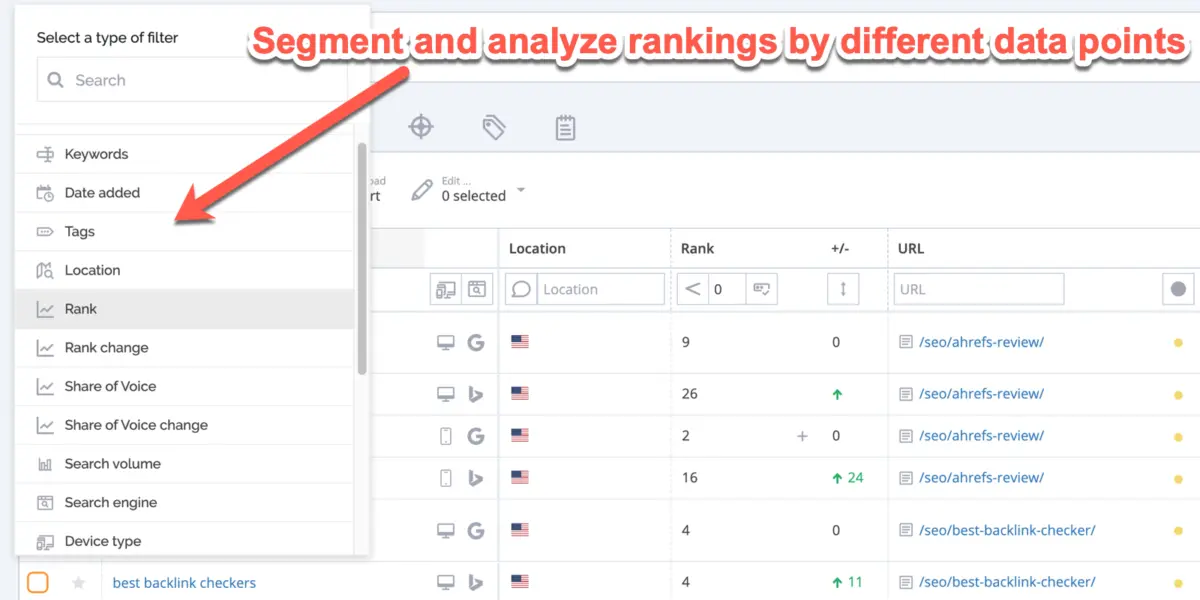
National averages can be deeply misleading. Top-tier tools provide multi-tiered geographic filtering—scaling seamlessly from country and state levels down to individual cities and zip codes. Furthermore, separate tracking for desktop and mobile environments is non-negotiable, given the significant divergence in layout and user behavior between devices.

5. Connecting Rankings to Traffic and Revenue
The ultimate justification for SEO spend is its impact on the bottom line. Advanced trackers integrate seamlessly with web analytics suites like Google Analytics or Adobe Analytics. By merging organic visitor data, bounce rates, conversion goals, and revenue metrics with rank tracking data (such as Share of Voice), businesses gain an unobstructed view of how SERP movements affect revenue.

6. Historical Performance Tracking & Competitor Comparison
Point-in-time data offers limited strategic value. Comprehensive historical trend lines allow SEOs to observe long-term momentum, benchmark performance against primary competitors, and bucket keywords into logical position brackets (e.g., positions 1–3, 4–10, 11–50) to measure overall market penetration.

The 7 Best SERP Tracking Tools for 2025
The following shortlist profiles four dedicated standalone SERP trackers and three comprehensive all-in-one SEO platforms with market-leading tracking modules.

1. AccuRanker (Best Standalone SERP Tracker)
Trusted by over 32,000 global companies—including prominent brands like HubSpot, IKEA, and Kinsta—AccuRanker is widely regarded as the gold standard for dedicated, high-speed keyword rank tracking.

- Key Features: Lightning-fast on-demand data refreshes, robust Share of Voice (SoV) analytics, deep historical data archiving, granular tag segmentation, and comprehensive SERP feature tracking across 50+ elements.
- Integrations: Direct integrations with Google Analytics, Adobe Analytics, and Google Looker Studio (formerly Data Studio) for streamlined client reporting.
- Ideal For: Enterprise brands, digital marketing agencies, and SEO consultants who demand real-time data accuracy and large-scale keyword monitoring.
- Pricing: Subscription tiers scale according to keyword volume, starting at approximately $116 per month for up to 1,000 tracked keywords.
2. Semrush Position Tracker & SERP Gap Analyzer (Best All-in-One Platform)
Serving more than 10 million users globally—including major enterprises like Samsung, Vodafone, and Booking.com—Semrush is an industry titan. Its dedicated Position Tracking Tool rivals the accuracy of standalone trackers while existing within a vast digital marketing ecosystem.

- Key Features: Hyper-accurate daily tracking from national to local zip-code levels, multi-device comparison, custom tagging, and competitor visibility distribution metrics.
- Standout Addition (SERP Gap Analyzer): Available via the Semrush App Center, this advanced tool scans SERPs to uncover under-optimized content, analyzes competitor weaknesses, integrates with Google Search Console, and provides actionable optimization recommendations to capture low-hanging fruit keywords.
- Ideal For: Marketing agencies, e-commerce giants, and in-house teams seeking a complete SEO and content marketing suite alongside world-class rank tracking.
- Pricing: Platform plans begin at $139.95 per month.
3. ProRankTracker (Best Cost-Effective Standalone Solution)
Supporting more than 60,000 customers worldwide, ProRankTracker is a robust, highly scalable standalone tracking and reporting platform designed for precision and affordability.

- Key Features: Comprehensive multi-engine tracking (including YouTube video rankings), automated white-label reporting, local map pack monitoring, and intuitive mobile applications for on-the-go tracking.
- Ideal For: SEM agencies, international brands, and video marketers looking for granular multi-language and multi-device data without enterprise-level pricing friction.
- Pricing: Tiered plans begin at an accessible entry point of $39 per month.
4. Advanced Web Ranking – AWR (Best for Enterprise Flexibility & Cloud Deployment)
Advanced Web Ranking is a veteran player in the SEO software space, trusted by prominent enterprise brands like Microsoft for its deeply customizable reporting and flexible data architecture.
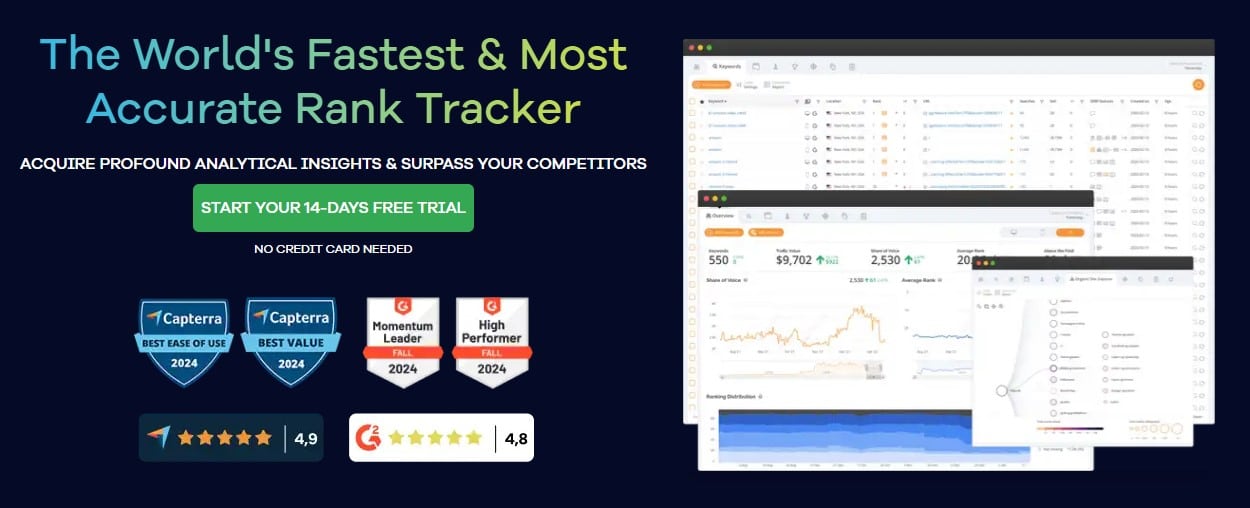
- Key Features: Unlimited user seats across plans, white-label client dashboards, localized tracking down to hyper-local coordinates, and robust API access for custom data pipelines.
- Ideal For: Large in-house marketing departments and enterprise agencies requiring strict data governance, custom reporting parameters, and unlimited team collaboration.
- Pricing: Subscription plans start at $99 per month.
5. SERPWatcher by Mangools (Best for Simplicity and Ease of Use)
Developed by Mangools, SERPWatcher is celebrated for its clean, intuitive user interface and streamlined approach to tracking organic visibility. Trusted by major brands like Airbnb and adidas, it strips away unnecessary complexity.

- Key Features: The proprietary Performance Index metric (which gauges organic traffic potential based on current keyword positions and search volumes), interactive alert systems for sudden rank changes, and simplified sharing links.
- Ideal For: Small-to-medium businesses (SMBs), startups, and freelancers who want straightforward, highly visual rank tracking without a steep learning curve.
- Pricing: Bundled within Mangools’ platform starting at $29.90 per month.
6. SE Ranking (Best Feature-Rich Value Platform)
SE Ranking has rapidly emerged as a favorite among growing digital agencies, offering a feature-rich all-in-one SEO toolset anchored by a highly reliable Position Tracking module.

- Key Features: 100% accurate data collection via simulated user behavior across exact geographic locations, deep competitor matrix comparisons, comprehensive website auditing, and flexible white-label reporting.
- Ideal For: Small-to-medium digital agencies and in-house professionals seeking an affordable, comprehensive toolkit with rigorous local tracking capabilities.
- Pricing: Subscription plans start at $52 per month (factoring in daily updates for 500 keywords).
7. Nightwatch (Best for Global Scale and Custom Dashboards)
Trusted by major digital innovators such as Shopify, Scotiabank, and Coinbase, Nightwatch stands out for its unmatched geographic reach and sophisticated data visualization engine.

- Key Features: Precise ranking data pulled from over 107,000 distinct global locations, custom-built reporting dashboards, automated anomaly detection, and deep site-audit integration.
- Ideal For: Agencies, international enterprises, and advanced SEOs who manage complex, multi-region campaigns and require deep data segmentation.
- Pricing: Offers a 14-day free trial, with paid tiers starting at $32 per month for up to 250 keywords.
Future Outlook: The Next Generation of SERP Intelligence
As search engines continue to integrate artificial intelligence, generative summaries, and conversational search modules into the core results page, the definition of a "ranking" is undergoing a profound transformation. Traditional blue-link positions are increasingly being pushed below the fold by interactive AI widgets and rich media elements.

Looking ahead, SERP tracking software will evolve beyond simple numerical position monitoring. The next generation of tools will heavily emphasize:

- Generative Engine Optimization (GEO) Metrics: Tracking brand mentions and citations inside AI-generated answers and conversational query responses.
- Dynamic Visual Share of Voice: Measuring total pixel real estate occupied by a brand versus competitors on a single screen.
- Predictive Rank Modeling: Leveraging machine learning to forecast the traffic impact of algorithm updates before they fully roll out across global data centers.
Choosing the Right Tool for Your Organization
When making your final selection, align your choice with your operational scale and budget:

- If you require pure, uncompromised tracking speed and deep analytics as a dedicated tool, choose AccuRanker.
- If you need a robust, all-in-one marketing suite that combines world-class position tracking with advanced content gap analysis, choose Semrush.
- If you are operating on a leaner budget or prefer a streamlined user experience, explore agile alternatives like ProRankTracker, SERPWatcher, or SE Ranking.
By investing in the right SERP tracking infrastructure today, your team will secure the visibility, agility, and competitive edge required to thrive in the dynamic search ecosystem of 2025 and beyond.