

Executive Overview
In the modern digital ecosystem, maintaining a competitive edge requires more than simply publishing high-quality content and hoping for the best. For digital marketers, enterprise brands, and specialized SEO agencies, visibility on Search Engine Results Pages (SERPs) remains the ultimate currency. Yet, the traditional methods of tracking this visibility—relying on manual spreadsheets updated sporadically or waiting anxiously for delayed weekly batches of data—are obsolete. Today’s search engine results pages are dynamic, localized, deeply personalized, and heavily saturated with complex features ranging from traditional local packs to AI Overviews and rich snippets.
To validate SEO investments, demonstrate tangible progress to stakeholders, and tie organic movements directly to revenue and customer acquisitions, professionals require robust, real-time SERP tracking software. These platforms allow organizations to monitor thousands of keywords simultaneously, dissect shifts across multiple search engines, analyze device-specific performance, and understand hyper-local ranking fluctuations.

As we navigate through 2025, the market for search visibility intelligence has matured significantly. This comprehensive review investigates the critical features to look for in modern tracking systems, analyzes the top tools available today—ranging from dedicated standalone trackers to comprehensive all-in-one SEO platforms—and provides strategic guidance on selecting the right infrastructure for your business needs.
Detailed Chronology & Evolution of Rank Tracking
The evolution of SERP tracking mirrors the broader transformation of search engine algorithms over the past two decades. In the early days of search engine optimization, tracking progress was straightforward. Webmasters would manually query a search engine, look for their URL within the top ten blue links, and log the position in a local spreadsheet.

As search engines grew more sophisticated, personalization took root. SERP results began to fragment based on the user’s geographic location, browsing history, and device type. A desktop search in New York City yielded radically different results than a mobile search in Chicago. Recognizing the friction of manual tracking, early software developers introduced basic desktop-installed scraping tools. However, these tools frequently ran into IP blocking issues, forcing developers to build proxy rotation networks and eventually migrate tracking infrastructure to cloud-based architectures.
By the mid-2010s, the emergence of specialized SaaS tracking platforms revolutionized the industry. Tools like AccuRanker and ProRankTracker introduced on-demand data refreshes and cloud scalability. Concurrently, all-in-one SEO suites such as Semrush and SE Ranking integrated sophisticated position-tracking modules into their broader marketing ecosystems.

Today, in 2025, rank tracking has transcended simple position reporting. With the integration of advanced artificial intelligence, zero-click searches, and expansive SERP features like AI Overviews, modern tracking software functions as comprehensive intelligence hubs. They no longer just tell you where you rank; they illuminate how your target audience interacts with the entire search results page, tracking visibility losses to alternative features and correlating position shifts with bottom-line revenue metrics.
Supporting Context & Core Metrics: 9 Features to Look for in SERP Tracking Software
When evaluating software to manage your organization’s organic search visibility, choosing a tool at random can result in wasted budget and blind spots in your data architecture. The industry standard requires a specific set of advanced capabilities. Below are the nine essential features to look for when selecting the best SERP tracking software.

1. Access Accurate On-Demand Ranking Updates
SERP positions are volatile, shifting constantly due to algorithm updates, competitor publishing cadence, and localized personalization. Waiting days for a scheduled weekly or bi-weekly sync is no longer acceptable. You need access to real-time, on-demand data at the click of a button. Market leaders like AccuRanker automate daily checks while giving users the flexibility to trigger instant manual updates whenever an algorithm update hits or a major campaign launches.
2. Monitor Performance Across SERP Features
Securing a traditional organic top-three spot is only half the battle. Modern SERPs are dominated by "Position #0" features, including AI Overviews, featured snippets, People Also Ask (PAA) boxes, video carousels, and knowledge cards. A premier SERP tracker must identify which of your target keywords trigger these features and provide actionable insights on how to capture them from competitors. Systems equipped with comprehensive SERP analysis modules allow you to monitor dozens of distinct SERP features across your entire keyword portfolio in a single, filterable view.

3. Track SERP Movement Across All Major Search Engines
While Google remains the dominant global search engine, treating it as the sole channel can leave blind spots in your analytics—particularly if you operate in international markets or manage clients targeting alternative ecosystems. Robust tracking software must support major regional and alternative search engines, including Bing, Baidu, Yandex, and YouTube, ensuring complete visibility across your target demographic’s preferred platforms.
4. Granular Tracking (By Location and Device)
A high-level national overview is rarely sufficient for multi-location enterprises or local service businesses. Premium SERP trackers offer granular segmentation, allowing you to track rankings down to the state, city, or even zip code level. Furthermore, the platform must seamlessly differentiate between mobile and desktop rankings, as user intent and layout structures frequently diverge significantly between devices.

5. Map SERP Movements to Traffic and Revenue/Conversions
Tracking rank positions in isolation provides an incomplete narrative. To truly justify SEO budgets to executive leadership, you must connect ranking data to business outcomes. Leading tracking tools integrate directly with analytics platforms like Google Analytics and Adobe Analytics. By combining keyword data, search volume, and Share of Voice metrics with organic traffic, bounce rates, and conversion goals into unified reports, you gain a clear picture of how SERP movements impact your bottom line.
6. View Historical Rank Performance
A snapshot of your current ranking tells you where you stand today, but historical trend analysis reveals the trajectory of your strategy. Advanced tracking software stores comprehensive historical data for every monitored keyword, allowing SEO teams to visualize long-term performance trends, evaluate the impact of past optimizations, and benchmark historical growth against direct competitors.

7. Run Competitor Comparisons
Search visibility is a zero-sum game: every position you gain is positions lost by a competitor. Modern SERP trackers categorize keywords into performance buckets (e.g., positions 1-3, 4-10, 11-50) to make competitive benchmarking straightforward. This allows digital marketers to quickly identify emerging market threats, spot content gaps, and adjust their optimization strategies accordingly.
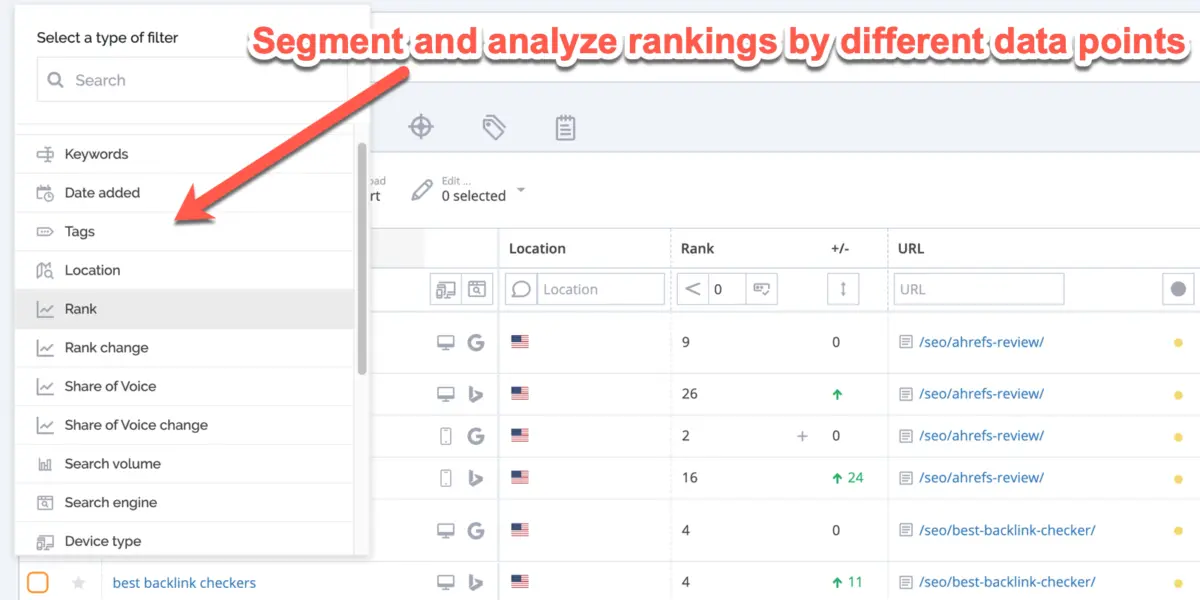
8. Tag and Segment Rankings Data
As keyword portfolios scale into the thousands, aggregate data becomes unwieldy. Keyword tagging and segmentation are essential features. Effective software allows you to group keywords by topic, customer funnel stage, content asset type, or device, enabling granular analysis of Share of Voice, rank changes, and visibility across specific product categories or content pillars.

9. Generate White-Label Reports
For agencies and enterprise consultants, client communication is paramount. The ability to generate clean, professional, white-label reports that clearly illustrate progress is a non-negotiable requirement. Whether through native reporting schedulers or seamless third-party connectors to data visualization suites like Google Looker Studio (formerly Data Studio) and Databox, your tracking stack must translate complex data into immediately digestible insights for stakeholders.
The 7 Best SERP Tracking Tools to Consider in 2025
With countless options populating the market, we have curated a definitive shortlist of the top-performing SERP tracking solutions. This selection covers both dedicated standalone trackers and comprehensive all-in-one SEO platforms.

1. AccuRanker
AccuRanker is widely recognized as a premier standalone SERP tracking tool, relied upon by over 32,000 companies, including enterprise brands like HubSpot, IKEA, and Kinsta. Designed explicitly for speed, accuracy, and depth, AccuRanker delivers lightning-fast on-demand data updates and robust analytics.
- Best Features: Automated daily updates with manual on-demand refreshes, comprehensive SERP feature tracking across 50+ variations, deep integrations with Google Analytics and Adobe Analytics for revenue attribution, and flexible keyword tagging.
- Who is it for: Agencies, enterprise organizations, and professional SEO consultants who demand the highest level of data freshness and granular multi-engine tracking.
- Pricing: Subscription plans scale based on the volume of tracked keywords, starting at $116 per month for up to 1,000 keywords.
2. Semrush (Position Tracker & SERP Gap Analyzer)
As an industry-standard all-in-one SEO platform used by over 10 million professionals—including teams at Samsung, Vodafone, and Booking.com—Semrush offers one of the most powerful position tracking suites on the market.

- Best Features: Hyper-accurate daily position tracking ranging from national to hyper-local map-pack levels; the unique SERP Gap Analyzer (available in the Semrush App Center) which scans SERPs to uncover under-optimized content and integrates with Google Search Console for low-hanging fruit optimization.
- Who is it for: Digital marketing teams, ecommerce brands, and enterprises looking for a robust all-in-one marketing suite that includes world-class rank tracking capabilities.
- Pricing: Comprehensive platform subscriptions start at $139.95 per month.
3. ProRankTracker
ProRankTracker is a scalable, cost-effective standalone tracking and reporting solution trusted by over 60,000 users worldwide. It provides deep visibility across global and local search engines without requiring an enterprise-tier budget.
- Best Features: Extensive multi-language support, accurate local pack tracking, robust video ranking metrics for YouTube marketers, and flexible automated reporting.
- Who is it for: International agencies, ecommerce enterprises, and video marketers requiring multi-device, multi-location tracking at a competitive price point.
- Pricing: Plans begin at an accessible $39 per month.
4. Advanced Web Ranking (AWR)
Advanced Web Ranking is a veteran standalone SERP tracker utilized by thousands of in-house marketing teams and major enterprises (such as Microsoft) to monitor complex digital estates and construct custom reporting dashboards.

- Best Features: White-label reporting customization, flexible cloud-based scaling, deep historical data access, and comprehensive multi-engine support.
- Who is it for: Enterprise-level in-house teams and large agencies needing reliable data architecture and robust white-label client reporting.
- Pricing: Subscription tiers begin at $99 per month.
5. SERPWatcher (by Mangools)
Developed by Mangools, SERPWatcher is designed to simplify rank tracking without sacrificing accuracy. Trusted by global brands like Airbnb and Adidas, it is celebrated for its intuitive interface and unique performance metrics.
- Best Features: The proprietary Performance Index, which calculates overall organic traffic potential based on current rankings and search volumes; clean, beginner-friendly dashboards; and bundled access to complimentary research tools like SERPChecker.
- Who is it for: Startups, small business owners, and growing agencies seeking an easy-to-use, streamlined tracking experience.
- Pricing: Mangools bundle plans start at $29.90 per month.
6. SE Ranking
SE Ranking is a comprehensive all-in-one SEO platform equipped with a powerful Position Tracking module. It is engineered to simulate exact user behavior across precise geographical targets to ensure pristine data accuracy.

- Best Features: Behavioral simulation for hyper-accurate local and global tracking, comprehensive competitor historical data, and flexible configuration options.
- Who is it for: Small-to-medium business owners and digital agencies looking for a reliable, feature-rich SEO toolkit with strong tracking fundamentals.
- Pricing: Plans start at $52 per month based on daily tracking parameters for 500 keywords.
7. Nightwatch
Nightwatch is a modern, highly accurate daily SERP tracker trusted by major enterprises like Shopify, Scotiabank, and Coinbase. It stands out for its massive global location database and modern UI.
- Best Features: Tracking capabilities across over 100,000 unique global locations, robust site auditing features, and exceptional data visualization dashboards.
- Who is it for: Freelancers, growing SMBs, and large agencies requiring hyper-local global tracking data.
- Pricing: Offers a 14-day free trial, with paid plans starting at $32 per month for up to 250 keywords.
Official Statements & Industry Perspectives
Industry leaders continue to emphasize the strategic necessity of utilizing specialized visibility intelligence tools rather than relying on manual reporting.

Matthew Howells-Barby, prominent digital marketer and co-founder of TrafficThinkTank, notes of modern tracking solutions: "It’s by far the best keyword ranking tracker in the market and has a ton of great reporting functions. If you want visibility on large volumes of keywords housed within a nice dashboard—this is for you."
Echoing the importance of clean visual reporting and data integration, Ian Howells, Co-Founder of Traffic Think Tank, highlights the value of connecting modern trackers to visualization suites: "The thing that really got me using them heavily in the last month or two is their Looker Studio connector. Combining the tag feature, as well as the Share of Voice metric… has been a big help in making these reports immediately digestible."

These perspectives underscore a fundamental truth in contemporary SEO: data collection is only valuable when it can be swiftly translated into strategic action and communicated clearly to executive stakeholders.
Future Outlook
Looking ahead, the landscape of search engine results pages will continue to evolve at a rapid pace. As artificial intelligence integration reshapes how search engines present information—shifting emphasis toward conversational interfaces and zero-click AI summaries—the definition of a "ranking" will expand.

Future SERP trackers will need to move beyond standard vertical position reporting to measure brand visibility inside generative AI responses, conversational search threads, and fragmented knowledge graphs. Organizations that invest in agile, feature-rich tracking infrastructure today will be best positioned to interpret these algorithmic shifts, protect their organic market share, and capitalize on emerging traffic acquisition channels through the remainder of the decade.