

Executive Overview
For digital marketers, search engine optimization (SEO) professionals, and enterprise growth teams, the days of relying on manual spreadsheets updated once a week are long gone. In the hyper-competitive digital ecosystem of 2025, search engine results pages (SERPs) are living, breathing entities. They shift dynamically based on user location, device, personalization, and an ever-expanding array of rich features—from traditional featured snippets to generative AI overviews.

Tracking these volatile movements manually is not only impossible at scale; it is fundamentally inaccurate. To validate SEO efforts, secure executive buy-in, and tie keyword rankings directly to bottom-line revenue, modern organizations require robust, real-time SERP tracking software.

This comprehensive guide evaluates the top seven SERP tracking tools for 2025. We explore what distinguishes a mediocre rank checker from an elite tracking platform, examine essential features ranging from on-demand updates to multi-engine tracking, and break down the market leaders across both standalone applications and all-in-one SEO suites. Whether you are an independent consultant managing local clients or an enterprise brand overseeing thousands of international keywords, this review provides the analytical depth needed to make an informed investment.

Detailed Chronology & Evolution of Rank Tracking
To understand the sophistication of today’s SERP trackers, it is helpful to look at how the technology has evolved over the past decade.

- The Spreadsheet Era (Pre-2015): SEO was largely defined by static keyword lists tracked in Excel. Practitioners checked rankings manually, often leading to skewed data influenced by local browser caching, personalization, and localized data centers.
- The Rise of Automated Scrapers (2015–2018): Early software solutions introduced automated daily scraping. While this eliminated manual labor, these tools were frequently plagued by IP bans, CAPTCHAs, and delayed data refreshes that left marketers flying blind for days after major core algorithm updates.
- The Multi-Device & Global Transition (2018–2021): As mobile search surpassed desktop, tracking tools had to split their architectures to monitor desktop and mobile indexes separately. Granular location tracking dropped from the country level down to cities and zip codes to support the boom in local SEO.
- The Era of Rich SERP Features & AI Integration (2022–Present): Modern search is no longer just about the "Ten Blue Links." With the proliferation of People Also Ask (PAA) boxes, video carousels, knowledge panels, and AI-driven conversational search summaries, trackers have transformed into complex intelligence suites. They now map pixel-depth visibility, capture dynamic SERP feature fluctuations, and integrate deeply with business intelligence platforms like Google Looker Studio and Databox.
Supporting Context & Core Evaluation Metrics
Investing in the right software requires a clear understanding of what separates standard rank checkers from enterprise-grade SERP analytics platforms. When evaluating solutions for 2025, industry experts look for nine non-negotiable features:

1. Accurate, On-Demand Ranking Updates
Search engine positions fluctuate rapidly throughout the day. Waiting 24 to 48 hours for a scheduled update during a volatile algorithm rollout is unacceptable. Leading tools like AccuRanker offer automated daily checks alongside on-demand, single-click data refreshes that pull real-time rankings instantly.

2. Multi-Dimensional SERP Feature Monitoring
Securing a traditional #1 ranking is only half the battle; capturing "Position #0" via featured snippets, AI overviews, or knowledge cards can dramatically elevate click-through rates. Top-tier tools track 50+ unique SERP features simultaneously, flagging precisely which keywords trigger them and what content adjustments are required to steal them from competitors.

3. Cross-Engine Search Intelligence
While Google commands the lion’s share of global search traffic, comprehensive SEO strategies often require monitoring alternative engines. Whether tracking Bing in Western markets or Baidu and Yandex for international campaigns, platforms must support multi-engine tracking capabilities.

4. Hyper-Granular Location & Device Filtering
National aggregates hide local nuances. Enterprise-grade tools allow users to filter rankings down to the state, city, or zip code level, while cleanly separating desktop performance from mobile metrics.

5. Tying SERP Movements to Revenue and Conversions
Rankings are a leading indicator, but executives care about lagging indicators: traffic, leads, and revenue. Advanced trackers integrate seamlessly with Google Analytics and Adobe Analytics, merging keyword positions with bounce rates, load times, and conversion metrics into unified reporting dashboards.

6. Deep Historical Data Accessibility
Understanding current positions is only valuable in context. Robust platforms maintain extensive historical archives, allowing analysts to map multi-year ranking trends against historical algorithm updates and competitor expansions.

7. Competitor Share of Voice (SoV) & Distribution
Tracking isolated keywords can create tunnel vision. The best tools group keywords into performance tiers (e.g., positions 1–3, 4–10, 11–50) to evaluate relative market share and identify emerging competitive threats.

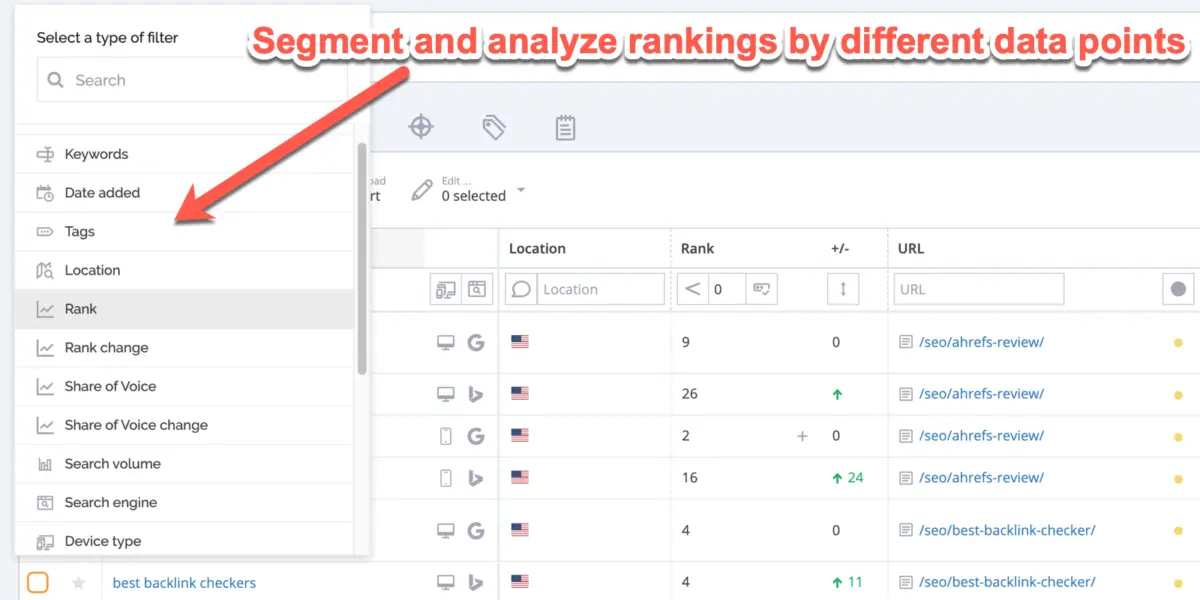
8. Advanced Tagging and Segmentation
Large keyword portfolios require organization. Teams must be able to tag and segment data by content type, marketing funnel stage, product category, or target persona to extract actionable insights.

9. Flexible White-Label Reporting
Agencies and in-house teams need to communicate value clearly to stakeholders. Native white-label scheduling and robust API connectors to visualization tools like Looker Studio are essential for streamlined reporting.

The 7 Best SERP Tracking Tools for 2025
The market features countless rank-tracking solutions, but a select few consistently outperform the competition. Below is our curated shortlist, divided into dedicated standalone trackers and all-in-one SEO platform modules.

Category A: Dedicated Standalone SERP Trackers
1. AccuRanker
- Overview: AccuRanker is widely regarded as the gold standard for dedicated, high-speed SERP tracking. Trusted by over 32,000 companies—including enterprise giants like HubSpot, IKEA, and Kinsta—it is built specifically for speed, accuracy, and deep agency integration.
- Standout Features: Unmatched on-demand data refreshing, robust SERP feature analysis covering 50+ feature types, and a powerful Landing Pages report that merges ranking data with Google Analytics to show direct revenue impact.
- Best For: Agencies, enterprise brands, and SEO professionals who demand real-time data refreshing, high-volume keyword handling, and advanced API access.
- Pricing: Tiered plans based on keyword volume, starting at $116/month for up to 1,000 tracked keywords.
2. ProRankTracker
- Overview: Serving over 60,000 users, ProRankTracker is a robust, highly scalable standalone tracking and reporting platform designed to handle large-scale international and local tracking requirements efficiently.
- Standout Features: Comprehensive multi-language support, accurate local map pack tracking, and intuitive progress-reporting modules tailored for agency workflows.
- Best For: Digital marketing agencies, global ecommerce operations, and video marketers needing multi-device tracking across diverse geographic regions.
- Pricing: Subscription plans begin at an accessible $39/month.
3. Advanced Web Ranking (AWR)
- Overview: A veteran in the SEO space, AWR is a trusted standalone tracker utilized by thousands of enterprises and internal marketing teams (including Microsoft) to monitor complex global SERP movements.
- Standout Features: Exceptional handling of localized search engines, deep historical data access, and highly customizable white-label reporting engines.
- Best For: In-house corporate teams and enterprise agencies requiring robust data security, deep historical tracking, and bespoke reporting formats.
- Pricing: Plans start at $99/month.
4. Nightwatch
- Overview: Nightwatch stands out for its sleek user interface and hyper-accurate tracking capabilities spanning over 100,000 distinct global locations. It is trusted by major modern brands like Shopify, Coinbase, and Scotiabank.
- Standout Features: Advanced data segmentation, automated site audits tied directly to rank fluctuations, and flexible filtering options that simplify massive keyword databases.
- Best For: Freelancers, growing SMBs, and modern tech companies looking for a clean, intuitive, and highly accurate tracking environment.
- Pricing: Offers a 14-day free trial, with paid plans starting at $32/month for 250 keywords.
Category B: All-In-One SEO Platforms with Powerful SERP Modules
5. Semrush (Position Tracker & SERP Gap Analyzer)
- Overview: As a titan in the digital marketing industry utilized by over 10 million users (including Samsung and Vodafone), Semrush offers a Position Tracking tool that rivals the accuracy of any standalone software.
- Standout Features: Exceptional daily tracking accuracy across local map packs and mobile devices. Furthermore, its specialized SERP Gap Analyzer (available via the Semrush App Center) scans search results to uncover under-optimized content, integrating directly with Google Search Console to identify low-hanging fruit keywords.
- Best For: Marketing teams and enterprises looking for a comprehensive digital marketing suite that includes world-class rank tracking alongside keyword research, site auditing, and backlink analysis.
- Pricing: Platform subscriptions start at $139.95/month.
6. SERPWatcher (by Mangools)
- Overview: Created by Mangools, SERPWatcher is designed for users who want simplicity without sacrificing core tracking integrity. It is favored by global brands like Airbnb and Adidas.
- Standout Features: The proprietary Performance Index metric, which evaluates organic traffic potential across all tracked terms in a single, easy-to-read score, paired with Mangools’ user-friendly interface.
- Best For: Small business owners, startups, and agile agencies seeking an affordable, streamlined, and visually appealing tracking experience.
- Pricing: Bundled within Mangools’ platform plans, starting at $29.90/month.
7. SE Ranking
- Overview: SE Ranking is a versatile all-in-one SEO platform featuring a highly customizable Position Tracking module that simulates real user behavior across specific target locations and devices.
- Standout Features: 100% accurate data collection via precise geolocation simulation, comprehensive competitor ranking distribution graphs, and automated marketing plan generators.
- Best For: Small-to-midsize agencies and digital consultants who need an all-encompassing SEO toolset with reliable, localized daily rank tracking.
- Pricing: Subscriptions start at $52/month based on daily tracking for 500 keywords.
Official Industry Perspectives & Expert Commentary
To gauge how these tools perform in real-world agency environments, industry leaders emphasize the integration of rank tracking with broader analytics infrastructure:
- Matthew Howells-Barby (Co-Founder, TrafficThinkTank): Highlighting standalone market leaders, he notes: "It’s by far the best keyword ranking tracker in the market and has a ton of great reporting functions. If you want visibility on large volumes of keywords housed within a nice dashboard—this is for you."
- Ian Howells (Co-Founder, TrafficThinkTank): Emphasizing the importance of modern reporting integrations, he explains: "The thing that really got me using them heavily in the last month or two is their Looker Studio connector. Combining the tag feature, as well as the Share of Voice metric… has been a big help in making these reports immediately digestible."
Future Outlook: What to Expect Beyond 2025
As we look further into the future of search engine optimization, the role of SERP tracking software will continue to undergo a metamorphosis.

- AI Search Dominance: With the widespread integration of generative search experiences by major search engines, trackers will need to evolve beyond simple numerical positions (1 through 100). Future metrics will likely measure conversational brand mention frequency, share of voice within AI-generated summaries, and semantic visibility.
- Hyper-Personalization Metrics: As search results become increasingly tailored to individual user intent and browsing history, enterprise trackers will rely heavier on synthetic user personas to map localized ranking variances accurately.
- Unified BI Convergence: The silos between rank tracking, traffic analytics, and financial conversion data will continue to dissolve. Expect seamless, out-of-the-box data pipelines that connect SERP volatility directly to customer lifetime value (LTV) and return on ad spend (ROAS) models.
Choosing the Right Tool for Your Organization
- If you require uncompromising speed, real-time data refreshes, and dedicated focus, choose a standalone platform like AccuRanker.
- If you need a comprehensive digital marketing toolkit that combines elite rank tracking with robust keyword research, content optimization, and competitive intelligence, invest in Semrush.
- If budget and simplicity are your primary drivers, lightweight alternatives like SERPWatcher or Nightwatch offer exceptional value.
Evaluate your portfolio size, reporting requirements, and technical workflows carefully before committing to a subscription, and ensure your chosen platform scales alongside your growth objectives in the evolving digital landscape.