

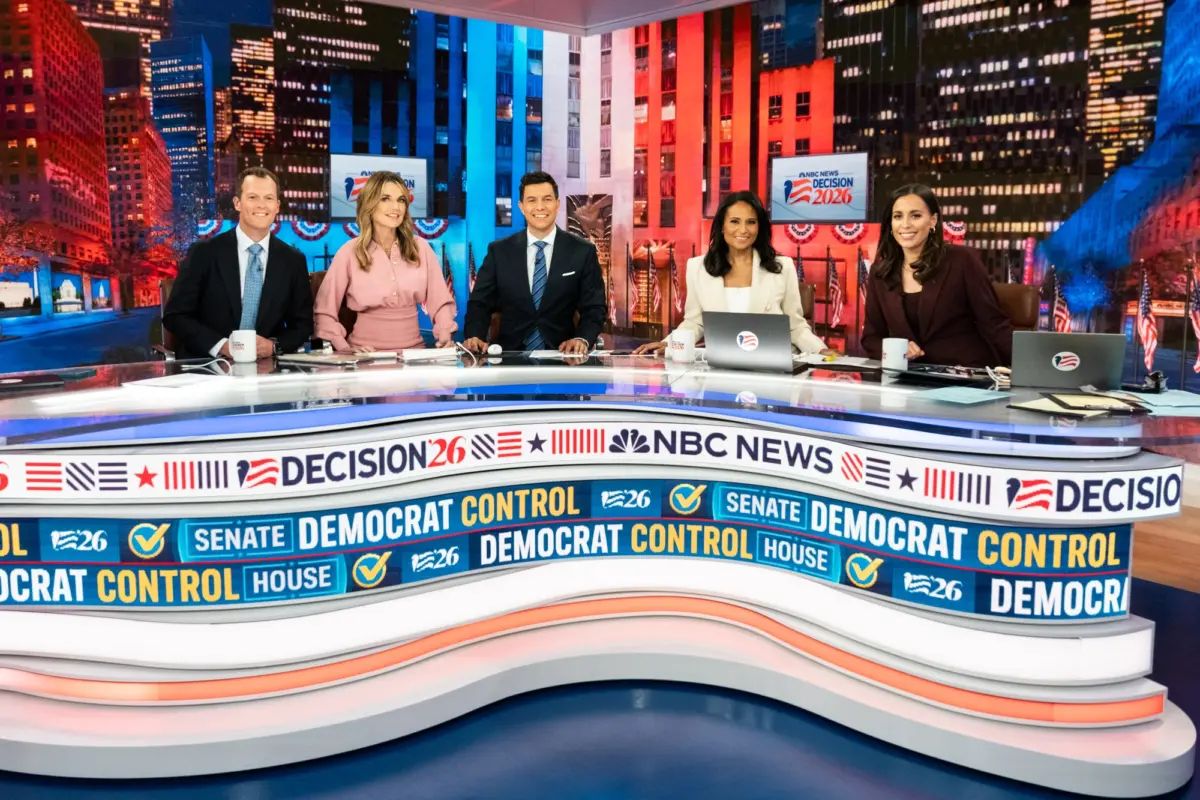
As the political dust settles from a historic midterm election cycle that saw the Democratic Party engineer a sweeping "blue wave" to capture legislative control of both the United States Senate and the House of Representatives, the nation’s premier broadcast and cable news outlets are finally downshifting from round-the-clock special coverage. They are quietly returning to regular, day-to-day programming.
Yet, the reverberations of Tuesday night’s broadcasting marathon will be felt across the media landscape for months to come. Across 13 competing networks, a staggering cumulative audience of 31 million viewers tuned in to watch the unfolding political drama. In the aftermath of this monumental television event, TVNewser convened a panel of industry masterminds to dissect the triumphs, technical hurdles, and unexpected twists of election night.
The post-election debrief featured three defining architects of the evening’s coverage: Marc Greenstein, Executive Vice President of Creative, Innovation & Field Production at NBC News, whose network dominated the ratings as the No. 1 primetime broadcast in total viewers and the coveted Adults 25–54 demographic; Abigail Crutchfield, Senior Vice President of Washington & Special Events Programming at CNN, which claimed the crown as the most-watched cable news network in that same prized demographic; and Chris Stirewalt, Political Director at NewsNation, whose network—working in close coordination with Decision Desk HQ (DDHQ)—made media history by being the first to project Democratic majorities in both chambers of Congress.
What follows is an exclusive, in-depth look at how these newsrooms successfully operated at the bleeding edge of broadcast technology, editorial agility, and sheer human endurance.
Executive Overview: The Architecture of an Unprecedented Night
The 2026 midterm elections presented a complex set of logistical and technological challenges for American news networks. Executive producers and technical directors were tasked with bridging traditional linear television with real-time digital streaming, vertical video feeds, and high-stakes data visualization tools, all while managing live anchors and volatile, fast-moving political developments.
For NBC News, the night was defined by unprecedented dual-broadcast engineering. Greenstein spearheaded an initiative that allowed superstar data analyst Steve Kornacki to simultaneously anchor a linear broadcast and a dedicated streaming feed from the exact same physical studio space utilized by primetime anchors Savannah Guthrie and Tom Llamas.
Meanwhile, CNN doubled down on immersive physical spaces and dynamic data integration. Under the direction of Reza Baktar, the network constructed a fluid Washington control room and set design that liberated its anchors—including the legendary John King—to move seamlessly between traditional desks, the iconic "magic wall," and a newly introduced vertical data interface.

At NewsNation, the strategic decision to partner with Decision Desk HQ paid immediate dividends. By focusing heavily on raw analytical speed and transparent voter education, Chris Stirewalt and his team bypassed the grueling wait-times traditionally associated with race calls, seizing an early competitive advantage that caught even seasoned industry veterans by surprise.
Detailed Chronology: From Primetime Anticipation to Early Calls
As the first polls closed on the East Coast on Tuesday evening, newsrooms across New York, Washington, and Chicago braced themselves for a long, grueling night of nail-biting, down-to-the-wire race calls. Traditional wisdom and pre-election polling suggested a fractured electorate and agonizingly tight margins across key battleground states, pointing toward a protracted multi-day vote count.
Instead, the political landscape shifted beneath the feet of producers within minutes.
By 8:30 p.m. ET, the narrative of the night had fundamentally upended expectations. Rather than hunkering down for weeks of litigation and contested suburban counts, networks were suddenly flooded with definitive early indicators from the electorate. The projected "blue wave" materialized with surprising velocity, prompting early mathematical models to flash green.
For NewsNation, the speed of DDHQ’s algorithms meant that Stirewalt and his editorial team were able to call major legislative shifts far ahead of legacy competitors. At NBC News, Greenstein and his control room found themselves adjusting on the fly as projections for the Senate rolled in significantly faster than internal models had predicted.
Despite the compressed timeline, the rigorous months of scenario-planning paid off. Networks smoothly transitioned from emergency fallback plans to executing fast-paced celebratory and analytical rundowns. The frantic atmosphere of the control rooms, fueled by a mixture of adrenaline and technological novelty, transformed an expected war of attrition into a swift, decisive storytelling sprint.
Supporting Context & Metrics: The Ratings and the Tech Behind the Screens
The sheer scale of the 2026 midterms was underscored by massive audience engagement. With 31 million total viewers locking their screens onto election coverage across 13 distinct networks, television news proved once again that high-stakes democracy remains an incomparable live-viewing event.

The Ratings Giants
- NBC News: Captured the coveted overall primetime crown, dominating both in total overall viewers and within the crucial Adults 25–54 demographic.
- CNN: Led the charge across cable news networks, securing the top spot in the prized Adults 25–54 demo through a combination of crisp Washington-based production and aggressive live reporting.
- NewsNation: Cemented its growing clout in the national political conversation by leveraging Decision Desk HQ to secure historic first-to-call milestones for both the House and Senate.
Technological Innovations
The technical feats achieved on Tuesday night mark a watershed moment for broadcast journalism:
- AI Audio and Dual Broadcasting: NBC successfully deployed cutting-edge AI audio management to cleanly separate and produce simultaneous linear and streaming broadcasts just feet apart from one another, all without spatial bleed or editorial disconnect.
- Advanced Visualizations: CNN expanded its storytelling arsenal with John King’s new vertical magic wall and a mobile studio layout designed by Reza Baktar, allowing anchors to interact directly with deep data sets on the fly.
- Vertical Video Integration: Recognizing shifting consumer habits, networks pushed robust vertical video feeds tailored specifically for mobile-first audiences without sacrificing the rigorous depth of their core journalism.
Official Statements: Inside the Control Room with the Industry Leaders
During the post-election AskNewser debrief, Greenstein, Crutchfield, and Stirewalt opened up about what truly drove their operations behind the scenes.
On Coverage and Breakthrough Technology
Marc Greenstein (NBC News):
"Steve Kornacki continues to be the best at breaking down the vote, providing context and helping viewers understand not just what is happening, but where the night is headed. We combined editorial and technology in a new way, allowing Steve to contribute to the linear broadcast while simultaneously hosting his own dedicated streaming feed from the same studio… We played more than 35,000 graphics across our zones and platforms, delivering results and analysis with speed and clarity."
Abigail Crutchfield (CNN):
"It was having all of our experts and talent together in one place. It gave the DC bureau great energy, and it was fun to watch the reporters and anchors work together to unpack the results. Our director, Reza Baktar, designed a phenomenal set that gave us more mobility than ever… I also loved giving John King the ability to analyze the data at the magic wall or to bring his mini magic wall over to our analyst tables."
Chris Stirewalt (NewsNation):

"You can’t beat the cards. We had such an advantage by having Decision Desk HQ on our side. I think we did a good job of bringing viewers into the process and explaining what we were doing, but when you get down to it, the advantage of being so far ahead of the competition was just amazing."
On the Biggest Surprises of the Evening
When asked about what caught them off guard, the executives pointed primarily to the astonishing velocity of the vote tabulation.
- The Swift Senate Call: Greenstein admitted that while a strong night for Democrats was anticipated, the rapid confirmation of Senate control caught producers slightly off guard. He also expressed relief over the flawless performance of the network’s high-risk AI audio routing technology during live execution.
- Rapid Electoral Answers: Crutchfield noted that despite preparing for endless contingency scenarios, the decisive and rapid cadence of the voters provided immediate clarity.
- Redundant Preparations: Stirewalt humorously lamented the hours he spent deeply analyzing hyper-competitive battleground races, only to find by 8:30 p.m. that the unexpected sweep required deep-dive coverage into entirely different geographical regions, such as Mississippi.
Fueling the Marathon: Late-Night Survival Tactics
Sustaining peak cognitive performance through hours of high-tension live broadcasting requires a specialized regimen:
- Marc Greenstein: Relied on classic control-room fuel—coffee, Diet Coke, and the pure, intoxicating adrenaline rush of sitting in the director’s chair for the first time since Election Night 2024.
- Abigail Crutchfield: Powered through the evening with copious cups of hot tea, the collaborative energy of a phenomenal team, and a massive bag of gummy bears.
- Chris Stirewalt: Opted for a natural high, noting that the sheer thrill and psychological reward of watching DDHQ and his newsroom team crush their metrics left him "high on life" without the need for artificial stimulants.
Future Outlook: What the 2026 Midterms Mean for Media Strategy
As networks pack away their touchscreens, dismantle temporary studio additions, and allow their production crews to catch up on much-needed sleep, industry analysts are already looking ahead to the structural lessons embedded in the 2026 midterms.
First, the massive success of dual-streaming setups and dedicated mobile video feeds at networks like NBC proves that future election coverages can no longer treat digital and streaming platforms as secondary afterthoughts. Linear television and multi-platform streaming must exist as equal, co-dependent pillars of modern newsroom architecture.
Second, the increasing reliance on advanced data infrastructure—exemplified by CNN’s fluid physical set architecture and NewsNation’s partnership with Decision Desk HQ—highlights an escalating arms race for analytical speed and graphical transparency. Viewers no longer just want to be told who is winning; they expect to interact dynamically with granular data through trusted journalistic guides.
Ultimately, the 2026 midterm election coverage set a new, higher watermark for the broadcast industry. By successfully marrying human editorial instincts with cutting-edge audio engineering, AI integration, and rapid-fire data analytics, networks have proven that even in an increasingly fragmented digital media ecosystem, high-quality, authoritative live journalism remains an indispensable pillar of American civic life.
