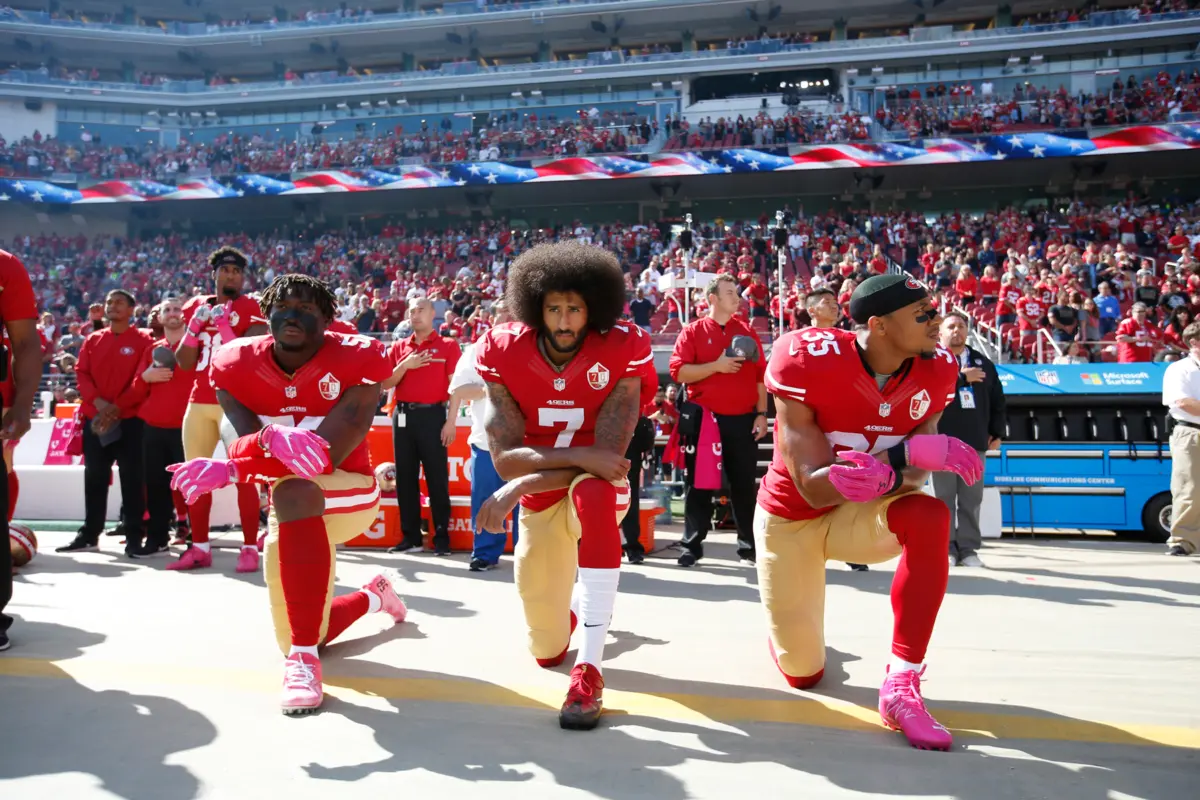
Ten years have passed since San Francisco 49ers quarterback Colin Kaepernick dropped to one knee on a sun-drenched September afternoon, transforming a traditional sign of athletic reverence into a watershed moment for civil rights protest. While Kaepernick’s gesture became the defining cultural flashpoint of the late 2010s—launching a global conversation, sparking intense corporate patronage, and ultimately cementing his status as the undisputed lightning rod of athlete activism—the singular focus on his narrative has obscured a broader truth.
A collective movement of athletes across multiple leagues, spanning diverse demographics and predating Kaepernick’s initial protest, stood shoulder-to-shoulder with him, only to face institutional silencing, career termination, and systemic erasure.
In examining the decade-long aftermath of the 2016 wave of athletic protest, a deeper narrative emerges. The cultural reduction of a sprawling social justice movement to a single figurehead mirrors historical patterns seen during the Civil Rights era. Just as American society continually elevates Dr. Martin Luther King Jr. while obscuring grassroots pioneers like Claudette Colvin, the sports world has anointed Kaepernick while largely forgetting pioneers like WNBA star Maya Moore, MLB catcher Bruce Maxwell, and NFL wide receiver Kenny Stills.
Through exclusive interviews and historical retrospection, this investigation explores the immense professional sacrifices, the chilling effects of corporate co-optation, and the enduring legacies of the athletes who risked millions—and their livelihoods—to demand systemic accountability.
Detailed Chronology: The Summer of Discontent and Its Precursors
The ground had been shifting beneath American sports long before the autumn of 2016. The modern era of athletic activism did not begin in a vacuum; it was forged in the crucible of escalating racial tension, high-profile police killings, and historic systemic inequality.
The Groundwork: Early Precursors
Activism within sports had occasionally flared up in prior years, albeit met with severe institutional pushback. In 2014, Ariyana Smith, a Black player for the Knox College women’s basketball team, became the first athlete to protest on behalf of the Black Lives Matter movement during a collegiate game. Kneeling during the national anthem and collapsing to the floor for four and a half minutes—symbolizing the four hours Michael Brown’s body lay exposed in Ferguson, Missouri—Smith was suspended indefinitely. Though reinstated following media outcry, the chilling message to other collegiate athletes was clear.
July 2016: The WNBA Leads the Charge
The tinderbox ignited in July 2016. Within a harrowing 48-hour span, Alton Sterling was killed by police in Baton Rouge, Louisiana, and Philando Castile was fatally shot during a routine traffic stop in Falcon Heights, Minnesota—mere minutes away from the arena of the WNBA’s Minnesota Lynx.
Unlike their male counterparts in major leagues, WNBA players, predominantly Black women, viewed these tragedies not as distant political talking points, but as immediate community realities. Led by co-captain Maya Moore and head coach Cheryl Reeve, the Lynx became the first professional sports team to mount a coordinated, collective protest.
On July 9, 2016, during warm-ups ahead of a game against the Dallas Wings, the Lynx wore black t-shirts bearing the words “Change Starts With Us — Justice & Accountability,” with the names of Sterling and Castile printed on the back.
Dr. Drew Brown, a sociology and African American studies professor at the University of Florida, notes the stark disparity in how these protests were received:
"Black women were leading as whole teams, which hadn’t been seen before. The reason it didn’t get much notoriety is because of misogynoir and the fact that, at the time, women weren’t million-dollar athletes, although they were still risking their salaries and being punished. Professional male athletes were risking millions, which made it more of a spectacle."
September 2016: Kaepernick and the NFL Wave
On Sept. 1, 2016, Colin Kaepernick formally knelt alongside teammate Eric Reid during the national anthem before a preseason game, stating to the press: "I am not going to stand up to show pride in a flag for a country that oppresses Black people and people of color."
By September 11, opening week of the NFL season, the movement expanded to include Miami Dolphins players Kenny Stills, Arian Foster, Jelani Jenkins, and Michael Thomas, who joined together in a silent protest against police brutality. Despite severe internal locker-room friction and fierce external blowback from military families and conservative fanbases, these athletes persisted, setting off a chain reaction across professional sports.
Supporting Context & Metrics: The Cost of Dissent
The financial and professional toll exacted on these athletes paints a stark picture of corporate risk aversion and systemic retaliation.
The NFL Exile: Colin Kaepernick was effectively forced out of the league by February 2017 and never played another down in the NFL, despite remaining athletically competitive.
The Baseball Fallout: In Major League Baseball, Bruce Maxwell became the league’s lone kneeling player on Sept. 23, 2017, following incendiary remarks by Donald Trump regarding protesting athletes. Maxwell quickly faced ostracization, a lack of institutional backing from his team, and a barrage of violent death threats. By mid-2018, his Major League career was effectively over following a demotion to the minor leagues and an unceremonious release.
The Corporate Shift of 2020: Following the murder of George Floyd in May 2020, corporate America experienced a temporary reckoning. The NFL committed $250 million to social justice initiatives; the NBA temporarily paused playoff games after the police shooting of Jacob Blake; and MLB acknowledged its historical segregation. However, athletes argue this corporate awakening was largely superficial. Kenny Stills notes that behind the public relations campaigns, the underlying mechanics of suppressing independent political thought remained firmly intact.
Official Statements and Perspectives
The erasure of collective nuance in favor of singular iconography remains a central critique among sports sociologists and movement veterans alike.
Dr. Harry Edwards, a legendary organizer of the 1968 Olympic Black Power protest and a sociological consultant to the 49ers during Kaepernick’s 2016 season, reflects on the societal obsession with finding a single prophetic figurehead:
"Every now and then, somebody asks me where the next Dr. King is coming from, but I’m not looking for that. I’m looking for the next Claudette Colvin," Edwards remarks, referencing the civil rights pioneer who refused to surrender her bus seat months before Rosa Parks. "People follow Dr. King’s pattern, because it is the pattern in American society. Sports recapitulates society."
For Maya Moore, stepping away from the peak of her athletic career in 2019 to focus entirely on criminal justice reform—specifically helping overturn the wrongful conviction of Jonathan Irons, whom she later married—was an act of alignment with her core purpose.
"As women basketball players, we innately have an activism strand in our DNA, because of how hard we’ve worked to have a place in this industry," Moore reflects. "The grind of what we do is no joke, and I wanted to be more present for this hard battle, fighting for Jonathan’s freedom and starting our life, while still publicly advocating for these issues."
Kenny Stills, whose career trajectory shifted drastically following his trade from the Miami Dolphins to the Houston Texans—a move he interprets as a calculated effort by management to stifle his activism—reflects on the current climate of international sports:
"It seems like there have been fewer athletes using their voice," Stills observes. "I was excited to see Lamine Yamal from Barcelona wave the Palestinian flag in their parade. He’s one of the biggest stars at the moment, and that’s inspiring for the next generation. But a lot of guys are afraid because they understand the consequences, whether it be something like Colin, or my situation, slowly being eased out."
Future Outlook: The Next Generation of Athlete Activism
As professional sports leagues enter a new decade, the landscape of athlete activism has mutated. While corporate sponsorships and league-sanctioned social justice funds have institutionalized a sanitized version of corporate philanthropy, grassroots radicalism faces a chilling environment.
Athletes today navigate a paradox: international stars like those in European football leagues demonstrate increasing willingness to leverage global platforms for human rights issues, yet domestic American athletes frequently remain hesitant, hyper-aware of the professional termination that befell Kaepernick, Maxwell, and Stills.
The legacy of the 2016 protests ultimately transcends the iconic imagery of a single knee on a gridiron. It lives on in the quiet resilience of Maya Moore championing criminal justice reform, Bruce Maxwell securing communities through private security work after baseball doors were slammed shut, and Kenny Stills introducing marginalized youth to outdoor sports.
As Bruce Maxwell starkly reminds observers:
"I tell people all the time, bro, racism is everywhere."
The true measure of the 2016 movement is not found solely in the name remembered by mainstream pop culture, but in the enduring courage of the collective vanguard who recognized that the pursuit of justice is far greater than any paycheck, franchise, or game.