

Executive Overview
In the world of digital product development and corporate branding, the graveyard of failed projects is largely populated by initiatives that collapsed long before the first logo was ever sketched. Typically, the post-mortem points to the strategy phase—specifically, the moment when abstract adjectives like "modern," "trustworthy," "premium," "friendly," and "disruptive" were left undefined.
When design teams receive a brief saturated with these broad, unvetted buzzwords, a dangerous disconnect immediately forms between what a brand is fundamentally meant to communicate and what a designer is expected to produce. This chasm is what leading identity architects refer to as the "pre-concept phase."
Far too often, designers are handed a standard creative brief, a handful of fragmented stakeholder conversations, a sparse moodboard, and a loosely curated list of adjectives, and told to "make something that feels right." But "right" is an impossible metric to judge when an entire cross-functional team has never established a baseline consensus on the brand’s core semantic meaning.
To build resonant visual systems, teams must master the pre-concept phase: a rigorous methodological bridge spanning the gap between raw corporate strategy and initial visual execution. By utilizing contextual research, interactive perception mapping, visual metaphors, and a disciplined three-tiered visual foundation, organizations can transform ambiguous linguistic aspirations into concrete design boundaries.
Detailed Chronology of a Branding Breakdown
To understand why the pre-concept phase is indispensable, one must examine how standard branding projects typically derail. The timeline of a typical corporate identity crisis usually follows a predictable, flawed trajectory:
1. The Kickoff and the Illusion of Consensus
During the initial kickoff meeting, stakeholders readily agree on their ambitions. Executives nod in unison when a consultant suggests the new product identity should be "trustworthy, disruptive, and modern." Because these words are universally positive, everyone assumes a shared understanding. In reality, each stakeholder has imported their own subjective mental model into these terms.

2. The Vacuum of Translation
Armed with these unexamined adjectives, the design team retreats to design tools like Figma or Illustrator. Without deeper operational context, the designer relies on personal intuition to interpret what "disruptive" or "premium" looks like.
3. The Shock of the First Concept Reveal
Weeks later, the design team unveils their initial concepts. To their surprise, the executive team recoils. The designs are criticized as "too radical," "too cold," or "missing the mark entirely." Frustration mounts on both sides. The designers feel the clients don’t know what they want; the clients feel the designers didn’t listen.
4. The Real-World Case of Misaligned Semantics
Consider a recent engagement with a health-tech company specializing in software for large government medical institutions. During early interviews, the client insisted the brand needed to look "modern, trustworthy, and disruptive."

At first glance, "disruptive" implies a push toward bold, unconventional, rule-breaking aesthetics. However, through deep pre-concept exploration, a vital nuance emerged: within a highly conservative healthcare ecosystem dealing with government bureaucracy, radical disruption would signal instability. Their version of disruption had to feel impeccably credible, methodical, and safe. Visually, their ideal expression of "disruptive" was far more traditional than the literal definition implied.
Had the design team taken the word at face value without interrogating its context, the resulting visual identity would have alienated the very audience the company needed to convert.
Supporting Context & Metrics: Uncovering Hidden Assumptions
Navigating the pre-concept phase requires moving past polite consensus and dismantling hidden assumptions. As Marty Neumeier famously noted in The Brand Gap, "A brand is a person’s gut feeling about a product, service, or company." Because a brand ultimately lives entirely within the subjective perception of the audience, the pre-concept phase must actively deconstruct what perception the organization is trying to engineer.

Stage 1: Researching Brand Context
Standard discovery workshops naturally touch upon core business metrics, target audiences, and competitive landscapes. However, top-tier branding teams focus heavily on a targeted set of perception questions that illuminate category assumptions:
- What specific beliefs must this brand alter in the minds of consumers?
- Where must the brand maintain absolute credibility?
- Which industry norms should the brand blindly follow, and which should it aggressively challenge?
Stage 2: Competitor Perception Mapping
To ground abstract ideas in reality, teams can employ Competitor Perception Mapping. By plotting industry competitors across a custom two-axis matrix—such as Understated vs. Bold or Accessible vs. Exclusive—stakeholders reveal their internal biases regarding the market.
This exercise rarely yields a clean, unanimous map. Instead, it sparks productive friction. One stakeholder might categorize a rival firm as "progressive," while another views them as "generic." Surface-level arguments about layout or color are replaced by profound debates on what constitutes true industry authority.

Stage 3: The Visual Brand Driver Exercise
Popularized by frameworks like GV’s Three-Hour Brand Sprint (championed by design leaders like Jake Knapp), tangible exercises help transform abstract corporate goals into concrete associations.
In the Visual Brand Driver exercise, stakeholders are forced to select imagery representing the company across unrelated categories: transportation, typography, architecture, animals, and even beverages. Crucially, participants must select images not based on personal aesthetic preference, but on how accurately the image mirrors corporate character.
- If the company were a vehicle, is it a quiet electric car, a high-speed freight train, or a nimble bicycle?
- If it were a piece of furniture, is it a heavy boardroom table or a modular desk?
Paired with four or five descriptive adjectives, these metaphors expose deep ideological splits within the leadership team, highlighting precise areas that require alignment before a single vector is drawn.

Official Frameworks & Methodological Layers
Once discovery and alignment exercises are complete, the designer translates shared strategic understandings into a physical visual foundation. This intermediary phase relies on three distinct layers that bridge strategy and execution:
[Strategy / Words]
       ↓
[Look & Feel Boards] (Discussing overarching mood & perception)
       ↓
[Design Code] (Translating core ideas into visual principles)
       ↓
[Brand Assets] (Defining typography, color, iconography, & tone)
       ↓
[Concept Generation in Figma]
1. Look and Feel Boards
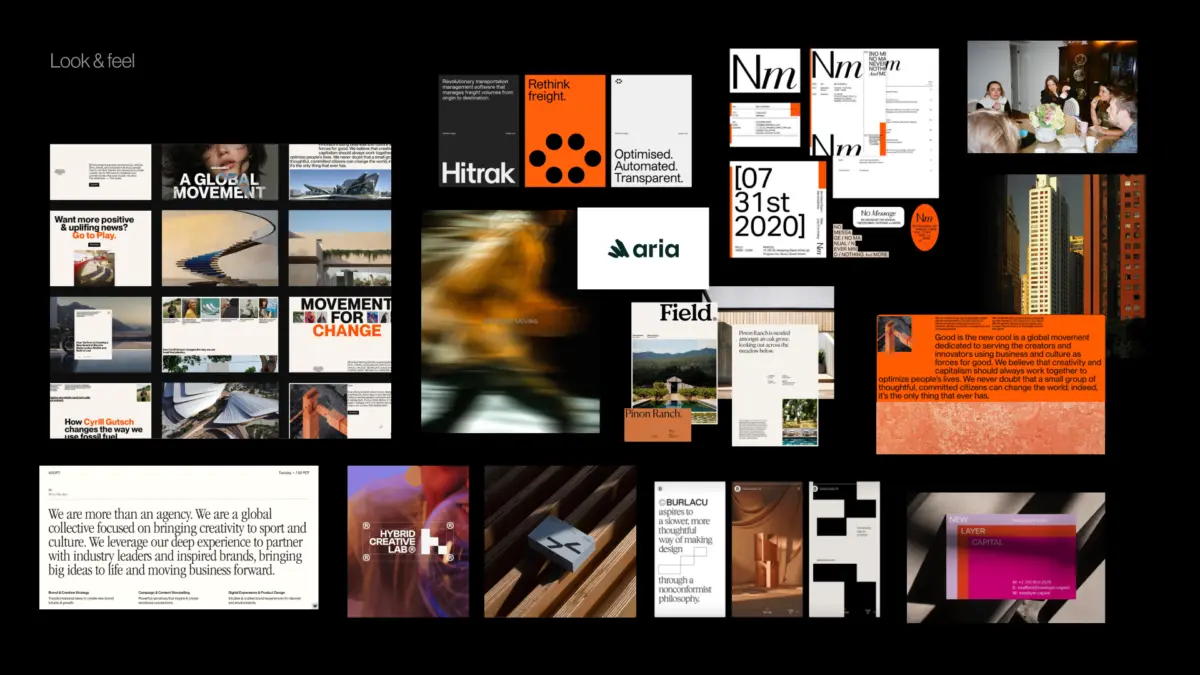
Look and feel boards are not moodboards showcasing visual styles the team simply finds appealing. They are perception boards. Curated exclusively from third-party visual references, they serve as testing grounds for mood, category tension, and brand character. If a brand must feel authoritative yet human, these boards prompt the team to discuss the specific shade of humanity they want to project before approving color palettes or logo layouts.
2. Design Code
The design code layer translates core brand propositions into actionable visual principles.

- For a parenting app whose core strategy is "personalized support for a unique journey," the design code might dictate organic shapes, handwritten lines, and soft, asymmetrical compositions.
- For a corporate PR agency rooted in the concept of "momentum in motion," the design code might explore dynamic lines, ripple effects, or intentional motion blur.
3. Early Brand Asset Direction
The final pre-concept layer introduces the foundational elements of identity: typographic temperament, color range, photographic style, and graphic language. By evaluating these assets in isolation, the team establishes clear boundaries. The designer is no longer guessing blindly; they understand precisely what visual parameters to respect and, equally importantly, what styles to explicitly avoid.
Future Outlook: The Evolution of Collaborative Branding
As digital products become more complex and market differentiation harder to maintain, the margin for error in brand identity design continues to shrink. Organizations can no longer afford the luxury of linear, siloed creative processes where strategy is handed off to designers in a vacuum.
The future of brand development belongs to multidisciplinary teams that treat the pre-concept phase as an essential, non-negotiable cornerstone of product strategy. By institutionalizing frameworks like perception mapping, visual brand drivers, and structured design coding, companies insulate themselves against subjective second-guessing and endless revision cycles.

Ultimately, a well-executed pre-concept phase transforms the critique of visual work. When leadership reviews the first round of actual design concepts, the conversation shifts permanently away from arbitrary declarations of "I like this" or "I don’t like this" and elevates toward a much sharper, professionally authoritative inquiry:
"Does this visual system accurately express the brand strategy we collectively agreed to build?"
When that question replaces personal taste, brand design ceases to be a gamble—it becomes a precise, repeatable business asset.