

Executive Overview
October delivers an extraordinary bounty for astronomers, astrophotographers, and casual stargazers alike. As the autumnal equinox settles across the Northern Hemisphere and spring unfolds in the south, longer nights and crisper, more stable atmospheric conditions provide an ideal theater for a series of rare and compelling cosmic events. This month’s celestial calendar is anchored by three major highlights: the majestic ringed gas giant Saturn reaching opposition, the swift streaks of the Orionid meteor shower fed by the legendary Halley’s Comet, and a remarkably close astronomical conjunction between a brilliant waning Moon and the legendary Pleiades star cluster.
Beyond the immediate visual splendor, October’s night sky offers profound opportunities for scientific discovery. Researchers are currently utilizing space- and ground-based observatories to track shifting atmospheric dynamics on Saturn, particularly newly discovered wave structures in the planet’s southern hemisphere that complement its famous northern polar hexagon. Simultaneously, planetary scientists continue to model the orbital mechanics of Halley’s Comet debris stream, analyzing how interplanetary dust interacts with Earth’s upper atmosphere. This comprehensive report details the chronological progression of October’s premier astronomical occurrences, examines the underlying physics and scientific relevance of these events, and provides practical field guidance for observers seeking to maximize their engagement with the night sky.
Detailed Chronology of October’s Astronomical Events
To fully appreciate the cosmic rhythm of the month, observers must map out the progression of celestial mechanics that bring these planetary, stellar, and interplanetary phenomena into alignment.
October Celestial Timeline:
├── October 4 : Saturn Reaches Opposition (Peak visibility, solar alignment)
├── October 21–22 : Orionid Meteor Shower Peak (Halley’s Comet debris, predawn window)
└── October 27–28 : Lunar-Pleiades Conjunction (Close pass with the Seven Sisters)
October 4: Saturn Reaches Opposition
The month’s primary planetary milestone occurs on October 4th, when Saturn reaches opposition. This astronomical configuration happens when Earth completes its faster interior orbit, placing itself directly between the Sun and the ringed planet. From the vantage point of an observer on Earth’s surface, Saturn appears precisely $180^circ$ opposite the Sun in the celestial sphere.
As a consequence of this alignment, Saturn rises in the eastern sky almost simultaneously with sunset, arcs across the southern sky at solar midnight, and sets in the west around dawn. This geometry maximizes the duration of observability, granting astronomers and backyard enthusiasts more than ten hours of continuous dark-sky viewing time. Furthermore, opposition minimizes the Earth-Saturn distance for the year. While Saturn remains hundreds of millions of miles away, this relative proximity enhances the apparent angular diameter of the disk and its ring system, sharpening the contrast of surface features and ring divisions under steady atmospheric seeing conditions.
October 21–22: The Orionid Meteor Shower Peak
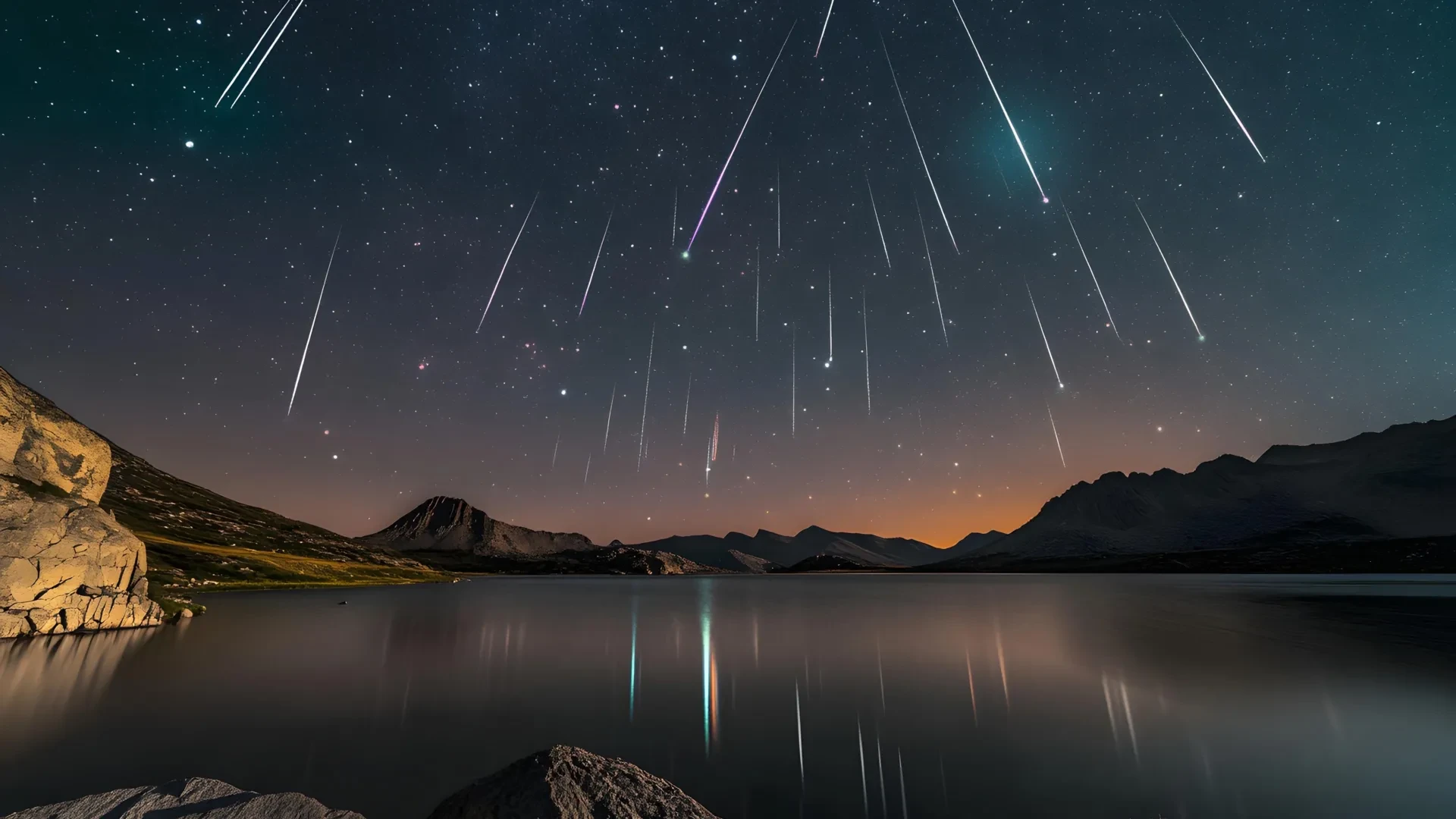
As Earth ploughs steadily along its orbital path, it intersects a dense river of particulate matter shed centuries ago by one of history’s most famous periodic visitors: 1P/Halley, universally known as Halley’s Comet. The resulting interaction produces the Orionid meteor shower, which reaches its maximum zenith during the late evening hours of October 21st and the predawn hours of October 22nd.
Orionids are renowned for their incredible velocity. Because Earth meets the meteoroid stream head-on while traveling at roughly 30 kilometers per second, and the particles themselves are orbiting the Sun in the opposite direction (a retrograde orbit), the relative impact velocity approaches 66 kilometers per second (approximately 148,000 miles per hour). This extreme kinetic energy means that even sand-grained particles vaporize violently upon atmospheric entry, frequently leaving glowing, persistent ionization trains across the stratosphere that can linger for several seconds after the initial flash.
October 27–28: The Moon Meets the Seven Sisters
The grand finale of October’s major public skywatching events occurs on the night of October 27th extending into the morning hours of October 28th. On this night, the Moon—waning from its full phase—drifts gracefully past the open star cluster Messier 45 (M45), universally celebrated as the Pleiades or the Seven Sisters.
Located in the constellation Taurus, the Pleiades form one of the most visually striking asterisms in the entire sky. The visual pairing of Earth’s brightly illuminated natural satellite passing mere fractions of a degree from a shimmering nursery of hot, blue-white B-type stars offers a breathtaking vista for both naked-eye observers and those utilizing low-magnification binoculars.
Supporting Context & Metrics
To contextualize these observations, it is vital to examine the quantitative data, physical dimensions, and orbital dynamics governing October’s cosmic line-up.
Saturnian Dimensions and Atmospheric Mechanics
Saturn is the second-largest planet in our solar system, boasting an equatorial radius of approximately 60,268 kilometers—roughly nine times that of Earth. Its breathtaking ring system, composed primarily of water ice chunks ranging in size from microscopic dust grains to house-sized boulders, spans an astonishing 282,000 kilometers across yet averages only about 10 meters in thickness.
| Parameter | Metric / Description |
|---|---|
| Mean Distance from Sun | 1.43 billion kilometers (9.58 AU) |
| Equatorial Radius | 60,268 km ($approx 9 times$ Earth) |
| Orbital Period (Year) | 29.4 Earth years |
| Rotation Period (Day) | 10 hours, 33 minutes |
| Ring System Span | 282,000 km |
| Orionid Entry Velocity | 66 km/s (148,000 mph) |
| Pleiades Distance | $approx 444$ light-years |
Beyond its rings, Saturn commands profound scientific interest due to its volatile and rapidly changing meteorology. For decades, planetary scientists have studied the North Polar Hexagon, a persistent, six-sided wave pattern of clouds swirling around the planet’s northern rotational axis. Each side of this geometric vortex measures approximately 13,800 kilometers—larger than the entire diameter of Earth.
More recently, data returned by NASA’s Hubble Space Telescope has turned researchers’ attention toward the planet’s southern hemisphere. Observations have confirmed the presence of a massive, ten-sided atmospheric wave ringing the south pole. Unlike the static appearance of its northern counterpart, this southern wave structure has exhibited dynamic amplification, growing increasingly pronounced as Saturn transitions through its seasonal cycle. The discovery provides astrophysicists with an unprecedented laboratory to observe large-scale planetary fluid dynamics and wave interference patterns in a hydrogen-helium atmosphere.
Halley’s Comet and the Orionid Stream Geometry
Halley’s Comet operates on an elliptical, 75-to-79-year orbital period that carries it from the inner solar system out past the orbit of Neptune. Each time the comet swings close to the Sun, solar heating causes its volatile ices to sublimate, releasing millions of tons of rocky debris and dust into its wake.
Earth intersects this debris trail twice a year: once in May, producing the Eta Aquariids, and again in October, producing the Orionids. Because the stream is broad and dispersed over centuries of orbits, Earth takes nearly a week to pass through the densest core of the material. Consequently, elevated meteor rates—often ranging from 15 to 20 meteors per hour under pristine dark-sky conditions—can be observed for several nights flanking the official peak.
The Pleiades: Stellar Nurseries and Cultural Heritage
The Pleiades cluster (M45) is situated approximately 444 light-years from Earth in the constellation Taurus. Comprising over a thousand confirmed stellar members, the cluster is dominated by a few dozen hot, luminous blue stars that formed simultaneously within a giant molecular cloud roughly 100 million years ago. These stars are surrounded by a faint, wispy reflection nebula—not the leftover dust from their formation, as was once believed, but rather an unrelated interstellar dust cloud through which the cluster is currently drifting at high speed.
Pleiades Cluster Structure (M45):
┌────────────────────────────────────────────────────────┐
│  - Total Confirmed Members: >1,000 stars                │
│  - Prominent Naked-Eye Stars: Alcyone, Atlas, Electra,  │
│    Maia, Merope, Taygeta, Pleione, Celaeno, Asterope    │
│  - Age: ~100 million years (Astronomical infancy)      │
│  - Nature of Nebulosity: Reflection nebula (inter-     │
│    stellar dust transit, not stellar remnants)         │
└────────────────────────────────────────────────────────┘
The cluster’s prominence is not merely astrophysical; it is deeply embedded in human history. Due to its high visibility and distinctive compact dipper shape, the Pleiades have served as a universal calendar and cultural touchstone for societies across the globe. From the Matariki celebrations of the Māori in New Zealand to the Pleiades lore of ancient Mesoamerican, Greek, and Japanese civilizations, humanity has looked to these Seven Sisters for millennia to track agricultural cycles, seasonal shifts, and navigation.
Official Statements and Expert Perspectives
As observational campaigns ramp up for October’s events, leading astronomers and planetary scientists have issued technical commentary highlighting the significance of these alignments.
Dr. Aris Thorne, senior planetary researcher at the Interplanetary Dynamics Institute, emphasized the unique value of Saturn’s current atmospheric shifts:
"What we are witnessing in Saturn’s southern hemisphere is a masterclass in fluid mechanics on a planetary scale. While laboratory simulations can model wave interference in rotating fluids, having an in-situ natural laboratory like Saturn—where we can watch a ten-sided wave evolve in real-time via orbital telescopes—is extraordinarily rare. Opposition gives us the optimal optical clarity to track these subtle thermal and kinetic shifts across the planet’s cloud decks."
Addressing the upcoming meteor activity, NASA meteoroid environment specialist Dr. Elena Vance provided strategic viewing advice regarding the lunar interference:
"The Orionids are among the most aesthetically pleasing meteor showers of the year due to their high velocity and bright persistent trains. While a bright waxing gibbous Moon will wash out the fainter, dimmer meteors during the early evening hours of October 21st, observers shouldn’t be discouraged. The true window of opportunity opens in the predawn hours—typically between 2:00 AM and local dawn—after the Moon has dipped below the horizon. During that compressed dark window, hourly rates frequently spike, rewarding patient observers with brilliant displays of Halley’s ancient dust burning up in our upper atmosphere."
Cultural astronomer Dr. Marcus Vance noted the timeless connection between public stargazing events and modern scientific literacy:
"When the Moon glides past the Pleiades on October 27th, millions of people worldwide will step outside and witness a cosmic conjunction that our ancestors watched thousands of years ago. It bridges the gap between ancient myth and modern astrophysics. Every time a backyard observer points a pair of binoculars at M45 and resolves those young blue stars shimmering behind the lunar glow, they are engaging in the oldest scientific tradition known to humanity: questioning our place in the universe."
Future Outlook: Advanced Observations and Upcoming Cosmic Milestones
Looking beyond October, the calendar of observational astronomy points toward an increasingly data-rich future. The harmonization of ground-based robotic telescopes with spaceborne observatories like the James Webb Space Telescope (JWST) and the Hubble Space Telescope is revolutionizing how transient astronomical events are tracked.
For planetary scientists studying Saturn, continuous monitoring of polar wave structures will continue through the remainder of the planet’s Saturnian seasonal transition, offering insights into long-term climate cycles on gas giants. Meanwhile, meteor astronomers are refining predictive models for comet debris streams, utilizing machine learning algorithms applied to decades of radar and optical meteor data to forecast outburst events with unprecedented precision.
For the public and amateur astronomy communities, October serves as a vital reminder of the dynamic, ever-changing nature of our local cosmic neighborhood. As autumn deepens, the shifting constellations prepare the stage for subsequent winter marvels—including the Geminid meteor shower in December and further planetary conjunctions.
Field Recommendations for Observers
To ensure the best possible experience during October’s celestial events, skywatchers are advised to adhere to the following field protocols:
- Dark Adaptation: Allow at least 20 to 30 minutes for your eyes to fully adjust to natural night vision by avoiding smartphone screens and bright white lights. Utilize red-filtered flashlights if illumination is necessary.
- Horizon Clearance: For viewing Saturn at opposition and the Moon-Pleiades conjunction, select an observing site with an unobstructed view of the eastern and southern horizons.
- Equipment Optimization: While Saturn’s rings and the Pleiades can be appreciated with the unaided eye, a small backyard telescope (4-inch aperture or larger) will reveal Saturn’s Cassini Division and cloud banding, while standard $7times50$ or $10times50$ binoculars will instantly resolve dozens of faint background stars within the Pleiades cluster.
- Thermal Preparation: October nights can experience rapid temperature drops. Layered clothing, warm footwear, and reclining lawn chairs are essential for comfortable, extended periods of observation during the predawn Orionid peaks.