

Executive Overview
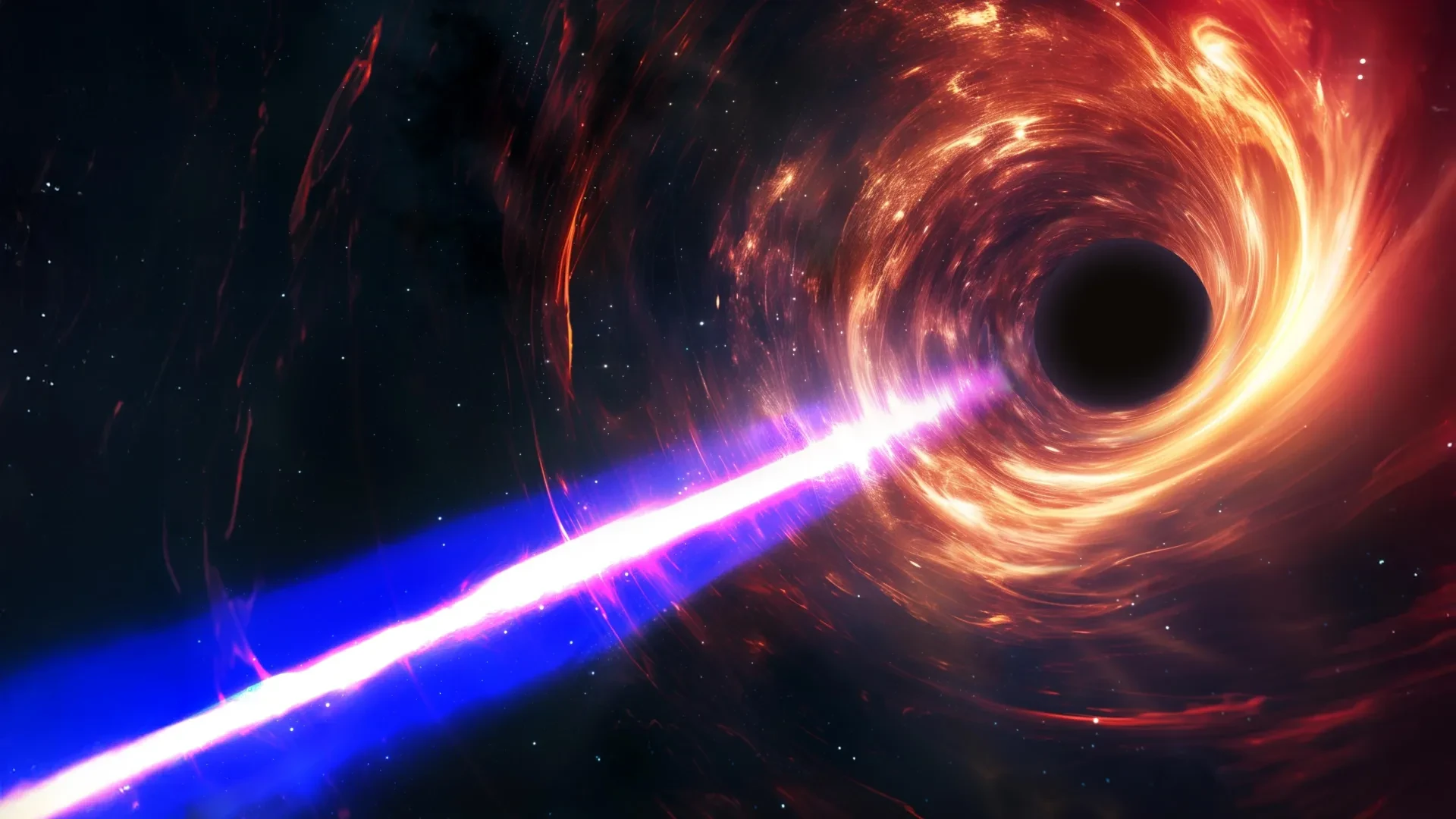
In what is being heralded as a watershed moment for high-energy astrophysics, an international team of researchers has uncovered what appears to be a universal physical law governing the most violent phenomena in the universe: the launching of powerful relativistic jets by black holes. Published in the prestigious journal Nature Astronomy under the title "A universal critical accretion rate for black hole jet formation," the study bridges a massive knowledge gap that has confounded astronomers for decades.
For the first time, scientists have demonstrated that black holes—ranging from modest "stellar-mass" variants weighing roughly ten times our Sun to colossal supermassive engines millions or billions of times heavier—launch their signature radio jets at the exact same critical stage of their feeding cycle. This breakthrough suggests that the fundamental mechanics of black hole feeding and feedback are scale-invariant, operating by the same immutable rules whether the gravitational monster resides in a dwarf galaxy or the active galactic nucleus of a giant elliptical system.
Co-led by Andrew Mummery, a Martin A. and Helen Chooljian Member (2025–30) in the School of Natural Sciences at the Institute for Advanced Study (IAS), and Adelle Goodwin, a Forrest Research Foundation Fellow at Curtin University’s International Centre of Radio Astronomy Research (ICRAR) in Western Australia, the research required an unprecedented synthesis of multi-wavelength observations. By analyzing data collected from orbital space observatories and terrestrial telescope networks spanning the Americas, Australia, India, and South Africa, the team turned transient cosmic events into a laboratory for testing extreme gravity.
The implications of this discovery extend far beyond theoretical astrophysics. By identifying a precise, universal threshold—specifically, when a black hole’s feeding rate drops to approximately two percent of its theoretical physical limit—astronomers can now predict when these dormant cosmic giants will suddenly roar back to life and eject high-speed plasma into the intergalactic medium. This predictive capability promises to revolutionize how major global telescope facilities are scheduled, maximizing scientific return for next-generation instruments like the forthcoming Square Kilometre Array (SKA).
Detailed Chronology: From a Madrid Bar to a Breakthrough Discovery
The genesis of this paradigm-shifting discovery did not occur in a sterile, high-tech laboratory, but rather amid the casual academic exchange of an international astrophysics conference in Madrid. It was there that Andrew Mummery and Adelle Goodwin engaged in a sprawling conversation about the erratic behavior of cosmic accretion disks. They confronted a persistent, vexing enigma: why do certain supermassive black holes unleash powerful radio jets almost immediately after shredding an unfortunate star, while others remain frustratingly dormant, only to unexpectedly ignite their engines months, or even years, later?
To solve this puzzle, the researchers turned their attention to tidal disruption events (TDEs). These violent cataclysms occur when a wandering star passes too close to the event horizon of a supermassive black hole. The black hole’s immense tidal forces generate extreme gravitational gradients that violently shear and rip the star apart, stretching it into a long, thin stream of stellar debris—a process colloquially referred to by astronomers as "spaghettification."
For observational astronomers, TDEs represent a rare, golden opportunity. Typically, changes in the environment surrounding supermassive black holes unfold sluggishly across evolutionary timescales spanning thousands or millions of years—far too slow for human observation. However, when a supermassive black hole consumes a shredded star, the resulting feeding frenzy evolves over the course of just a few short years. This rapid progression provides a compressed, real-time chronicle of extreme accretion physics.
Mummery and Goodwin realized that by leveraging a robust sample of TDEs, they could bypass the timescale barrier that had historically stalled progress in supermassive black hole research. Returning to their respective institutions, the researchers spearheaded an exhaustive data-gathering campaign. They scoured astronomical archives for observations across the electromagnetic spectrum, compiling light curves and spectral data from optical, ultraviolet, X-ray, and radio facilities worldwide.
Out of an initial sample of twenty documented tidal disruption events, the team rigorously filtered the data down to ten exceptionally high-quality events. For these ten systems, the researchers possessed sufficient multi-wavelength coverage to reliably reconstruct both the precise feeding rate of the black hole over time and the exact temporal emergence of its radio outflows.
When the final datasets were mapped and analyzed, a striking pattern emerged from the noise. The data revealed two distinct chronological periods during which black hole jets could form. The first phase occurs early in the event, characterized by hyper-accretion when the black hole is consuming stellar material at a ferocious, near-maximal rate. The second phase, however, occurs much later—hundreds to thousands of days after the initial stellar destruction.
It was during this delayed phase that the researchers identified the smoking gun: regardless of the black hole’s mass, these delayed jets consistently fired the exact moment the accretion rate dipped to precisely two percent of the Eddington limit. This revelation connected the violent outbursts of supermassive black holes directly to the behavior of smaller, stellar-mass black holes residing within our own Milky Way galaxy, which are already known to obey this identical two-percent threshold.
Supporting Context & Metrics: Decoding the Physics of Cosmic Feeding
To fully appreciate the significance of Mummery and Goodwin’s findings, one must examine the extreme physics governing black hole accretion and feedback. Popular culture often portrays black holes as cosmic vacuum cleaners that quietly and efficiently suck in everything in their vicinity. In reality, the feeding process is remarkably messy, volatile, and inefficient.
When a supermassive black hole tears apart a star, it does not swallow the entire mass neatly across its event horizon. Instead, a complex, swirling accretion disk forms around the singularity. A fraction of the stellar material spirals inward, heating up to millions of degrees and emitting intense X-rays, ultraviolet light, and optical radiation. However, a massive portion of the infalling gas and plasma cannot be accommodated by the black hole’s consumption capacity.
This surplus material is violently expelled from the inner edges of the accretion disk, launched outward along the black hole’s rotational axis in tightly collimated streams of particles known as relativistic jets. These jets travel at near-light speeds, carrying immense amounts of energy and heavy elements across vast cosmological distances. These cosmic "burps" are not merely local spectacles; they play a critical regulatory role in the life cycles of galaxies. By heating surrounding gas clouds and quenching star formation, black hole jets dictate how galaxies evolve over billions of years.
Central to the new study is the concept of the Eddington limit. Named after the British astrophysicist Sir Arthur Eddington, this metric defines the maximum luminosity a body (such as a star or a black hole) can achieve when there is a balance between the inward pull of gravity and the outward radiation pressure exerted by the gas it is consuming. When a black hole feeds at or above its Eddington limit, its accretion disk becomes radiatively saturated and radically unstable.
For decades, astrophysicists understood that stellar-mass black holes—those weighing roughly 10 solar masses ($Modot$)—undergo state transitions governed by the Eddington limit. As their accretion rates drop from extreme levels down to a critical threshold of approximately 2% of the Eddington limit ($0.02 , LtextEdd$), these smaller systems reliably undergo a dramatic structural shift in their inner accretion flows, triggering the launch of steady, hard-state radio jets.
However, proving that this exact threshold applied universally across the mass spectrum—scaling up to supermassive black holes weighing millions or billions of solar masses ($10^6$ to $10^9 , M_odot$)—remained an unverified hypothesis. The sheer mass discrepancy spans a factor of a million or more, making it theoretically plausible that gravitational scaling laws, general relativistic frame-dragging effects, or plasma dynamics might alter the critical thresholds.
By demonstrating through empirical TDE data that both stellar-mass and supermassive black holes ignite their delayed jets at this exact two-percent Eddington boundary, Mummery and Goodwin have provided definitive proof that black hole accretion physics is scale-invariant. Whether dealing with a stellar remnant born from a supernova or a behemoth lurking at the heart of a distant galaxy, the core engine operates by a single, universal rulebook.
Official Statements: Perspectives from the Research Front
The collaborative nature of the discovery and its profound implications for modern astronomy were highlighted by the lead researchers in official statements accompanying the publication of their study.
Reflecting on the motivations that drove the multi-year investigation, Dr. Andrew Mummery emphasized the psychological and observational hurdles of cracking the black hole jet puzzle:
"We really wanted to figure out this massive puzzle. Why do some supermassive black holes blast out radio jets right after shredding a star, while others just sit there looking completely dormant, only to suddenly fire up their jets months or even years later?"
— Dr. Andrew Mummery, Martin A. and Helen Chooljian Member, Institute for Advanced Study
Mummery noted that the ability to unify the behavior of disparate classes of black holes under a single physical framework represents a major leap forward for theoretical astrophysics. By systematically tracking the energetic output of shredded stars across multiple wavelengths, the team was able to strip away the observational noise and isolate the core physical trigger governing jet launching.
Dr. Adelle Goodwin of Curtin University and the International Centre of Radio Astronomy Research (ICRAR) elaborated on the chaotic, messy reality of black hole feeding, dispelling the common misconception of celestial vacuum cleaners:
"When a black hole tears apart a star, it does not swallow everything neatly. Some of the stellar material falls toward the black hole, while much of it can be violently expelled into space through powerful outflows. These enormous cosmic ‘burps’ can carry material across vast distances and can significantly affect the evolution of the galaxies that contain them."
— Dr. Adelle Goodwin, Forrest Research Foundation Fellow, Curtin University & ICRAR
Goodwin emphasized that understanding these titanic outflows is essential for comprehending galactic evolution. Because galaxy growth and supermassive black hole growth are inextricably linked—a phenomenon known as co-evolution—pinpointing the exact moment and mechanism of jet ignition provides astronomers with a vital missing link in cosmic history.
Future Outlook: Predictive Astronomy and Next-Generation Telescopes
Beyond its theoretical value in affirming the universality of general relativity and accretion disk physics, Mummery and Goodwin’s discovery unlocks unprecedented practical applications for observational astronomy. For decades, studying transient high-energy phenomena like TDE jets has been a game of chance. Telescopes were often pointed at targets based on guesswork or late-stage notifications, frequently resulting in wasted observing time directed at dormant systems.
The identification of a universal two-percent Eddington threshold transforms this dynamic, shifting observational astronomy from a reactive posture to a predictive science. By calculating the precise mass of a supermassive black hole and tracking the decay rate of the stellar debris disk following a tidal disruption event, astronomers can now calculate precisely when the accretion rate will cross the critical two-percent boundary.
Armed with this predictive timeline, research institutions can schedule targeted radio and X-ray observations with surgical precision. This efficiency is paramount in modern astronomy, where demand for telescope time across major global facilities vastly exceeds availability. By cutting down on observations conducted during periods of low activity, observatories can optimize resource allocation and ensure that transient phenomena are captured at the exact moment of ignition.
This capability will become critically important with the advent of next-generation mega-science facilities. Foremost among these is the Square Kilometre Array (SKA) project, an international radio telescope initiative being constructed across South Africa and Western Australia. Scheduled to begin collecting foundational scientific data around 2028, the SKA will possess unprecedented sensitivity and survey speed, capable of detecting faint, distant radio transients that are invisible to current-generation instruments.
By combining the predictive framework established by Mummery and Goodwin with the unmatched observational power of the SKA and other forthcoming facilities, astronomers stand poised to uncover thousands of new tidal disruption events. This impending influx of data will allow researchers to test the universality of the two-percent rule across diverse cosmic environments, shedding light on the environmental factors that influence black hole activity.
As the scientific community looks toward the future, the work of the IAS and ICRAR research team stands as a testament to the power of cross-disciplinary collaboration, theoretical ingenuity, and multi-wavelength astronomy. In the words of Dr. Mummery, looking toward the horizon of discovery:
"We hope that our work will pave the way for even more profound discoveries about our universe."