

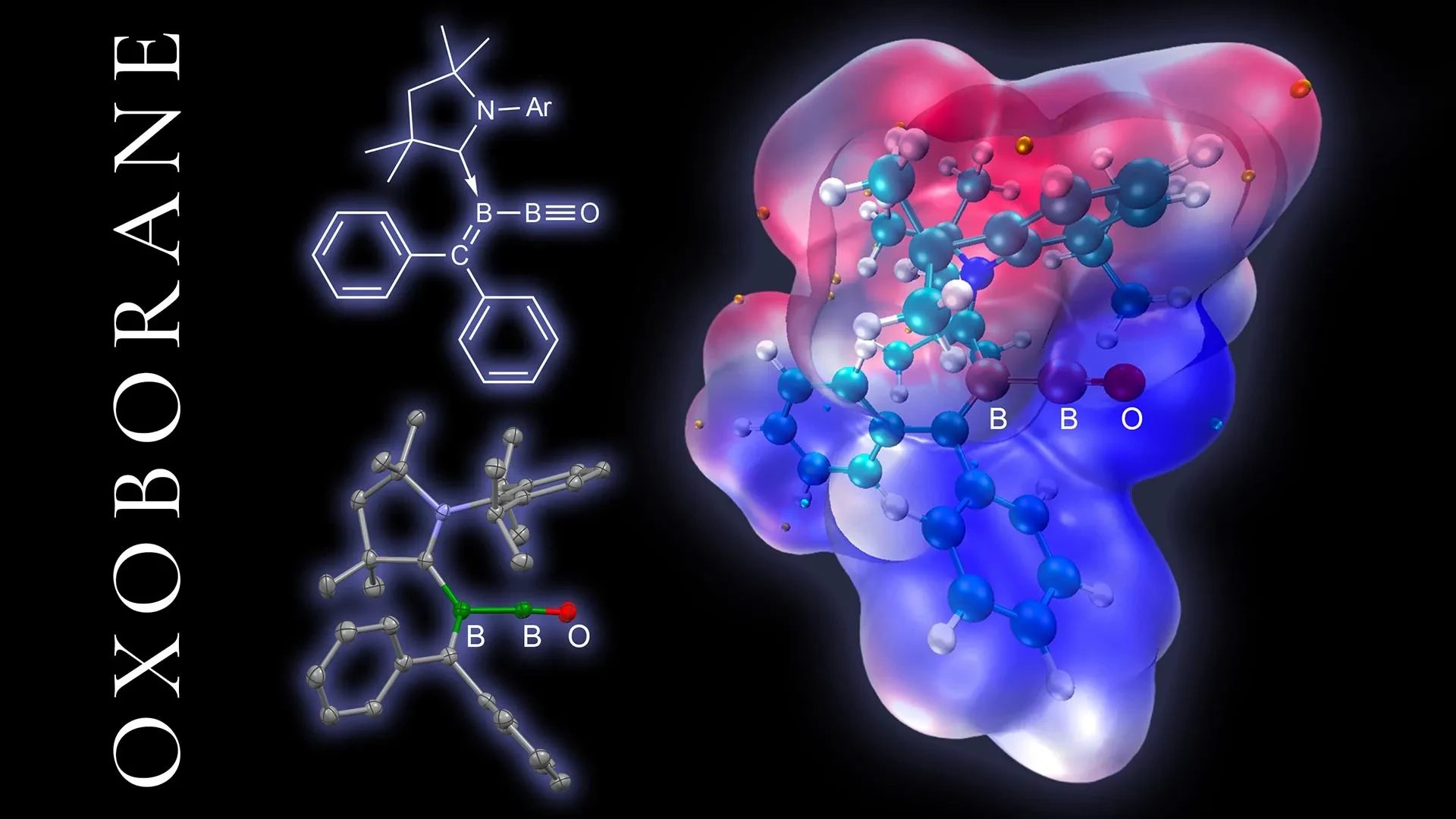
Executive Overview
For over six decades, the chemical sciences community chased a phantom: a stable, isolable oxoborane. These enigmatic molecules—characterized by a high-energy triple bond between a boron atom and an oxygen atom—long defied capture, deemed by generations of researchers to be structurally impossible to isolate under standard laboratory conditions. Because boron sits awkwardly in the periodic table, famously averse to forming the multiple bonds that carbon, nitrogen, and oxygen make routinely, these compounds were frequently dismissed as fleeting intermediates that would instantly decompose or polymerize.
That narrative changed in a German laboratory. In a landmark paper published in Nature Chemistry, researchers at the Julius-Maximilians-Universität Würzburg, spearheaded by Professor Holger Braunschweig, announced the successful production and isolation of stable oxoboranes. Backed by rigorous computational modeling from Professor Ashwini K. Phukan’s team at Tezpur University in India, the Würzburg group leveraged an unexpected laboratory observation to bypass sixty years of chemical frustration.
What began as a routine investigation into diboracumulene reactions by doctoral students Lukas Lubczyk and Christian Markl ended in a paradigm-shifting discovery. By utilizing relatively simple, commercially available starting materials, the team watched in astonishment as vibrant orange and yellow crystalline solids precipitated from their flasks—stable oxoboranes that could be structurally characterized and preserved.
This breakthrough does more than simply close the book on a six-decade-old academic puzzle; it shatters existing assumptions regarding chemical stability and molecular reactivity. By demonstrating that oxoboranes can be coaxed into stability without extreme cryogenic environments or exotic trapping agents, the Würzburg-Tezpur collaboration has unlocked a fresh synthetic toolkit. This development promises to ripple across inorganic and organic synthesis, offering chemists a reliable gateway to design previously inaccessible materials, catalysts, and molecular architectures.
Detailed Chronology: From the 1960s Impasse to the Würzburg Breakthrough
The Six-Decade Hunt for the Elusive Boron-Oxygen Triple Bond
The history of oxoboranes reads like a classic scientific odyssey characterized by persistent roadblocks, near-misses, and theoretical despair. The pursuit of molecules containing a boron-oxygen triple bond stretches back to the early 1960s, during an era of rapid expansion in main-group chemistry. As synthetic chemists began mapping out the interactions of the p-block elements in the first row of the periodic table—specifically boron, carbon, nitrogen, and oxygen—they quickly realized that boron played by entirely different rules.
While carbon readily forms double and triple bonds with oxygen (as seen in carbon monoxide), boron’s electron-deficient nature makes it a reluctant participant in multiple bonding. Throughout the subsequent decades, researchers across the globe attempted to synthesize oxoboranes. While these efforts occasionally yielded transient, highly reactive species that could be trapped in inert matrixes at cryogenic temperatures or detected via indirect spectroscopic signatures, isolating them in a bottle remained out of reach.
Over time, the scientific consensus hardened into resignation. Most inorganic and organic chemists concluded that the extreme polarity of the boron-oxygen bond, combined with boron’s Lewis acidity and oxygen’s strong basicity, would inevitably drive spontaneous oligomerization or decomposition. For all practical intents and purposes, the chemical community moved on, abandoning oxoboranes as a bridge too far.
Braunschweig’s Long Campaign Against Boron’s Limitations
While mainstream opinion gave up on oxoboranes, Professor Holger Braunschweig made overcoming boron’s bonding limitations his life’s work. For over fifteen years at the University of Würzburg, Braunschweig’s laboratory systematically chipped away at the dogma surrounding main-group multiple bonds.
The first major domino fell in 2012, when Braunschweig’s team accomplished what many textbooks claimed was impossible: they synthesized and isolated the first stable molecule featuring a boron-boron triple bond. This monumental feat proved that boron atoms could indeed share three pairs of electrons under the right electronic and steric scaffolding.
Thirteen years later, in 2025, the laboratory struck gold again. Braunschweig’s team reported the first neutral molecule featuring a stable triple bond between boron and carbon. These successive milestones demonstrated that boron’s bonding repertoire was far more flexible than previously understood, provided chemists could design the correct protective ligand environments to shield the reactive centers from self-destruction.
Yet, despite these triumphs, the final frontier of the first-row p-block remained unconquered: the boron-oxygen triple bond. The chemical world still lacked a stable organic oxoborane.
The Serendipitous Discovery in Würzburg
The definitive breakthrough did not arrive via a meticulously planned multi-step synthesis designed specifically to target oxoboranes. Instead, it was born out of serendipity—that vital catalyst in scientific discovery where prepared minds recognize the value of the unexpected.
Two doctoral researchers in Braunschweig’s group, Lukas Lubczyk and Christian Markl, were working independently on parallel projects. They were investigating the chemical behavior of a class of compounds known as diboracumulenes, exposing them to various ketones—ubiquitous, highly versatile organic solvents and reagents used extensively in chemical synthesis.
During these routine exploratory reactions, both students noticed a striking visual cue: the reaction mixtures were turning brilliant shades of orange and yellow, quickly precipitating as stable crystalline solids. In synthetic chemistry, sudden and pronounced color changes during reactions involving colorless or pale starting materials often signal the formation of unusual, highly conjugated, or electronically unique species.
Lukas Lubczyk recalled the moment of realization: "The discovery was a pleasant surprise. I never thought the diboracumulene would react the way it did, let alone with multiple different, simple substrates. And when Christian came to me with his compound, I knew we were onto something."
Upon analyzing the crystalline precipitates using advanced spectroscopic and crystallographic techniques, the researchers were stunned. The primary products of these reactions were not complex organic byproducts or standard addition compounds, but pristine, remarkably stable oxoboranes.
Professor Braunschweig summarized the team’s collective disbelief: "Nearly everybody in the field had given up on oxoboranes, as they were thought to be just too unstable to be isolated. So we were stunned to see them spontaneously form in these reactions and stick around long enough that we could study them."
Supporting Context & Metrics: Decoding the Chemistry
Understanding the Boron-Oxygen Triple Bond
To appreciate the magnitude of this achievement, one must examine the fundamental electronic properties of the molecules involved. A chemical triple bond consists of one sigma ($sigma$) bond and two pi ($pi$) bonds, representing an electron-dense region shared between two atomic nuclei.
In oxoboranes ($BO$), the atoms involved present a severe electronic mismatch:
- Boron is an electron-deficient metalloid with only three valence electrons, making it a strong Lewis acid that desperately seeks electron density.
- Oxygen is electronegative and electron-rich, holding six valence electrons and possessing high Lewis basicity.
When forced together in a triple-bond configuration, this combination creates an extremely polarized dipole. Traditionally, this immense electronic polarization causes the molecules to aggressively react with themselves or surrounding molecules, leading to rapid degradation into polymeric resins or small inorganic rings.
To achieve stability, the Würzburg team utilized diboracumulenes featuring carefully engineered bulky substituents (steric hindrance). These large surrounding molecular groups acted as a molecular shield, physically blocking neighboring molecules from attacking the vulnerable boron-oxygen reaction center while electronic stabilization prevented internal collapse.
Quantitative Scope and Yields
The success of the Würzburg method was not an isolated, one-off anomaly. By exploiting the reaction between diboracumulenes and tailored ketones, the researchers successfully synthesized and structurally characterized three distinct oxoborane derivatives.
- Reproducibility: The reactions proceeded cleanly at room temperature under mild conditions, bypassing the cryogenic traps (temperatures below $-100^circtextC$) that historical attempts required.
- Crystallinity: The resulting orange and yellow solids exhibited thermal stability sufficient for single-crystal X-ray diffraction—the gold standard for proving molecular structure. X-ray analysis definitively confirmed the short bond lengths characteristic of triple-bond character between the boron and oxygen atoms.
- Substrate Scope: The protocol demonstrated versatility across multiple ketone substrates, indicating that this is a general reaction pathway rather than an idiosyncratic quirk of a single specific chemical pairing.
Official Statements & Collaboration Dynamics
The successful isolation of oxoboranes was not merely a triumph of physical synthesis; it was a testament to modern international and interdisciplinary scientific collaboration. Experimental prowess in Germany was paired seamlessly with advanced theoretical modeling in India.
The Experimental Team: University of Würzburg
Professor Holger Braunschweig emphasized that the breakthrough was a collective victory for his research group, particularly highlighting the intuition and persistence of his doctoral students.
"For decades, the consensus in main-group chemistry was absolute: oxoboranes were theoretical curiosities, destined to remain out of reach of the reagent bottle. When Lukas and Christian brought me the data showing these stable orange and yellow crystals, it completely upended our assumptions. Science advances when young researchers have the freedom to explore unexpected observations without the bias of historical failures."
— Professor Holger Braunschweig, Chair of Inorganic Chemistry, University of Würzburg
Lukas Lubczyk, co-lead author of the experimental findings, reflected on the emotional trajectory of the discovery:
"When you run reactions day after day and encounter unexpected precipitates, the first instinct is often to troubleshoot what went wrong. But when the analytical data started rolling in, we realized that what went ‘wrong’ according to textbook chemistry was actually opening the door to a completely new chemical reality."
— Lukas Lubczyk, Doctoral Researcher and Co-lead Author
The Computational Powerhouse: Tezpur University
Synthesizing an unstable molecule is only half the battle; proving its electronic structure requires sophisticated theoretical backing. This is where Professor Ashwini K. Phukan’s research group at Tezpur University in India played an indispensable role. Utilizing advanced Density Functional Theory (DFT) calculations, the Indian team modeled the orbital interactions, bond energies, and charge distributions of the newly isolated oxoboranes.
"Understanding why these molecules do not instantly decompose required deep quantum chemical modeling. By mapping the frontier molecular orbitals of the diboracumulene-ketone reaction pathways, our computational work provided the theoretical framework explaining how the steric shielding and electronic distribution conspire to grant these elusive compounds their surprising stability."
— Professor Ashwini K. Phukan, Tezpur University
Funding and Institutional Support
The realization of this sixty-year quest was made possible through robust financial backing and institutional resources from international science agencies:
- The German Research Foundation (DFG): Provided core funding for equipment and personnel in Würzburg.
- The German Academic Exchange Service (DAAD): Facilitated international academic mobility and collaborative exchanges.
- The Department of Science & Technology (DST) of India: Supported the computational infrastructure and research personnel at Tezpur University.
Future Outlook: Opening New Frontiers in Molecular Science
The publication of this discovery in Nature Chemistry marks not an endpoint, but a beginning. With the 60-year oxoborane barrier officially broken, the chemical community stands on the precipice of a new era in main-group element engineering.
Expanding the Synthetic Toolbox
The immediate priority for Professor Braunschweig’s laboratory is exploring the broader scope of this synthetic methodology. Now that a reliable pathway to oxoboranes has been established using relatively simple starting materials, researchers are actively testing modifications to the starting diboracumulenes and ketone substrates.
By tuning the steric bulk and electronic properties of these precursors, the team aims to synthesize a comprehensive library of functionalized oxoboranes. These derivatives could exhibit unique optical, electronic, or catalytic behaviors that diverge sharply from traditional organic and inorganic compounds.
Beyond Boron and Oxygen: Targeting Other Elusive Bonds
Perhaps the most profound implication of the Würzburg breakthrough lies in its philosophical takeaway for chemical synthesis. The discovery demonstrates that long-standing chemical dogma—the belief that certain functional groups are inherently too unstable to isolate—can be systematically dismantled by combining creative exploratory synthesis with unexpected reaction pathways.
Energized by this success, the Würzburg-Tezpur partnership is already setting its sights on other missing entries in the periodic table’s multiple-bonding matrix. Researchers are asking whether similar stabilization strategies can be deployed to isolate other reactive, high-energy bonds involving p-block and d-block elements that have thus far eluded capture.
Potential Technological Applications
While oxoboranes currently reside in the domain of fundamental chemical research, molecules with extreme electronic polarization and unique multiple bonds frequently find transformative applications in materials science and catalysis.
- Advanced Catalysis: The high reactivity paired with structural stability makes main-group species exceptional candidates for activating small, inert molecules like carbon dioxide, nitrogen, or water.
- Optoelectronic Materials: Molecules featuring unusual coordination numbers and rigid, conjugated triple-bond frameworks often display fascinating photophysical properties, paving the way for novel dyes, sensors, or organic electronic components.
As the scientific community digests the implications of Braunschweig and Phukan’s collaborative triumph, one thing is abundantly clear: the periodic table still holds plenty of surprises, waiting for the right combination of curiosity, collaboration, and courage to bring them to light.
