

Executive Overview
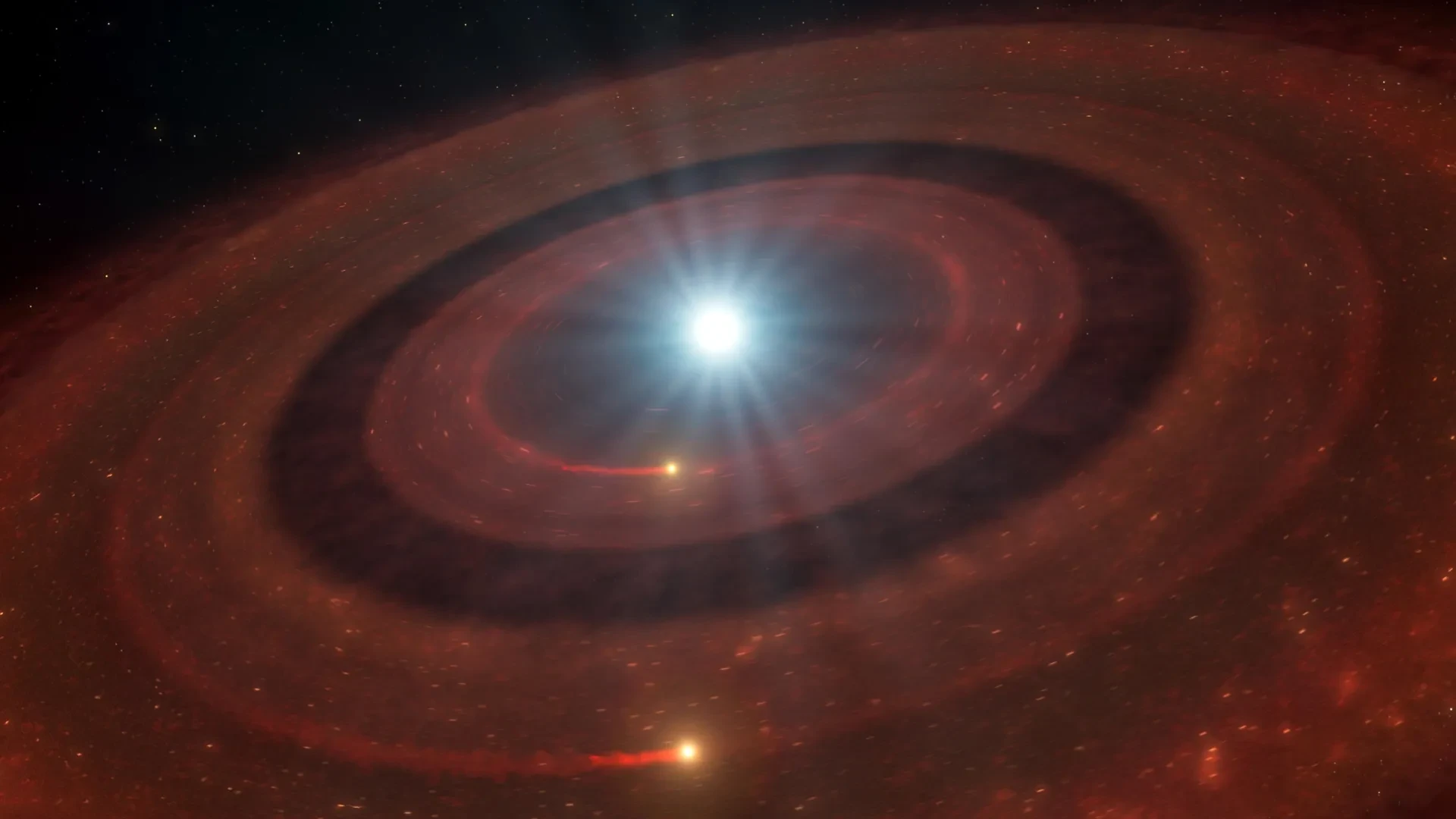
In a discovery that challenges current models of stellar evolution and planetary dynamics, an international team of astronomers has uncovered an extraordinary, highly structured system of planetary wreckage encircling a dead star. Utilizing the European Southern Observatory’s (ESO) Very Large Telescope (VLT) located in Chile’s Atacama Desert, researchers identified a rare double debris disc surrounding the white dwarf designated as J1328−1450.
Unlike previously observed stellar corpses—which typically feature a single, uniform ring of vaporized rocky material—this white dwarf plays host to two distinct, concentric rings of debris separated by a remarkably stable void. Scientists theorize that this enigmatic layout is not a cosmic coincidence, but rather the handiwork of surviving planetary bodies, or planetesimals, that somehow endured the catastrophic death of their host star. One of these unseen gravitational guardians is estimated to be comparable in scale to Pluto or even Earth’s Moon.
Published in the esteemed journal Nature Astronomy, these findings serve as a compelling cosmic preview of what may await our own solar system billions of years from now. As astronomers peer into the chaotic aftermath of star death, systems like J1328−1450 provide unprecedented empirical data on how rocky worlds are dismantled, how remnants are redistributed, and how planetary resilience might manifest in the twilight of stellar lifecycles.
Detailed Chronology and Discovery Methodology
The path to uncovering the complex architecture of J1328−1450 began with targeted observations utilizing some of the most advanced ground-based astronomical hardware currently in operation.
The Technological Catalyst: ESO’s VLT and X-Shooter
The breakthrough was achieved using the X-Shooter spectrograph, mounted on the European Southern Observatory’s Very Large Telescope. X-Shooter is a unique, highly versatile instrument designed to capture the entire spectrum of light—from ultraviolet, through the optical, and into the near-infrared wavelengths—in a single exposure.
When observing white dwarfs that are accreting planetary debris, astronomers look for specific spectroscopic signatures. As rocky material falls toward the dense stellar remnant, it vaporizes, generating characteristic emission and absorption lines that reveal the chemical composition of the infalling matter.
For years, white dwarf debris systems have presented a remarkably consistent observational fingerprint: a flat, continuous, rotating disc of gas and dust. However, when the research team processed the light signatures emanating from J1328−1450, the data deviated sharply from established models. The spectral lines indicated not a single, cohesive disc, but rather a dual-component emission profile—the distinct signature of two separate rings operating at different orbital radii.
Unraveling the Dual-Disc Architecture
Upon confirming the presence of two concentric rings, the research team immediately confronted a theoretical hurdle: in a frictionless vacuum subject to the immense gravitational and radiative forces of a white dwarf, how do two distinct discs of gas and dust maintain their separation over astronomical timescales? Without a confining mechanism, differential rotation and viscous spreading would naturally cause the inner and outer rings to smear together, forming a single continuous structure.
The persistence of the gap strongly implies the presence of an intervening dynamic force. The researchers modeled various scenarios and concluded that the most plausible explanation involves planetary bodies—surviving planetesimals—sweeping out orbital clean zones, much like shepherd moons maintain the divisions within Saturn’s ring system.
By analyzing the width of the gap and the dynamical stability of the system, the astronomers calculated that two distinct planetesimals are likely at work:
- The Inner Planetesimal: A diminutive body measuring only a few kilometers across, driving the structure of the inner ring.
- The Outer Planetesimal: A massive body potentially reaching the scale of Pluto or the Earth’s Moon, operating at a greater distance from the white dwarf to maintain the outer ring’s boundary.
Supporting Context & Metrics
To fully grasp the significance of the J1328−1450 discovery, it is essential to understand the life cycle of stars like our Sun, the nature of white dwarfs, and the geochemical signatures encoded within their surrounding debris.
Stellar Evolution: From Main Sequence to White Dwarf
Stars with initial masses ranging from roughly 0.8 to 8 times the mass of our Sun spend the vast majority of their lifespans on the "main sequence," fusing hydrogen into helium within their cores. Once that hydrogen fuel is exhausted, the star undergoes a dramatic transformation.
- The Red Giant Phase: The core contracts and heats up while the outer layers expand enormously, swelling out to swallow nearby planets and drastically altering the thermal environment of the entire planetary system.
- The Planetary Nebula Phase: Having exhausted its nuclear fuel entirely, the star gently ejects its outer envelope into space, creating a glowing shroud of gas known as a planetary nebula.
- The White Dwarf Stage: What remains is the exposed, degenerate core of the star—a white dwarf.
White dwarfs are astonishingly dense objects. Packing a mass roughly equivalent to that of our Sun into a volume comparable to that of Earth, a teaspoon of white dwarf material would weigh as much as an elephant on Earth. Their immense surface gravity creates extreme physical conditions, causing heavy elements like calcium, iron, and magnesium to sink rapidly out of the atmosphere. Therefore, any heavy elements detected in the spectrum of a white dwarf must have arrived recently—polluted by ongoing accretion from external planetary debris.
Geochemical Fingerprints and Planetary Autopsies
The analysis of J1328−1450 yielded vital chemical clues regarding the nature of the destroyed worlds. Through spectroscopic analysis, researchers identified four key rock-forming elements within the rings:
- Calcium (Ca)
- Oxygen (O)
- Magnesium (Mg)
- Iron (Fe)
The presence of these specific elements confirms beyond doubt that the rings are composed of rocky, terrestrial planetary material rather than primordial gas leftover from the star’s birth.
Most intriguingly, a profound chemical asymmetry exists between the two rings. The inner ring is heavily saturated with magnesium gas, whereas the outer ring is notably depleted of it. This chemical bifurcation points toward two distinct scenarios:
- Multiple Destroyed Worlds: The rings may represent the remains of two completely separate planets that possessed different initial bulk compositions, perhaps formed at different distances from the original star.
- Differentiated Planetary Layers: The debris could originate from a single, massive differentiated planet—a world that had separated into layers over time, with a heavy metallic core and a silicate mantle. In this scenario, one ring might preserve material from the planet’s outer crust, while the other contains deeper interior components.
Official Statements from the Research Team
The complexity and rarity of the J1328−1450 system have elicited profound reactions from the astronomical community, underscoring a shift in how scientists view the afterlife of planetary systems.
Nicola Gentile Fusillo, an astronomer at the Università degli Studi di Trieste in Italy, lead author of the study, and an affiliate of the INAF-Astronomical Observatory of Trieste, emphasized the unprecedented nature of the discovery:
"We have known for some time that planets may survive beyond the transformation of their central star, but this is the first example of a complex system with a double debris disc and potentially two surviving planetesimals."
Elaborating on the chaotic processes at play, Gentile Fusillo added:
"The system is a rare glimpse of the violent, chaotic process by which a planetary system meets its end, and it hints that dead stars can have disc structures far more complex than previously realized."
Co-author Felipe Lagos-Vilches, an astronomer at the University of Warwick in the UK and the Universidad Técnica Federico Santa María in Chile, underscored the stability of the system against theoretical expectations:
"The structure we see in this system is particularly intriguing because the two gaseous rings are remarkably stable and remain separated by a gap."
Reflecting on the broad philosophical and scientific implications of the research regarding the fate of planetary architectures across the cosmos, Lagos-Vilches concluded:
"The system therefore offers a remarkable glimpse of what the future of planetary systems, including systems like our own, might look like."
Future Outlook: Implications for Our Solar System
For centuries, humanity has pondered the ultimate destiny of Earth and its celestial neighbors. While standard astrophysical models have long predicted that our Sun will expand into a red giant in roughly 5 billion years—vaporizing the inner planets including Mercury and Venus, and likely rendering Earth a charred, uninhabitable rock—the long-term fate of the outer solar system remained less certain.
Discoveries like J1328−1450 breathe empirical life into theoretical models of planetary survival. They demonstrate that the gravitational architectures of planetary systems do not simply vanish when their host stars die. Instead, gravitational interactions can persist, scattering asteroids, comets, and even larger planetesimals into new orbits where they are slowly ground down, consumed, and preserved in the chemical signatures of white dwarf atmospheres.
The Next Frontier in Stellar Archaeology
As observational technology continues to advance, astronomers are gearing up for the next generation of telescopes—such as the Extremely Large Telescope (ELT) currently under construction in Chile—which will possess the light-gathering power to resolve circumstellar environments with even greater fidelity.
By continuing to survey white dwarfs for anomalous debris signatures, researchers hope to determine whether systems like J1328−1450 are rare cosmic anomalies or common milestones in the evolutionary pathway of planetary systems throughout the Milky Way. Each dead star studied acts as a forensic site, allowing astronomers to piece together the life, death, and enduring legacy of distant worlds—and, by extension, providing a sobering, fascinating mirror through which to view our own deep-time future.
