

Executive Overview
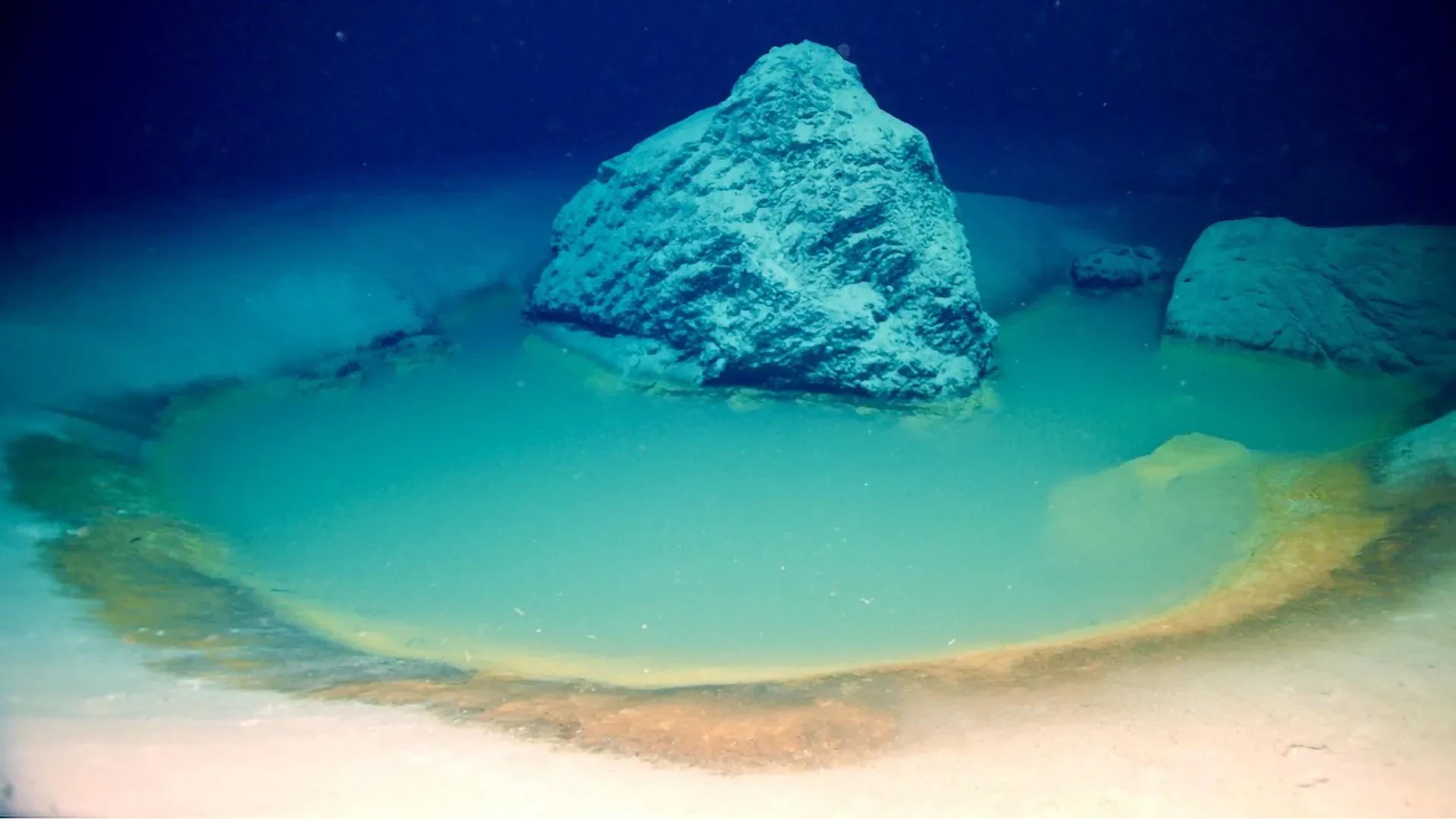
In the crushing, pitch-black abyss more than a mile beneath the surface of the Red Sea, a team of international marine scientists has struck a scientific goldmine. Utilizing cutting-edge robotic submersibles launched from the advanced research vessel OceanXplorer, researchers from the University of Miami (UM) Rosenstiel School of Marine and Atmospheric Science, in collaboration with OceanX, have discovered a series of rare, oxygen-free deep-sea brine pools in the Gulf of Aqaba.
These hyper-saline underwater lakes—dubbed the NEOM Brine Pools—represent the first documented discovery of their kind in this northern extension of the Red Sea. Far from being lifeless water traps, these extreme aquatic environments harbor thriving, dense communities of extremophilic microorganisms. These resilient microbes not only offer profound insights into the physiological limits of life on Earth, but they also serve as terrestrial analogs for the hostile conditions likely found on other celestial bodies in our solar system and beyond.
Beyond their immense astrobiological value, these subterranean basins function as ultra-sensitive natural archives. Because the brine pools are completely devoid of oxygen and possess unusual chemical compositions, organic matter and geological sediments settling to the bottom remain remarkably well-preserved. Consequently, the pools act as historical tape recorders, capturing millennia of tectonic upheavals, catastrophic tsunamis, flash floods, and undersea landslides that have shaped the Arabian Peninsula.
Published in the journal Communications Earth & Environment, this landmark discovery carries profound implications not only for astrobiology and Earth history, but also for modern coastal hazard mitigation. As nations bordering the Red Sea—particularly Egypt and Saudi Arabia—rapidly expand their coastal infrastructure and mega-developments, the historical hazard data locked within these brine pools provides vital intelligence for safeguarding human lives and billions of dollars in real estate against future marine catastrophes.
Detailed Chronology
The Expedition and the Final-Hour Breakthrough
The journey to this groundbreaking discovery began as part of a rigorous, multi-week oceanographic expedition aboard the OceanXplorer, a state-of-the-art research vessel designed to probe the most remote and inaccessible marine environments on Earth. Funded by the Saudi Arabian coastal development organization NEOM, the four-week mission brought together a multidisciplinary team of marine geoscientists, microbiologists, and ocean engineers.
At the helm of the scientific team was Sam J. Purkis, professor and chair of the Department of Marine Geosciences at the UM Rosenstiel School. Armed with advanced sonar mapping systems and high-resolution imaging technology, Purkis and his colleagues set out to meticulously survey the seabed of the Gulf of Aqaba, a narrow, tectonically active basin bordered by the Sinai Peninsula to the west and the Arabian Peninsula to the east.
At a depth of approximately 1,770 meters (over 5,800 feet) below the surface, the expedition deployed a remotely operated underwater vehicle (ROV) to investigate acoustic anomalies detected on the seafloor. Operating a submersible at such crushing depths requires immense precision, as hydraulic pressures reach hundreds of atmospheres and bottom currents can dramatically complicate navigation.
As the expedition’s timeline drew to a close, the team faced mounting pressure. The operational window allocated for ROV exploration of this specific target was rapidly evaporating. In deep-sea research, every hour of submersible time represents tens of thousands of dollars in operational costs, and mission schedules are unforgiving.
"We were very lucky," recalled lead researcher Sam Purkis. "The discovery came in the last five minutes of the ten-hour ROV dive that we could dedicate to this project."
Just as mission controllers were preparing to recall the robotic vehicle to the surface, the ROV’s high-intensity floodlights pierced the murky abyss to reveal a stunning geological formation: a distinct, liquid basin resting entirely separated from the surrounding marine waters. The brine pool, possessing a distinct density gradient and shimmering boundary layer, lay undisturbed in the crushing darkness. This eleventh-hour revelation transformed a routine oceanographic survey into a historic scientific breakthrough.
Confirmation, Sampling, and Analysis
Following the initial visual confirmation, the research team immediately adjusted their protocols to extract samples from the newly discovered basin. Navigating the ROV carefully across the sharp density boundary where normal seawater met the heavy, highly concentrated brine, the team collected water samples, sediment cores, and microbial mat specimens from the basin floor.
Back on board the OceanXplorer, an onboard laboratory allowed researchers to immediately begin analyzing the physical and chemical properties of the brine. Subsequent laboratory analysis confirmed that the water within the NEOM Brine Pools exhibited salt concentrations many times higher than normal seawater—levels so extreme that fish, marine mammals, and most conventional aquatic life cannot survive within them.
Furthermore, exhaustive chemical assays revealed that the pools are entirely devoid of dissolved oxygen. Despite these punishing conditions, biological assays confirmed the presence of a rich, highly specialized ecosystem of microbes that have evolved unique metabolic pathways to exploit the chemical energy radiating from the seafloor.
Supporting Context & Metrics
The Science of Brine Pools
To understand the significance of the NEOM discovery, one must examine the physics and chemistry of brine pools. These bodies of water are essentially subterranean or deep-sea lakes of hyper-saline water. They form when geological processes—such as the dissolution of ancient salt deposits (evaporites) left behind by evaporating prehistoric seas—infuse trapped groundwater or seawater with massive quantities of dissolved minerals.
Because brine is significantly denser than regular seawater, it does not easily mix with the overlying ocean water. Instead, it pools in depressions, troughs, and fault-bounded basins along the seafloor, creating a distinct, stratified water column. A sharp halocline and pycnocline form at the boundary layer, acting almost like the surface of a liquid where the brine meets the open sea.
Globally, deep-sea brine pools are exceedingly rare. Prior to this discovery, scientists had identified brine pools in only a handful of locations worldwide, including the Mediterranean Sea, the Gulf of Mexico, and a few isolated basins elsewhere in the central Red Sea. The Gulf of Aqaba, characterized by intense tectonic activity and steep submarine topography, was previously thought to lack the stable depression geometry required to retain such pools over geological timescales.
Astrobiological Significance: Hunting for Life in the Cosmos
The discovery of complex microbial life thriving in the toxic, oxygen-free brine pools of the Red Sea carries profound implications for the search for extraterrestrial life. Astrobiologists have long sought to understand the absolute boundaries of habitability—the physical and chemical thresholds beyond which biological organisms simply cannot exist.
+-------------------------------------------------------------------+
|               ASTROBIOLOGICAL ANALOGY FRAMEWORK                   |
+----------------------------+--------------------------------------+
| Terrestrial Environment    | Extraterrestrial Target Analogs      |
| (NEOM Brine Pools)         | (Solar System & Beyond)              |
+----------------------------+--------------------------------------+
| High Salinity (Hyper-salt) | Europa (Subsurface subsurface oceans)|
| Complete Anoxia (No Oxygen)| Enceladus (Hydrothermal vent systems)|
| High Hydrostatic Pressure  | Mars (Subsurface brine pockets)      |
| Extreme Chemical Toxins    | Exoplanetary ocean worlds            |
+----------------------------+--------------------------------------+
By cataloging the metabolic mechanisms of extremophiles—microorganisms that thrive under physical or geochemical extremes—scientists gain a conceptual roadmap for identifying life in alien environments. Worlds such as Jupiter’s moon Europa and Saturn’s moon Enceladus harbor vast subsurface oceans capped by thick ice sheets, potentially featuring high-salinity hydrothermal environments analogous to Earth’s deep-sea brine basins.
Furthermore, previous microbiological investigations into Red Sea brine pools have yielded remarkable biotechnological discoveries, including biologically active molecules and enzymes demonstrating potent anticancer properties. The newly discovered NEOM Brine Pools will undoubtedly become a focal point for bioprospecting, as researchers search for novel pharmaceutical compounds capable of withstanding extreme physiological stresses.
Geological Archives: Tsunamis, Earthquakes, and Tectonic History
Beyond their biological utility, the NEOM Brine Pools serve as irreplaceable natural archives of regional geological history. The Gulf of Aqaba is situated along the Dead Sea Transform fault system, a major active tectonic boundary where the Arabian Plate is sliding northward relative to the Sinai Peninsula. This tectonic engine constantly fractures the seabed, generating frequent earthquakes and associated marine geohazards.
Because the brine pools are intensely salty and entirely devoid of oxygen, they lack the bioturbating organisms—such as bottom-feeding worms, crustaceans, and fish—that typically churn up and destroy sediment layers in standard marine environments. As a result, particulate matter, volcanic ash, terrestrial runoff, and storm debris that settle into the pools are deposited in undisturbed, highly resolved chronological strata.
These undisturbed sediment cores provide an extraordinarily clear record of paleo-events. Earlier in 2022, Purkis and his team utilized sediment analysis from the region to uncover definitive evidence of a massive 500-year-old underwater landslide that triggered a devastating local tsunami. By analyzing the sediment cores recovered from the newly discovered brine pools, researchers can push this historical timeline back thousands of years, mapping the frequency, magnitude, and recurrence intervals of seismic and tsunami events in the Gulf of Aqaba.
Official Statements
The significance of the discovery was underscored by statements from key researchers and institutional leaders involved in the expedition.
Sam J. Purkis, Professor and Chair of the Department of Marine Geosciences, UM Rosenstiel School:
"Until we understand the limits of life on Earth, it will be difficult to determine if alien planets can host any living beings. Our discovery of a rich community of microbes that survive in extreme environments can help trace the limits of life on Earth and can be applied to the search for life elsewhere in our solar system and beyond."
Mattie Rodrigue, Science Director at OceanX:
"Working aboard the OceanXplorer allows us to take science where it has never gone before. The discovery of the NEOM Brine Pools highlights the power of combining advanced submersible technology with world-class academic expertise to unlock the deepest secrets of our planet."
Ameer Abdulla, Representative from NEOM:
"Our partnership with OceanX and the University of Miami reflects NEOM’s deep commitment to scientific exploration and environmental stewardship. Understanding the complex geology and unique ecosystems of the Red Sea is essential as we pioneer sustainable coastal development along the Saudi Arabian shoreline."
Future Outlook
Implications for Coastal Development and Regional Safety
As the nations bordering the Red Sea embark on massive coastal infrastructure projects—most notably NEOM’s ambitious futuristic city developments in northwestern Saudi Arabia—understanding regional geological hazards has transitioned from an academic pursuit to an urgent commercial and humanitarian necessity.
The historical data retrieved from the sediment layers of the NEOM Brine Pools will directly inform engineering standards for coastal real estate, desalination plants, ports, and tourism hubs along the Red Sea. By quantifying the recurrence intervals of tsunamis and submarine landslides driven by the Dead Sea Transform fault, civil engineers can design resilient structures capable of withstanding extreme seismic events.
Next Steps in Deep-Sea Exploration
Following the publication of their findings in Communications Earth & Environment, the research consortium is already planning subsequent expeditions. Future research objectives include:
- Genomic Sequencing: Conducting deep metagenomic sequencing on the microbial mats retrieved from the NEOM Brine Pools to map their complete metabolic pathways and identify potential novel antibiotics and anticancer compounds.
- High-Resolution Mapping: Deploying autonomous underwater vehicles (AUVs) to map the broader bathymetry of the Gulf of Aqaba in search of additional, undiscovered brine basins.
- Long-Term Monitoring: Installing persistent oceanographic sensors near the brine pool interfaces to monitor real-time shifts in temperature, salinity, and tectonic micro-seismicity.
The discovery of the NEOM Brine Pools serves as a humbling reminder that planet Earth still harbors wild, unexplored frontiers. By looking into the darkest, most inhospitable corners of our own oceans, humanity continues to unlock the deep history of our world while casting a hopeful gaze toward the stars.
Research Team Roster
The landmark study, titled "Discovery of the deep-sea NEOM Brine Pools in the Gulf of Aqaba, Red Sea," published on June 27, 2022, in Communications Earth & Environment, was made possible through the collaborative efforts of the following researchers and institutions:
- Sam J. Purkis, Hannah Shernisky, Peter K. Swart, Arash Sharifi, Amanda Oehlert, Gaëlle Duchêtellier, James Klaus, Gregor P. Eberli, Larry Peterson, Graham Kolodziej – University of Miami Rosenstiel School of Marine and Atmospheric Science.
- Fabio Marchese, Francesca Benzoni – King Abdullah University of Science and Technology (KAUST) Red Sea Research Center, Saudi Arabia.
- Giovanni Chimienti – University of Bari Aldo Moro, Italy.
- Andrew Craig, Mattie Rodrigue – OceanX.
- Jürgen Titschack – MARUM – Center for Marine Environmental Sciences, Germany.
- Ameer Abdulla – NEOM, Saudi Arabia.
Funding and logistical support for the expedition were provided by NEOM. For an in-depth visual documentary of the discovery, viewers can watch the NEOM OceanX feature available on YouTube at https://youtu.be/bWNftnYDx9c.
