For digital marketers, search engine optimization (SEO) professionals, and enterprise strategists, keyword research remains the bedrock of successful online visibility. Yet, navigating the modern software landscape can feel like a fool’s errand. A quick search engine query for "best keyword research tools" reveals hundreds of bloated listicles, often citing anywhere from 10 to 100 different applications.
Instead of adding to the noise, a definitive study was conducted by directly surveying 139 search marketing experts, asking them one straightforward, high-stakes question:
"If you could only use 3 tools for keyword research, which 3 would you choose?"
By circumventing generalized software roundups and going straight to the source—practitioners managing massive international brands, boutique agencies, and high-growth affiliate portfolios—a clear consensus emerged. Rather than requiring dozens of fragmented platforms, the industry’s top operators rely on a tightly curated core stack.
This comprehensive report breaks down the leaderboard, analyzes the standout features of the market leaders, and distills the collective wisdom of 139 industry veterans to help you build profitable, high-converting organic and paid campaigns.
Detailed Chronology: The Evolution of Keyword Discovery
Keyword research has undergone a seismic shift over the past decade. What began as a simple exercise in identifying exact-match, high-volume vanity terms has evolved into a sophisticated discipline centered around semantic context, search intent, and topical authority.
As search engines like Google evolved through major algorithmic updates (such as Hummingbird, BERT, and MUM), keyword tools had to adapt. Early strategies relied heavily on free platforms like the Google Keyword Planner to blindly scoop up high-volume terms. However, as Google restricted granular search volume data for non-advertisers and introduced the dreaded "not provided" keyword data in analytics, third-party software developers stepped in to fill the void.
During the mid-2010s, tools like Ubersuggest, KeywordTool.io, and LongTail Pro gained prominence by leveraging autocomplete and long-tail scraping. Soon after, all-in-one SEO suites—most notably Semrush and Ahrefs—disrupted the market by offering massive, proprietary keyword databases, advanced backlink integration, and sophisticated competitive intelligence dashboards.
Today, modern SEO relies less on isolated keywords and more on topic clusters, entity mapping, and search intent alignment. The expert consensus surveyed in this report reflects this evolution, highlighting a clear migration toward comprehensive platforms capable of reverse-engineering competitor strategies at scale.
Supporting Context & Metrics: The Expert Leaderboard
When the votes from all 139 participating search marketing experts were tallied, three heavyweights dominated the leaderboard, establishing themselves as the undisputed gold standards of the SEO industry:
Semrush: 87 Votes
Google Keyword Planner: 57 Votes
Ahrefs Keywords Explorer: 55 Votes
1. Semrush (87 Votes)
Semrush captured the top spot as the most-voted keyword research tool among the surveyed experts. Recognized as an industry-leading all-in-one SEO and PPC suite, Semrush boasts one of the largest keyword databases globally, spanning over 23 billion keywords across 142 international databases.
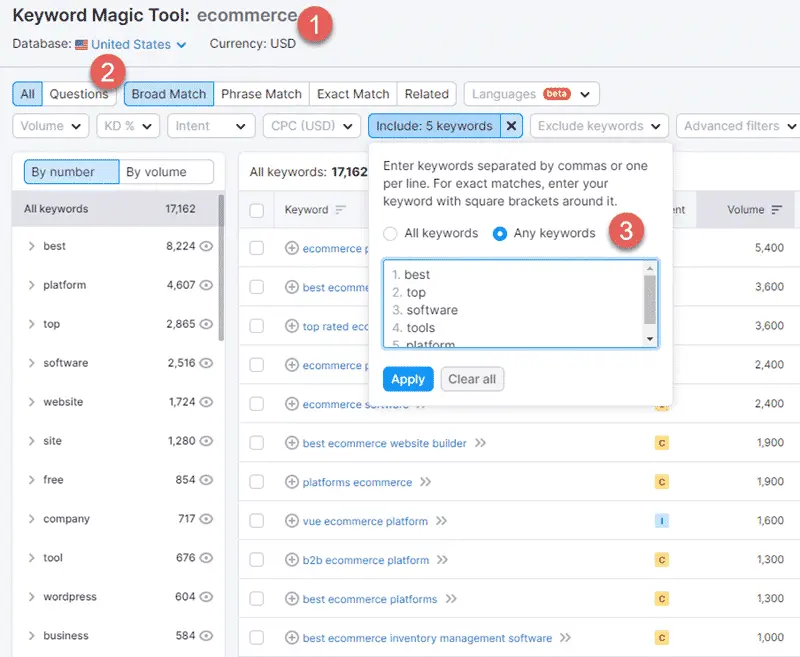
The Keyword Magic Tool: Highly praised for its ability to group keywords by topic, search intent, question type, and SERP features. Users can effortlessly push filtered keywords directly into position trackers or PPC campaigns.
The Keyword Gap Tool: A favorite among enterprise SEOs, this feature allows side-by-side keyword comparisons of up to five competitors, identifying high-value keyword intersections and missed traffic opportunities.
2. Google Keyword Planner (57 Votes)
As the native platform provided by Google, the Keyword Planner remains a staple, though opinions on its utility are heavily nuanced. While it serves as a reliable baseline for relative traffic data and PPC campaign planning, experts note its limitations for pure organic SEO.
The Catch: Unrestricted, exact search volume data is now primarily reserved for active Google Ads accounts, while non-advertisers receive broad ranges. Furthermore, its grouping mechanisms often lump semantically distinct terms together, requiring careful manual auditing.
3. Ahrefs Keywords Explorer (55 Votes)
Trailing Semrush by a razor-thin margin, Ahrefs stands out for its robust data integrity and deep backlink integration.
The Keyword Ideas Report: Similar to Semrush’s counterpart, Ahrefs allows users to input seed terms and generate thousands of suggestions across Google, Bing, YouTube, Amazon, and Yahoo.
SERP Overview & Position History: Experts repeatedly highlighted Ahrefs for its ability to analyze historical ranking fluctuations and evaluate the true traffic potential of a query based on the backlink profiles of top-ranking competitors.
Official Statements: Perspectives from the Trenches
To understand how top professionals leverage these tools in day-to-day operations, we turn directly to the insights shared by a cross-section of the 139 contributing experts.
Luke Monaghan (International SEO Manager at Lululemon)
"If I had to choose three keyword research tools that I use the most regularly, I’d have to choose Semrush—hands down for competitive insight… SISTRIX for identifying historical keyword performance… and Keywordtool.io for more long-tail variants. SEO has moved on from just targeting an exact-match, vanity keyword; you’ve got to build long-tail context around such terms."
Geoff Kenyon (Founder at GeoffKenyon.com)
Emphasizing workflow integration, Kenyon highlights a distinct operational stack:
"The three tools that I use most frequently are KeywordTool.io, SEMrush, and Excel. KeywordTool.io is great for discovering variations… Semrush is great for competitive keyword research, digging into both organic and paid bidding strategies… And Excel serves to create actionable keyword mapping and geographic region permutations using concatenate formulas."
John Doherty (Founder at Credo)
Doherty breaks his toolkit down by specific tactical functions:
"Ahrefs, Semrush, and Answer The Public. Ahrefs is killer for topic research, Semrush provides domain-level analysis for competitors, and Answer The Public nails question-based keyword research."
Paul Shapiro (Technical SEO Lead at Shopify)
Shapiro pushes beyond the conventional toolset to advocate for advanced semantic analysis:
"Instead of focusing on the 3 tools that everyone needs… I’ll give you my top 3 tools that you need to go above-and-beyond: KNIME for open-ended semantic keyword analysis, MarketMuse for sophisticated topic modeling and content gap identification, and Seed Keywords to bring a human element into how consumers actually search."
Brendan Hufford (Growth Content Marketer at ActiveCampaign)
Hufford underscores the critical importance of search intent over raw keyword metrics:
"If I only had 3 keyword research tools, I’d use tools that focus more on topical research and search intent instead of ‘keywords.’ Simply putting keywords in the right places won’t help you rank if you don’t match the search intent. I use Ahrefs to reverse-engineer consistent ranking content, paired with my brain to analyze search intent levels."
Future Outlook: Where Keyword Research is Heading
As we look toward the future of search marketing, the definition of a "keyword research tool" continues to blur. Several key trends highlighted by the expert panel point toward what is next for the industry:
AI-Driven Content Clustering and Natural Language Processing (NLP): Tools like Keyword Insights and MarketMuse are pioneering automated content grouping, leveraging machine learning to dictate whether a set of keywords can be targeted on a single page or must be fractured into an entire content cluster.
The Rise of Zero-Click Searches and Entity SEO: With search engines increasingly answering queries directly within the SERPs via featured snippets, knowledge graphs, and AI-generated overviews, professionals are focusing less on raw volume and more on capturing featured snippets, "People Also Ask" (PAA) boxes, and semantic entities.
First-Party Data Integration: A recurring theme among veteran SEOs—such as Carrie Hill and Kurt Frankenberg—is that software should never replace direct customer communication. Interviewing client service teams, reviewing customer support logs, and mining internal search data often uncovers the most authentic, high-converting language long before it appears in third-party databases.
That’s a Wrap!
The debate over the optimal SEO stack will undoubtedly evolve, but the core lesson from 139 of the industry’s brightest minds remains clear: Success doesn’t come from owning dozens of subscriptions; it comes from mastering a tight, synergistic core stack that balances competitive intelligence, search volume data, and user intent.
Special thanks to all 139 search marketing experts who contributed their time and insights to this definitive guide.