

Executive Overview
The streets of New York City have once again become the epicenter of a high-stakes collision between federal immigration enforcement and local governance. A targeted Immigration and Customs Enforcement (ICE) operation in the Marble Hill neighborhood of the Bronx descended into violence when an federal agent fired seven rounds into a vehicle, striking 28-year-old Oscar Belgal in the neck. Compounding the gravity of the incident, Belgal’s 5-year-old son was seated inside the automobile at the time of the shooting.
Newly released NYPD body-camera footage, alongside surrounding surveillance videos, has brought national scrutiny to the tactical methods employed by federal operatives in densely populated residential areas. The shooting has triggered rapid political fallout, drawing fierce condemnation from New York City Mayor Zohran Mamdani—who renewed his calls to abolish the federal agency—and demands for a rigorous, independent inquiry from New York Attorney General Letitia James.
While federal authorities defend the operation by citing Belgal’s criminal history and alleged gang affiliations, local leaders, legal advocates, and civil rights organizations view the incident as a reckless endangerment of civilians. As Belgal recovers under heavy guard and federal judges intervene to halt his immediate deportation, the tragedy has catalyzed mass demonstrations, exposing deep-seated rifts over immigration enforcement policies, local sanctuary laws, and the use of lethal force in urban communities.
Detailed Chronology of Events
The Operation in Marble Hill
The sequence of events began on the afternoon of October 8, 2026, at approximately 4:00 PM Eastern Time. Federal operatives from ICE initiated a targeted enforcement action in Marble Hill, a residential neighborhood situated at the northernmost tip of Manhattan, though historically tied to Bronx postal and community infrastructure.
According to federal incident reports, agents converged upon Oscar Belgal, a 28-year-old Dominican national. At the time of the approach, Belgal was inside his vehicle, accompanied by his 5-year-old son. Plainclothes armed agents surrounded the automobile, setting off a chaotic sequence of events that rapidly escalated from an arrest attempt into a shooting.
Surveillance footage captured the initial moments of the approach, showing armed operatives closing in on Belgal’s vehicle. Within moments, an ICE officer discharged their weapon multiple times. NYPD Commissioner Jessica Tisch later confirmed that at least one federal agent fired a total of seven rounds into the vehicle. One of the bullets struck Belgal in the neck, leaving him severely wounded. Remarkably, the 5-year-old child inside the vehicle was physically unhurt, though he bore witness to the immediate aftermath of the violence.
NYPD Response and Immediate Aftermath
Moments after the gunfire ceased, the New York City Police Department rushed to the scene following emergency calls reporting shots fired in a residential zone. Newly released NYPD body-camera footage provides a stark visual record of the chaotic scene that greeted responding local officers.
Upon arrival, NYPD personnel discovered Belgal wounded, handcuffed, and seated on the ground. Recognizing the severity of his injuries, local officers immediately rendered first aid and transported him in a police vehicle to a local hospital for emergency trauma care. While medical personnel worked to stabilize Belgal—who doctors noted still had a bullet lodged in his body following initial procedures—NYPD officers successfully located the victim’s young son, safeguarding the child and quickly reuniting him with a concerned family member.
Legal Maneuvers and Hospital Transfers
As Belgal fought for his life in a hospital bed, the legal landscape surrounding his case began to shift rapidly. Attorneys representing Belgal revealed that federal authorities attempted to transfer him out of state to a facility in New Jersey shortly after the shooting, a move widely interpreted by defense counsel as an effort to evade local accountability and judicial oversight.
Swift intervention by local legal advocates successfully thwarted the immediate transfer. A federal judge stepped in, issuing orders that formally restricted Belgal’s relocation and temporarily blocked any attempts by immigration authorities to deport him while ongoing investigations and legal challenges proceed. Following these judicial orders, Belgal was returned to federal custody within the state of New York, specifically housed in a secure Brooklyn facility while recovering under medical supervision.
Supporting Context & Metrics
The Political and Demographic Landscape of Marble Hill
To understand the intensity of the public reaction, one must examine the specific socio-political environment of Marble Hill and the broader five boroughs. New York City operates under stringent "sanctuary city" protections, which limit local law enforcement cooperation with federal immigration agencies unless judicial warrants are presented for violent offenses.
Marble Hill, characterized by dense residential apartment complexes, busy pedestrian walkways, and family-oriented neighborhoods, provided a volatile backdrop for a high-intensity armed raid. The presence of children and bystanders during broad-daylight enforcement actions has long been a flashpoint for community advocates, who argue that aggressive tactics by federal agents jeopardize civilian safety far beyond the intended targets.
Escalation of Protests
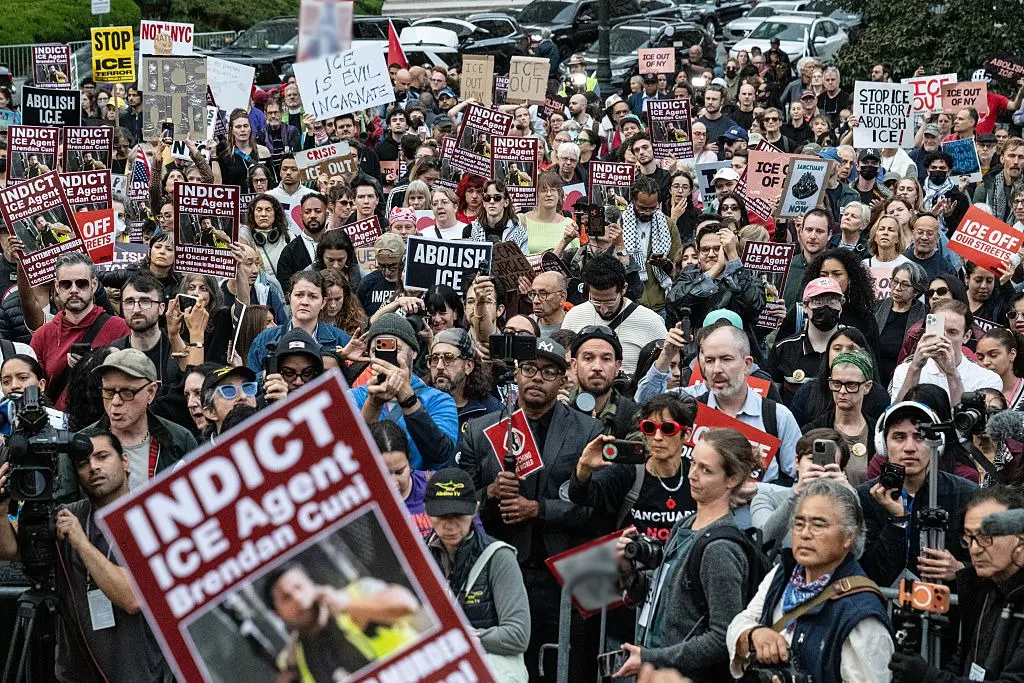
The shooting served as a catalyst for immediate, widespread mobilization. Within 48 hours of the incident, civil rights groups, immigrant advocacy coalitions, and concerned citizens organized demonstrations across Manhattan.
The protests culminated in a high-visibility march originating at Foley Square and moving toward federal immigration offices in downtown Manhattan. Demonstrators chanted slogans demanding systemic reform, greater transparency from federal agencies, and an end to aggressive urban enforcement sweeps. Placards bearing messages against ICE operations and calling for the protection of mixed-status families underscored the deep public anxiety and anger generated by the Marble Hill incident.
Official Statements and Divergent Narratives
The incident has highlighted an ideological and jurisdictional chasm between federal law enforcement agencies and local municipal leadership, with each side presenting sharply contrasting narratives of the event.
The Federal Position: ICE’s Account
U.S. Immigration and Customs Enforcement mounted a robust defense of its tactical operation, releasing a detailed public statement framing the shooting as an unavoidable outcome driven by the suspect’s actions and the constraints imposed by local sanctuary policies.
According to ICE, the operation targeted a "criminal illegal alien from the Dominican Republic" with a documented criminal history. The agency asserted that Belgal possessed a prior conviction for grand larceny, alongside multiple prior arrests relating to assault, robbery, drug possession, and weapons possession. Furthermore, federal officials alleged that Belgal maintained associations with the Trinitarios street gang—the same criminal enterprise linked to the severe shooting of a Customs and Border Protection (CBP) officer the previous year.
ICE’s official statement explicitly linked the dangerous nature of the arrest to local governance:
"During the incident, an ICE officer discharged his weapon and the criminal illegal alien was injured… When dangerous illegal aliens are released back onto the streets by radical sanctuary politicians, our officers are forced to make arrests at large in the community in unpredictable and dangerous environments. Our officers should not have to risk their lives, and innocent Americans should not have to face unnecessary danger, because sanctuary politicians refuse to cooperate with federal law enforcement."
Federal officials claimed that during the attempted apprehension, Belgal accelerated his vehicle directly toward federal agents, creating an immediate, life-threatening scenario that justified the use of lethal force.
The Local Leadership Response: Mayor Mamdani and State Officials
New York City Mayor Zohran Mamdani rejected the federal narrative, expressing outrage over the operation and the endangerment of a young child. In an initial social media post released shortly after the shooting, Mayor Mamdani detailed his immediate response and direct opposition to the federal agency’s presence in municipal spaces:
"This afternoon in Marble Hill, a New Yorker was shot by an ICE agent in a residential neighborhood. Early reports indicate agents surrounded him and a 5-year-old child in his car before firing multiple rounds. We believe the child was physically unharmed… This is an unconscionable and incredibly serious situation. I have called the President; when we speak I will demand that he ends all ICE enforcement actions in our city. I will not stand by while ICE agents terrorize our communities."
Mamdani confirmed that his subsequent appeals to President Donald Trump and Homeland Security Secretary Markwayne Mullin to secure Belgal’s release and halt local operations were unsuccessful. Frustrated by the lack of federal accountability, the mayor issued a definitive call to action: "Get ICE out of our neighborhoods. Get ICE out of our hospitals. Get ICE off our streets. Get ICE away from our children. Abolish ICE."
Demands for Transparency from the Attorney General
New York Attorney General Letitia James stepped into the fray to demand institutional accountability, calling for an independent and thorough inquiry. In an official release, James emphasized the necessity of an impartial inquiry, stating that the public requires a "full and transparent investigation conducted without fear or favor."
Concurrently, the Bronx District Attorney’s office launched an active investigation into the conduct of the federal agents involved, aiming to determine whether the use of deadly force met legal thresholds under state law. Notably, while local authorities have released body-camera and surveillance footage, federal officials have yet to publicly release their own body-camera recordings or internal tactical logs pertaining to the Marble Hill operation.
Future Outlook
The fallout from the Marble Hill shooting extends far beyond the immediate medical recovery of Oscar Belgal, signaling a protracted legal and political battle over the boundaries of federal authority within municipal jurisdictions.
- Judicial and Criminal Investigations: The ongoing inquiries by the Bronx District Attorney’s office and the New York Attorney General will set a critical precedent regarding whether local prosecutors can successfully investigate and potentially bring charges against federal law enforcement officers acting under color of federal authority.
- Federal-Local Confrontation: Mayor Mamdani’s administration, backed by city council members and advocacy networks, is expected to double down on legislative and administrative barriers designed to curb ICE operations within New York City limits, heightening tensions with the Department of Homeland Security.
- Immigration Proceedings and Deportation Defense: Belgal’s legal team faces an uphill battle in federal immigration courts. While judicial stays have temporarily halted his deportation and blocked out-of-state transfers, the underlying removal proceedings will test the efficacy of sanctuary protections when confronted with federal criminal allegations.
- Public Policy and National Discourse: The incident has injected itself directly into the national immigration debate. With the presence of a minor child during a shooting drawing universal horror from humanitarian groups, the event serves as a focal point for renewed legislative debates in Washington regarding the reform, restriction, or outright abolition of federal immigration enforcement tactics in civilian population centers.