

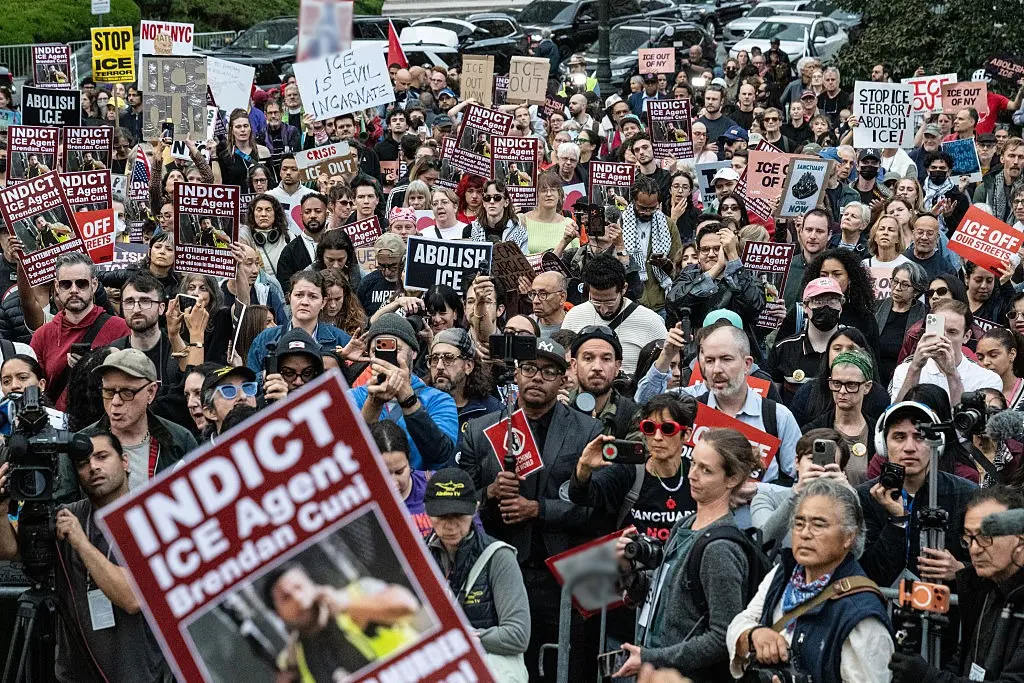
The release of newly obtained New York Police Department (NYPD) body-camera footage has intensified an already volatile political and legal firestorm sparked by an Immigration and Customs Enforcement (ICE) shooting in the Bronx. The incident, which unfolded in broad daylight on October 8, 2026, in the residential neighborhood of Marble Hill, left 28-year-old Oscar Belgal—a Dominican national—seriously wounded after a federal agent fired seven rounds into a vehicle that also contained Belgal’s 5-year-old son.
The shooting has catalyzed widespread outrage, triggering massive demonstrations across Manhattan, drawing sharp rebukes from high-ranking municipal and state officials, and igniting a fierce debate over federal immigration tactics, local sanctuary policies, and accountability within law enforcement.
At the center of the crisis are conflicting narratives. Federal authorities defend the operation as a necessary targeted enforcement action against a dangerous individual with alleged gang ties and a criminal record, casting blame on local sanctuary laws for forcing agents into high-risk, community-level arrests. Conversely, local leaders, led by New York City Mayor Zohran Mamdani, have condemned the action as reckless endangerment of civilians and children, demanding an immediate halt to ICE operations within city limits and calling for the abolition of the agency altogether.
As federal investigations proceed, Belgal remains trapped at the intersection of local medical care, federal detention, and high-stakes legal battles. A federal judge has temporarily halted his deportation while legal teams fight to address his ongoing medical needs and investigate the circumstances surrounding the shooting.
Detailed Chronology: How the Marble Hill Operation Unfolded
The events of October 8, 2026, quickly escalated from a targeted federal immigration operation into a critical incident involving local emergency responders, federal investigators, and public protests.
The Staged Confrontation in Marble Hill
At approximately 4:00 PM Eastern Time, ICE officers initiated a targeted enforcement operation in the Marble Hill neighborhood of the Bronx. Their objective was the apprehension of Oscar Belgal. According to federal accounts, plainclothes federal agents approached a vehicle occupied by Belgal and his 5-year-old son.
Surveillance footage recovered from the area shows armed, plainclothes operatives converging on the target’s vehicle in a residential street. Within moments, the situation deteriorated rapidly. According to NYPD Commissioner Jessica Tisch, at least one federal agent discharged their firearm multiple times, firing a total of seven rounds into the vehicle. One of the bullets struck Belgal in the neck. Despite the heavy gunfire and the close quarters, the 5-year-old child was physically unharmed.
NYPD Response and Immediate Aftermath
The sound of gunfire drew immediate attention from local residents and prompted emergency calls to the NYPD. Responding officers arrived to find a chaotic and tense scene.
Newly released NYPD body-camera footage documents the arrival of local police officers, who found a wounded Belgal handcuffed and seated on the ground. Recognizing the severity of his injuries—specifically the neck wound—NYPD personnel immediately rendered emergency first aid. Rather than waiting for federal transport or standard ambulance delays that could have proved fatal, local police officers rushed Belgal to a local hospital in the back of a police vehicle.
Simultaneously, secondary NYPD units located Belgal’s 5-year-old son, ensuring the child was safely transferred to the care of a family member.
Subsequent Transfers and Legal Stays
Following emergency treatment, Belgal’s legal representation reported that their client was abruptly transferred to a facility in New Jersey before being brought back under federal custody in Brooklyn.
Recognizing the jurisdictional and constitutional complexities of the case, a federal judge swiftly intervened, issuing an emergency order that restricted further transfers and temporarily blocked federal authorities from deporting Belgal while civil rights and criminal investigations move forward.
Supporting Context & Metrics: Sanctuary Policies, Gang Allegations, and Local Blowback
To fully understand the political shockwaves generated by the Marble Hill shooting, it is necessary to examine the broader policy framework governing immigration enforcement in New York City and the specific criminal history cited by federal authorities.
The Federal Case Against Belgal
In defense of the operation, ICE officials released a detailed statement outlining their justification for the high-priority arrest. The agency identified Belgal as a Dominican national unlawfully present in the United States, citing a prior criminal conviction for grand larceny. Furthermore, federal officials pointed to a history of multiple prior arrests involving assault, robbery, drug possession, and weapons charges.
Of particular concern to federal law enforcement was Belgal’s alleged association with the Trinitarios gang—a transnational criminal organization notorious for violent crime in the Northeast, including a high-profile shooting of a Customs and Border Protection (CBP) officer the previous year.
The Sanctuary City Controversy
Federal authorities used the incident to launch a direct attack on local governance. ICE officials stated that Belgal had previously been arrested by the NYPD on December 7, 2023, but was released back into the community shortly thereafter due to New York’s municipal sanctuary laws.
The agency argued that such policies prevent local law enforcement from cooperating with federal immigration detainers, effectively forcing ICE agents to conduct unpredictable, high-risk arrests on open public streets. According to this perspective, local politicians who champion sanctuary protections share indirect responsibility for the dangerous environment that necessitated a daylight operation in a residential neighborhood.
Protests and the March to Foley Square
The community reaction was swift and uncompromising. Rejecting the federal rationale, thousands of New Yorkers, civil rights advocates, and progressive activists mobilized across the city.
Demonstrations culminated in a massive march from Foley Square to federal immigration offices in Lower Manhattan. Protesters carried signs condemning ICE, demanding an end to federal enforcement actions within municipal borders, and calling for institutional accountability regarding the use of lethal force in close proximity to children.
Official Statements: A Divided Government Reacts
The shooting has exposed deep ideological fractures between municipal leaders, state investigators, and federal agencies.
Mayor Zohran Mamdani’s Condemnation
New York City Mayor Zohran Mamdani responded to the shooting with immediate and uncompromising outrage. In a widely circulated statement on social media, Mamdani revealed that he had directly appealed to the White House and Department of Homeland Security leadership demanding an immediate halt to ICE enforcement actions within New York City.
"This is an unconscionable and incredibly serious situation," Mamdani posted. "I have called the President; when we speak I will demand that he ends all ICE enforcement actions in our city. I will not stand by while ICE agents terrorize our communities… Get ICE out of our neighborhoods. Get ICE out of our hospitals. Get ICE off our streets. Get ICE away from our children. Abolish ICE."
Mamdani’s public appeals to President Donald Trump and Homeland Security Secretary Markwayne Mullin for Belgal’s release were ultimately unsuccessful, hardening the mayor’s stance against federal immigration authorities.
The Federal Defense
Conversely, the Department of Homeland Security and ICE stood by their tactical decisions, framing the shooting as an unavoidable outcome driven by suspect non-compliance and systemic local non-cooperation. Federal officials emphasized that their personnel acted in self-defense after Belgal allegedly accelerated his vehicle directly toward agents who feared for their lives.
State-Level Investigations
As the political rhetoric escalated, New York Attorney General Letitia James stepped in to demand an independent, exhaustive examination of the facts. James issued a formal call for a "full and transparent investigation conducted without fear or favor."
Simultaneously, the Bronx District Attorney’s office launched an independent criminal probe into the actions of the federal agent who discharged seven rounds into a vehicle containing a civilian and a child. Notably, despite calls for full disclosure, ICE has yet to publicly release its own body-camera footage or internal operations logs regarding the incident.
Future Outlook: Legal Battles, Policy Shifts, and Ongoing Investigations
As the dust begins to settle on the immediate crisis in Marble Hill, the long-term ramifications of the October 8 shooting are only beginning to unfold across multiple legal and political fronts.
Legal Challenges and Medical Recovery
Oscar Belgal remains hospitalized under heavy guard while managing the physical trauma of a gunshot wound to the neck. Legal teams representing Belgal are aggressively pursuing multiple fronts: ensuring access to comprehensive medical treatment, fighting federal deportation orders, and exploring potential civil rights lawsuits against the federal agents involved.
The federal stay preventing Belgal’s deportation ensures that he will remain within the jurisdiction of New York courts while these complex legal motions are adjudicated. However, the friction between federal detention facilities and local medical needs remains a constant point of tension.
Institutional Investigations
The dual investigations being conducted by the Bronx District Attorney’s office and the New York Attorney General’s civil rights division will test the limits of state jurisdiction over federal law enforcement officers acting in the line of duty. While the Supremacy Clause of the U.S. Constitution often protects federal agents from state prosecution when performing official duties, investigators are scrutinizing whether the use of deadly force—particularly with a child present in the vehicle—met the threshold of objective reasonableness.
The National Sanctuary Debate
On a policy level, the Marble Hill shooting has entrenched ideological divisions surrounding immigration enforcement in major American metropolitan areas. For the federal administration, the incident serves as a primary justification to push for the dismantling of sanctuary city policies and to expand aggressive, urban-based enforcement tactics.
For local officials like Mayor Mamdani and municipal legislators across the country, the event serves as empirical proof that federal immigration enforcement operations are fundamentally incompatible with public safety in dense urban neighborhoods. As protests continue and legal battles grind forward, the shooting of Oscar Belgal stands as a volatile flashpoint in the ongoing national conflict over immigration, policing, and civil liberties.