

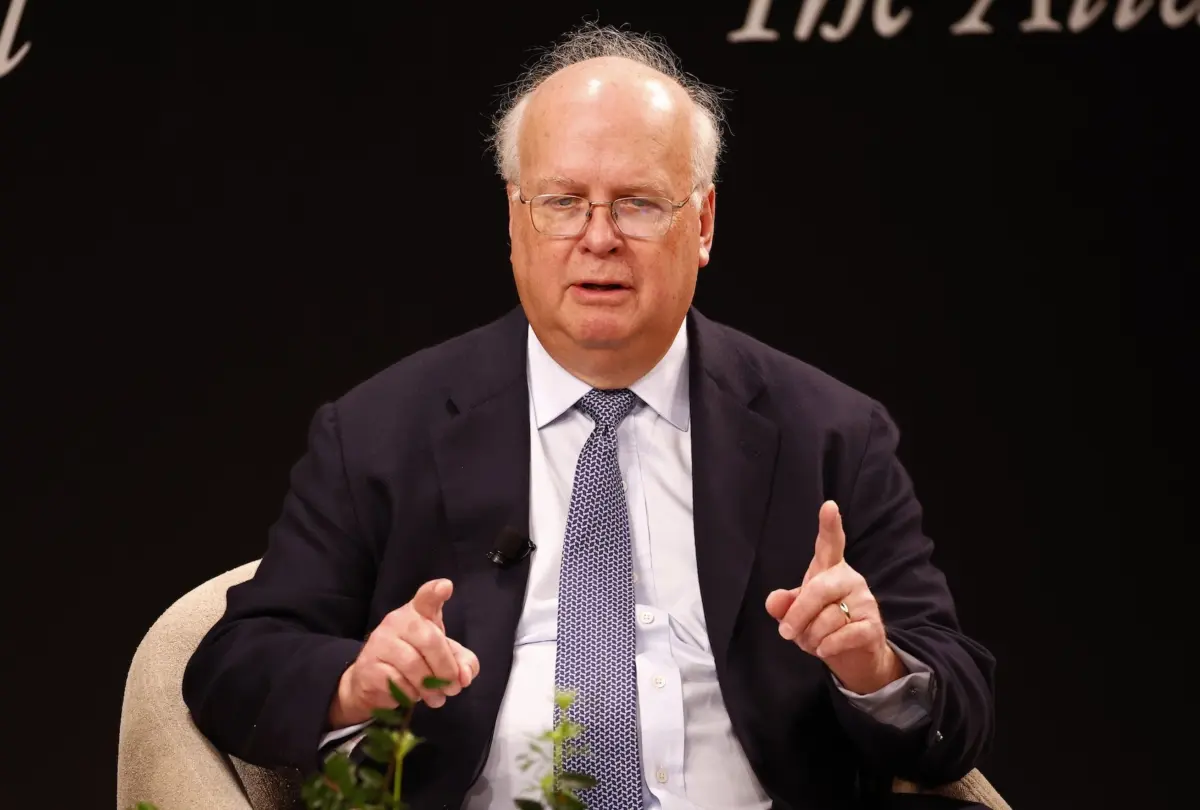
In a stunning political development that has sent shockwaves through the conservative establishment, veteran Republican strategist Karl Rove has broken a three-decade precedent of exclusively backing GOP candidates. Rove announced that he will cross party lines in an upcoming midterm election to vote for a Democrat, citing deep alarm over what he characterizes as the dangerous infiltration of far-right extremists and bigoted elements into the modern Republican Party.
The announcement, first detailed during a candid interview with The Texas Tribune, highlights a widening and increasingly bitter civil war within the GOP. For decades, Rove—widely known as "The Architect" behind George W. Bush’s presidential victories—was instrumental in shaping the modern conservative coalition, building winning electoral maps, and steering the party toward institutional dominance. Today, however, the master strategist finds himself alienated by a faction of the party that he believes has abandoned traditional conservatism in favor of xenophobia, conspiracy theories, and compromised leadership.
At the heart of Rove’s defection is a local Texas contest for the Railroad Commission, which regulates the state’s massive oil and gas industry. Rove intends to cast his ballot for Democratic state Representative Jon Rosenthal rather than the Republican nominee, Bo French. Rove’s opposition to French stems from racially charged and xenophobic social media posts targeting students of color. Furthermore, Rove blasted Texas Republican leadership for normalizing ties with white supremacists and far-right figures like Nick Fuentes, warning that the party’s tolerance of extremism threatens to undo generations of conservative political gains.
Beyond local races, Rove’s critique extends to high-profile statewide contests, including the turbulent Texas U.S. Senate race. There, embattled Texas Attorney General Ken Paxton secured the Republican nomination over incumbent Senator John Cornyn following an endorsement from President Donald Trump. Rove pulled no punches regarding Paxton’s well-documented legal and ethical baggage, noting that such controversies have transformed what should be a safe Republican seat into a competitive nightmare.
This in-depth report explores the background of Rove’s unprecedented defection, the specific catalysts behind his disillusionment with the contemporary GOP, the broader ramifications for Texas and national politics, and what this fracture means for the future of the conservative movement.
Detailed Chronology of a Conservative Fracture
The steady erosion of Karl Rove’s faith in the contemporary Republican Party did not happen overnight. It is the culmination of years of escalating tensions between the party’s traditional institutional wing and its ascendant populist, far-right faction. To understand the gravity of Rove’s recent announcement, it is necessary to examine the sequence of events that pushed one of the GOP’s most loyal architects to cross party lines.
Early September 2026: The Bo French Controversy Erupts
The immediate catalyst for Rove’s local defection materialized in early September 2026, when Republican nominee for Texas Railroad Commissioner Bo French published a series of xenophobic social media posts. The posts took direct aim at students of color who were celebrating a local college football victory, utilizing racially charged rhetoric that quickly drew widespread condemnation.
For Rove, who spent decades attempting to build a broader, more inclusive electoral coalition for the GOP—particularly targeting Hispanic voters in Texas—French’s rhetoric crossed an unpardonable line. Local political reports surfaced revealing that Rove was actively looking past party affiliation to oppose French. Instead of supporting the Republican ticket, Rove threw his weight behind the Democratic incumbent, state Representative Jon Rosenthal of Houston.
Mid-September 2026: Denouncing Extremism and Nick Fuentes
As the political fallout from the French controversy reverberated through Texas, Rove expanded his critique to target broader systemic issues within the state’s party apparatus. In subsequent interviews and public appearances, Rove condemned mainstream Republican leaders for cozying up to explicit white nationalists and internet provocateurs.
Specifically, Rove drew attention to instances where extremist podcaster Nick Fuentes traveled to Dallas to meet with various Republican leaders and grassroots organizers.
"Nick Fuentes goes to Dallas and meets with a bunch of Republican leaders. This guy is a Nazi," Rove bluntly stated during his appearance at the Texas Tribune Festival.
This public rebuke highlighted a deep-seated anxiety among old-guard conservatives that the party apparatus was actively lowering its guard against fringe elements, trading ideological discipline and moral standards for short-term populist enthusiasm.
Late September 2026: The Texas Tribune Festival Bombshell
The boiling point of Rove’s frustration was reached on September 28, 2026, during an extensive interview session. It was here that Rove formally acknowledged his intention to break a 30-year streak of voting exclusively for Republicans. By stating on the record that he would vote for a Democrat in the midterms, Rove transformed a simmering intra-party dispute into a national media spectacle.
During the same interview, Rove turned his analytical lens toward the high-stakes Texas U.S. Senate race. He contrasted the current nominee, Attorney General Ken Paxton, with the man Paxton unseated in the primary: veteran Senator John Cornyn. Rove asserted that if Cornyn had secured the nomination, the general election would have been a foregone conclusion. Instead, Paxton’s nomination—bolstered by a crucial endorsement from Donald Trump—saddled the GOP with a candidate facing severe ethical clouds, transforming a safe seat into an unpredictable battleground.
Supporting Context & Metrics: The Architecture of a Changing Party
To fully grasp the magnitude of Karl Rove’s decision, one must evaluate his historical footprint within the Republican Party alongside the quantifiable shifts in the political landscape of Texas and the United States.
Karl Rove’s Legacy: "The Architect"
Karl Rove is not a marginal figure or a recent convert to the "Never Trump" movement; he is foundational to modern conservative governance.
- The George W. Bush Era: Serving as senior advisor and deputy chief of staff to President George W. Bush, Rove earned the moniker "The Architect" for orchestrating the 2000 and 2004 electoral victories. His strategies focused on data-driven voter mobilization, wedge issues, and building a durable suburban coalition.
- Statewide Dominance: Long before his work in Washington, Rove was the mastermind behind the transformation of Texas from a safe Democratic stronghold into a red state fortress. He managed the successful campaigns of prominent conservative figures, including Governor Bill Clements, Senator John Ashcroft, and Senator John Cornyn.
Given his lifelong investment in building the Republican brand, his public break carries profound symbolic weight.
The Texas Political Landscape: Shifting Demographics and Friction
Texas has long been viewed as the ultimate firewall for the national Republican Party. However, rapid demographic shifts, explosive urban growth in counties surrounding Austin, Dallas, Houston, and San Antonio, and an influx of out-of-state tech and corporate relocations have steadily narrowed Republican margins.
- The Railroad Commission Race: While typically a down-ballot contest that flies under the radar of national media, the Texas Railroad Commission regulates the state’s multi-billion-dollar oil and gas sector. A win by Democrat Jon Rosenthal, aided by conservative defectors following Bo French’s extremist rhetoric, would represent a historic symbolic and practical defeat for the GOP in its industrial heartland.
- The Senate Race Dynamics: The Senate contest featuring Ken Paxton highlights the friction between institutional conservatism and populist loyalty tests. Paxton’s primary victory over Cornyn—achieved via a Trump endorsement—pitted institutional experience against populist grievance. Rove’s public airing of Paxton’s legal controversies underscores how deeply concerned the traditional wing is about candidate quality and ethical vulnerabilities.
Official Statements and Reactions
The fallout from Rove’s announcement has triggered defensive postures from the populist wing of the party, silent discomfort among establishment figures, and opportunistic celebration from Democrats.
- Karl Rove’s Stance: Rove has remained steadfast in his diagnosis, framing his defection not as a betrayal of conservative principles, but as a defense of them against extremist infiltration. His warnings regarding figures like Bo French and Nick Fuentes signal a desperate plea for the GOP to purge fringe elements before they permanently redefine the party’s identity.
- Democratic Response: Democrats have seized upon Rove’s comments as validation of their long-standing arguments that the modern Republican Party has drifted into dangerous, radical territory. State Representative Jon Rosenthal’s campaign has emphasized that good governance transcends party lines, welcoming disaffected conservatives disillusioned by the GOP’s lurch toward the far-right.
- Republican/Populist Counter-Narratives: Allies of Bo French and Ken Paxton have predictably dismissed Rove as a relic of the "establishment swamp"—a neoconservative operative whose era of influence has rightfully passed. To the populist base, Rove’s opposition is viewed as a badge of honor, signaling that a candidate is genuinely fighting the entrenched political establishment rather than playing by polite, institutional rules.
Future Outlook: Implications for the 2026 Midterms and Beyond
As the 2026 midterm elections approach, Karl Rove’s crossing of the aisle serves as a case study in political realignment. Several key questions remain regarding the long-term impact of this intra-party fracture:
- The Suburban Voter Revolt: If veterans of the conservative movement like Rove are willing to vote for Democrats over concerns regarding bigotry and extremism, how will moderate suburban independents—the historic swing voters of American politics—react? The answer could dictate the outcomes of close legislative and statewide races not only in Texas, but across the Sun Belt.
- The Future of the GOP Coalition: The Republican Party is currently engaged in a tug-of-war between populist/nationalist factions and traditional business-oriented conservatives. Rove’s defection highlights the widening chasm between these groups. Whether the traditional wing can claw back influence, or whether the populist wing will completely cement its takeover, remains the defining question for the future of American conservatism.
- Candidate Quality and Accountability: Rove’s critique of Ken Paxton’s ethical challenges points to a broader dilemma for national Republicans: the trade-off between baseline voter enthusiasm and general election viability. As parties increasingly prioritize ideological purity and personal loyalty over ethical standing, general election vulnerability in swing states and competitive districts is likely to grow.
Ultimately, Karl Rove casting a ballot for a Democrat is more than just a localized political anecdote—it is a flashing red warning light for a political party struggling to balance the demands of its populist base with the preservation of institutional norms and democratic accountability.