

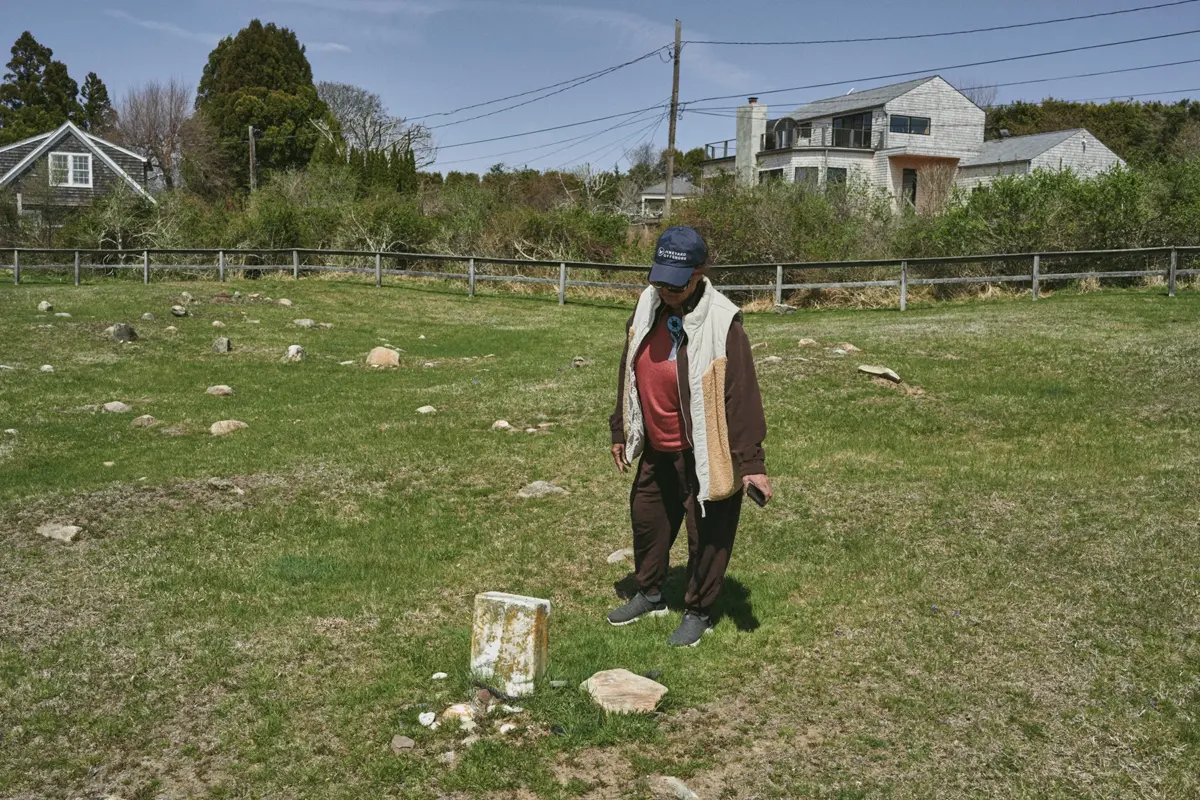
Sandwiched between two rows of suburban Long Island homes, a fenced-off tract of grass looks like any other nondescript lot ready for construction. But a walk inside reveals a ground laden with faint slabs of rock—gravestones from a centuries-old Indigenous family cemetery that had been obscured by time and neglect.
“When we started working here seven years ago, it was nothing but trees and trash—there were couches buried here, you name it,” says Sandi Brewster-walker, an octogenarian guide to the site, bending over to pick up a discarded beer bottle. “People in the houses throw stuff over the fence, so it’s been a project.”
For Brewster-walker, this place is sacred ground: the resting place of at least 80 members of the Montaukett tribe. Since she began serving as executive director a decade ago, uncovering lost history and setting historical records straight has been an obsession. Thanks to her tireless efforts digging up public records, tracing lineages, and petitioning officials, the town of Babylon now installs remembrance plaques and maintains these rehabilitated Montaukett burial grounds.

Yet, this small dignity contrasts sharply with a systemic injustice. The Montaukett are a once-flourishing tribe that was gradually dispossessed of its ancestral lands and then stripped of its official existence—a brazen case of legal erasure that continues to stain the annals of the New York State government. Despite eight separate bipartisan bills passing both the State Assembly and Senate with overwhelming majorities, successive governors have repeatedly vetoed them. The fight for state recognition has become a multi-decade battle against bureaucratic inertia, political cowardice, and the enduring shadows of historical racism.
Detailed Chronology of an Erasure
Deep Roots and Colonial Contact
Long before expressway traffic snarls, Maseratis, and sprawling waterfront estates defined Long Island, the Algonquian-speaking ancestors of the Montauketts arrived in the easternmost reaches of the region approximately 10,000 years ago. Surrounding seas offered abundant fish and oysters, while rich woodlands brimmed with wild game and provided timber for wigwams, longhouses, and dugout canoes. These watercraft enabled the tribe to establish extensive trade routes and military alliances throughout southern New England, including partnerships with early English settlers in the 17th century.
At initial contact, the native population was estimated to be upward of 10,000. Within decades, intertribal warfare and introduced European diseases decimated their numbers, reducing the population to roughly 500.

Predatory Dispossession and the 1910 Judicial Edict
In the years that followed, predatory land purchases, restrictive edicts, and forced displacement further fractured the tribe. In his definitive study, The Montaukett Indians of Eastern Long Island, historian John A. Strong debunks the myth that the tribe simply “vanished,” asserting the narrative was manufactured to clear the way for commercial expansion. While the English enforced deeds as permanent, absolute property transfers, the Montauketts understood them as reciprocal agreements for shared land use and resource rights.
As disease and intensified raids left the Montauketts increasingly dependent on English protection, they were compelled to concede more land to pay off mounting debts. By the late 19th century, developers like Arthur W. Benson began buying up vast tracts of land at the far-eastern tip of the island to create exclusive summer resorts, bypassing tribal consent and forcibly relocating families who refused to leave.
In 1896, Montaukett Chief Wyandanch Pharaoh filed a lawsuit to reclaim tribal territory. However, state courts weaponized prevailing racial stereotypes. In the devastating 1910 Pharaoh v. Benson trial, state Supreme Court Judge Abel Blackmar ruled that because the Montauketts had culturally assimilated and intermarried, their blood had “become so mixed that in many of them Indian traits were obliterated.”

In an instant, the Montaukett lost their legal status and right to compensation. This occurred despite an earlier U.S. Supreme Court ruling under which the nation would have qualified for federal recognition, and a 1906 Department of the Interior memorandum acknowledging them as an existing tribe.
Supporting Context & Metrics: Eugenics, Real Estate, and Political Hurdles
The 1910 judicial ruling against the Montauketts did not happen in a vacuum; it coincided with Long Island serving as the epicenter of the American eugenics movement. The Eugenics Record Office was founded in Cold Spring Harbor that same year, aiming to purge the country of the “unfit” and “degenerate.” By the 1920s, an estimated one out of seven Long Islanders belonged to the Ku Klux Klan, and federal redlining combined with Robert Moses’s exclusionary infrastructure projects deliberately restricted minority access to public recreational spaces.
With the Montauketts legally erased, state authorities and developers laid the groundwork for the East Hampton–Montauk corridor to become one of the wealthiest enclaves in America. In 1925, Carl G. Fisher purchased 10,000 acres of former Montaukett land for $2.5 million to create “the Miami Beach of the North.” Today, the average home in the Hamptons lists for nearly $3 million.

Despite this immense wealth sitting atop ancestral lands, the Montauketts have made no land claims or financial compensation requests. Robert Pharaoh, hereditary chief of the Montaukett Indian Nation, emphasizes their modest goals:
“I don’t want to throw anybody out of their houses, and I’m not looking for any big pieces of land. The only thing I want is a piece of property big enough that I can put a museum or cultural research center on, and maybe put up a natural Indian village outside. That’s all.”
The Veto Cycle
To date, eight bills recognizing the tribe have passed the State Assembly and Senate with bipartisan backing, only to be vetoed by Democratic Governors Andrew Cuomo (three times) and Kathy Hochul (four times and counting). Year after year, tribal leaders work in good faith with the Governor’s Office, only to receive a rejection call around the Christmas holiday—a timing strategy that ensures lawmakers are unavailable to override the veto.

Former Democratic State Assemblyman Fred W. Thiele Jr., who sponsored multiple reinstatement bills, notes that the 1910 decision is “one of the most racist court decisions in the history of New York State jurisprudence,” comparing it to the infamous Dred Scott and Plessy v. Ferguson rulings.
Official Statements & Perspectives
The resistance from Albany persists despite explicit denials of land claims from tribal leadership.
-
Governor Kathy Hochul’s Administration:
Ken Lovett, a spokesman for Governor Hochul, defended the administration’s stance in a statement to Rolling Stone:
“Gov. Hochul is committed to supporting and strengthening relationships with Indigenous peoples and Nations across New York State… [She] has worked hard to right some of the horrific wrongs inflicted in the past on Indigenous peoples and takes seriously the responsibility of determining whether to recognize a Native American tribe, which would be a sovereign nation. That includes ensuring any claims of tribal leadership can be substantiated.”
-
The Montaukett Leadership:
Sandi Brewster-walker expresses utter exasperation over the shifting goalposts, noting that the administration frequently claims missing documentation despite thousands of pages of historical records having been submitted.“They think I’ll give up sooner or later. Well, I’m not giving up—and I’re preparing other people behind me. Every time we get vetoed, we get stronger.”

-
The Shinnecock Parallel:
The enduring struggles of the Shinnecock Indian Nation—landed cousins of the Montauketts—provide a stark precedent. Lance Gumbs, vice chairman of the Shinnecock Nation’s Council of Trustees, highlights the systemic obstacles placed in the path of tribal economic development by state and local authorities:“We’ll work with you, we’ll work with you. You know how many years we’ve heard that… That never happens. It never comes to fruition. There’s been this concerted effort by the town and the state to keep us subservient.”
Future Outlook: Resiliance Beyond Bureaucracy
Political observers suggest that Albany’s underlying hesitation stems from deep-seated anxieties over real estate values, potential property tax complications, and competition with state-sanctioned casino networks in the New York metropolitan area.

Despite these formidable institutional barriers, the Montauketts remain undeterred. As the eighth iteration of the recognition bill heads back to Governor Hochul’s desk ahead of the legislative cycle, Brewster-walker and her allies are already mapping out legal and legislative contingencies. If current veto patterns hold, future strategies include introducing comprehensive statewide legislation that strips executive discretion from the governor’s office, alongside preparations to pursue federal recognition pathways modeled after the Shinnecock Nation’s grueling 32-year campaign.
For Brewster-walker, Pharaoh, and the younger generation of Montauketts practicing traditional dances and preserving oral histories, the struggle is fundamentally existential. It is not merely about a legal status, but about ensuring that a people who have inhabited the shores of Long Island for millennia are never legally erased again.
(Reporting for this story was supported with a grant from IllumiNative.)