

Executive Overview
The geopolitical architecture underpinning Western support for Ukraine faces its most profound test since the full-scale Russian invasion began. In mid-October 2026, a series of compounding fractures in the U.S.–Ukraine relationship spilled into the public domain, marked by confirmed interruptions in American intelligence-sharing, mounting Capitol Hill scrutiny over battlefield communication disruptions, and persistent diplomatic friction regarding Washington’s evolving economic posture toward Moscow.
Appearing on major Sunday morning news programs, Ukrainian President Volodymyr Zelenskyy confirmed that a vital pipeline of American intelligence—specifically utilized by Kyiv to detect and intercept incoming Russian missile strikes—had been temporarily severed before being quietly restored. This revelation directly challenged prior assertions from the White House. At the same time, Treasury Secretary Scott Bessent repeatedly sidestepped opportunities to explicitly designate Ukraine as an American "ally," underscoring an increasingly transactional, ambiguous foreign policy stance under President Donald Trump.
The policy shift has triggered a sharp backlash across party lines in Washington. Notably, Republican Representative Mike Turner of Ohio has demanded a formal congressional investigation into separate, highly disruptive slowdowns affecting SpaceX’s Starshield satellite communications network, which is mission-critical for Ukrainian frontline operations. As administrative officials—including Secretary of State Marco Rubio—face tough questions from lawmakers, the cumulative impact of flickering intelligence feeds, wavering sanctions enforcement, and strained technological lifelines threatens to tip the balance of a war of attrition where every second and every data point can mean the difference between survival and collapse.
Detailed Chronology: The October 2026 Policy Fracture
The events of mid-October 2026 did not occur in a vacuum; they represent the culmination of months of underlying policy adjustments, shifting diplomatic priorities, and behind-the-scenes friction between Washington and Kyiv.
Early October: Quiet Disruptions on the Digital Battlefield
In the opening weeks of October 2026, frontline Ukrainian military commanders began registering anomalous behavior in their vital communications architecture. Reports surfaced within defense circles that SpaceX’s Starshield—the military-grade counterpart to the commercial Starlink constellation—was experiencing sudden bandwidth degradation and connection drops. Because Ukrainian artillery units, drone squadrons, and infantry platoons rely on these networks for real-time targeting and tactical coordination, the disruptions caused immediate operational friction. Concurrently, intelligence feeds flowing from U.S. assets—designed to provide early warnings of incoming ballistic and cruise missile salvos—began to experience intermittent blackouts.
For several days, Ukrainian officials navigated the crisis quietly, attempting to resolve the anomalies through established bilateral channels. However, as Russian missile barrages struck targets with reduced warning times, the operational reality forced the issue into the open. President Donald Trump’s administration initially maintained that intelligence-sharing had never officially stopped, setting the stage for a high-stakes public confrontation.
Sunday, October 18, 2026: The Revelations on "Meet the Press"
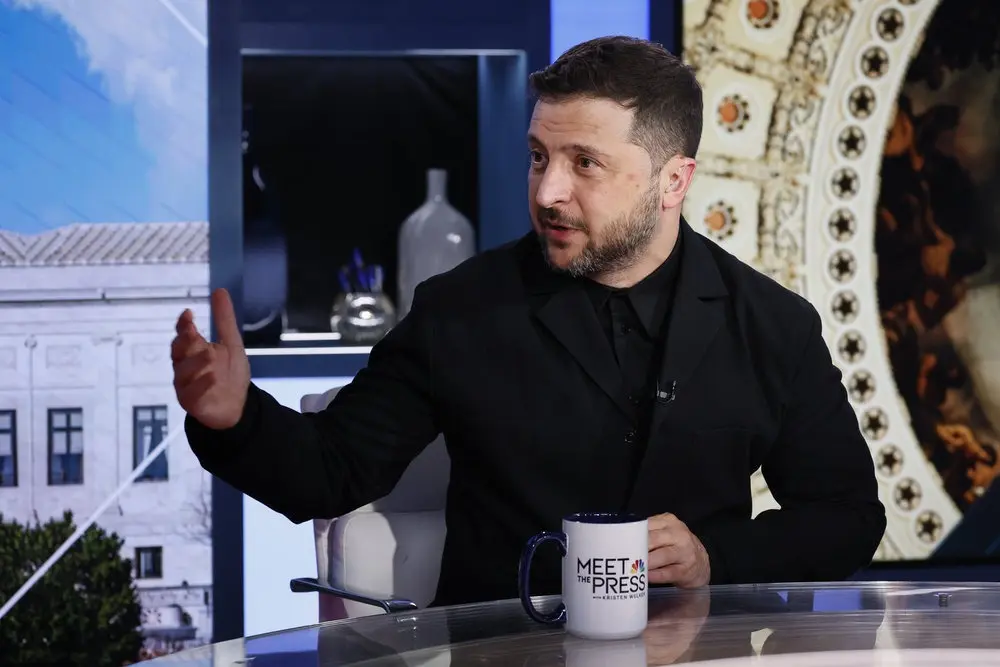
The diplomatic friction burst into plain view during a coordinated flurry of high-profile media appearances on Sunday, October 18. Speaking from Kyiv via satellite on NBC’s Meet the Press, President Volodymyr Zelenskyy openly confirmed what U.S. officials had previously downplayed or denied: the United States had indeed temporarily interrupted critical intelligence-sharing with Ukraine.
"We are very thankful for this," Zelenskyy told moderator Kristen Welker, acknowledging that the intelligence stream used to track and intercept incoming Russian missile strikes had ultimately been restored after a brief, tense pause. "Now it works."
However, Zelenskyy used the platform to issue a stark warning regarding broader administrative decisions. He pointed to the Trump administration’s recent policy shifts allowing certain Russian diesel imports and waiving specific sanctions targeting Moscow. Zelenskyy cautioned that such concessions could prove fatal to his country’s defense infrastructure. "If the United States will officially take the side of Russia… we will not prevail and we will not be able to stand," he stated plainly.
Treasury Secretary Bessent’s Strategic Ambiguity
Appearing on the same broadcast, Treasury Secretary Scott Bessent was pressed to clarify the Biden-to-Trump transition’s foundational commitments to Eastern Europe. In a telling exchange, moderator Kristen Welker asked Bessent three separate times whether the United States officially considers Ukraine an ally.
Rather than affirming the partnership, Bessent repeatedly deflected the question. "I’m not the secretary of state. I’m not the president," Bessent responded, attempting to narrow the scope of his departmental mandate. While pointing to ongoing financial and intelligence assistance as evidence of Washington’s continued engagement, Bessent emphasized that the overarching goal of the administration was to force a negotiated end to the conflict rather than an indefinite military commitment. The refusal to use the word "ally" reverberated through diplomatic corridors in Europe, signaling a deliberate downgrading of Washington’s formal ideological alignment with Kyiv.
Supporting Context & Metrics: The Lifelines Under Scrutiny
To understand the profound anxiety gripping Kyiv, one must examine the critical dependencies that sustain modern Ukrainian defensive operations. The conflict in 2026 is defined less by massive armored breakthroughs and more by electronic warfare, satellite telemetry, and preemptive missile defense.
The Role of U.S. Intelligence in Air Defense
Ukraine’s air defense architecture—comprising a patchwork of Western-supplied Patriot, NASAMS, and IRIS-T systems alongside legacy Soviet platforms—operates on a razor-thin margin of error. The speed of modern Russian hypersonic and supersonic cruise missiles leaves virtually no room for manual detection.
- Early Warning Timelines: U.S. space-based infrared sensors and electronic intelligence assets provide the initial cueing necessary to alert Ukrainian interceptor batteries seconds after a launch is detected deep inside Russian territory or from mobile platforms in the Black Sea.
- The Cost of Interruption: Even a brief, unannounced pause in these data feeds degrades the readiness posture of Ukrainian air defense crews, increasing the probability that decoys or strike packages will penetrate urban centers and critical national infrastructure.
The Starshield Dependency
Beyond strategic intelligence, tactical communications represent the nervous system of the Ukrainian Armed Forces. Following the widespread deployment of SpaceX’s satellite internet systems early in the war, Starlink and its secure variant, Starshield, became indispensable.
- Decentralized Command: Unlike traditional radio frequencies that are highly susceptible to Russian jamming and triangulation, low-earth-orbit satellite arrays allow small tactical units to coordinate drone strikes, artillery barrages, and logistical movements securely.
- The Vulnerability of Commercial Geopolitics: The administrative slowdowns and technical bottlenecks affecting Starshield underscore the inherent risks of relying on private corporate infrastructure for sovereign national defense. When regulatory policies or political friction intersect with corporate operational decisions, frontline commanders are left vulnerable.
Official Statements and Political Reactions
The revelations of intelligence cutoffs and communication bottlenecks sent immediate shockwaves through Washington, sparking a rare, bipartisan fracture within Republican national security ranks and drawing sharp rebukes from executive branch officials.
Rep. Mike Turner Demands Investigations
Leading the legislative pushback was Representative Mike Turner (R-Ohio), a senior voice on foreign policy and defense matters. Appearing on CBS’s Face the Nation on October 18, Turner sharply rejected explanations offered by Secretary of State Marco Rubio, who had previously maintained that the White House did not order any slowdown or interference with SpaceX’s Ukrainian network operations.
"Absolutely not," Turner responded when asked if Rubio’s assurances were sufficient to put the matter to rest. Declaring that the situation warranted immediate legislative oversight, Turner announced his intention to push for a formal congressional investigation into the Starshield disruptions.
"There needs to be a congressional investigation," Rep. Mike Turner stated on Face the Nation. "Interrupted communications on the battlefield directly endanger the lives of Ukrainian service members and undermine the security framework our allies rely upon."
Turner further urged the executive branch to reverse course on waiving economic sanctions against Moscow, arguing that economic appeasement directly undermines the military assistance provided to Kyiv.
The Administration’s Defense
Executive branch defenders, including Secretary of State Marco Rubio and Treasury Secretary Scott Bessent, have sought to frame these policy adjustments as part of a rationalization process aimed at driving the parties toward a diplomatic settlement. Administration officials argue that open-ended military and intelligence commitments without a defined diplomatic off-ramp risk entrenching a permanent war footing. By introducing strategic friction, the White House maintains it is encouraging both sides to take negotiations seriously, even if those tactics leave regional allies deeply unsettled.
Future Outlook: The Strategic Implications for European Security
As the autumn of 2026 progresses, the broader implications of Washington’s shifting posture extend far beyond the immediate battlefield. The events of mid-October have permanently altered the psychological and strategic calculations governing the trans-Atlantic alliance.
1. Accelerating European Strategic Autonomy
For months, European capitals have quietly prepared for a more transactional United States. The confirmed intelligence cutoff and Bessent’s refusal to label Ukraine an ally serve as a wake-up call for NATO members. European Union leadership is likely to accelerate efforts to build independent, sovereign intelligence-sharing networks and secure satellite communication arrays that are immune to shifts in Washington’s domestic political winds.
2. The Morale and Tactical Impact on the Frontline
While President Zelenskyy confirmed that intelligence feeds have been restored, the fact that they were interrupted has introduced a permanent element of strategic uncertainty into Kyiv’s operational planning. Ukrainian military leadership must now factor potential American support cutoffs into every major offensive and defensive design. This reality may force a conservative conservation of munitions and intelligence assets, potentially ceding the initiative back to Russian forces along the contested eastern and southern fronts.
3. The Legislative Showdown Ahead
In Washington, the coming weeks will likely see intense clashes between the executive branch and congressional hawks led by figures like Rep. Mike Turner. The proposed investigations into Starshield disruptions and intelligence handling will test the limits of executive authority in managing wartime alliances. Whether Congress can successfully legislate guardrails to protect critical military supply chains and intelligence pipelines will determine not only the immediate fate of Ukraine’s defensive lines but also the long-term credibility of American security guarantees worldwide.