

Executive Overview
The geopolitical tightrope walk between Washington and Kyiv experienced a violent tremor in October 2026, laying bare the profound uncertainties surrounding U.S. support for Ukraine. In a high-stakes confirmation that sent shockwaves through international diplomatic circles, Ukrainian President Volodymyr Zelenskyy revealed that the United States had temporarily severed critical intelligence-sharing operations. This abrupt halt left Ukrainian forces momentarily blind to incoming Russian missile trajectories.
While the data feed has since been restored, the episode underscores a volatile friction within American foreign policy under President Donald Trump. Compounding these anxieties are separate, unexplained disruptions to SpaceX’s Starshield satellite communications network—vital infrastructure underpinning Ukrainian battlefield coordination.
The policy shift is further highlighted by economic concessions toward Moscow, including the controversial allowance of Russian diesel imports and waived sanctions. These measures have drawn fierce pushback not only from Kyiv but also from prominent members of the U.S. Congress, most notably Republican Representative Mike Turner of Ohio, who is aggressively demanding formal oversight.
As Treasury Secretary Scott Bessent conspicuously sidesteps labeling Ukraine an "ally" on national television, the global community is left questioning the long-term durability of the Western security umbrella. This report synthesizes the unfolding crisis, detailing the sequence of events, official justifications, congressional investigations, and the wider geostrategic implications for the protracted war.
Detailed Chronology of the October 2026 Crisis
The unfolding diplomatic and operational standoff developed across a tense sequence of weekend news appearances and escalating political maneuvers in mid-October 2026.
The Revelation on "Meet the Press"
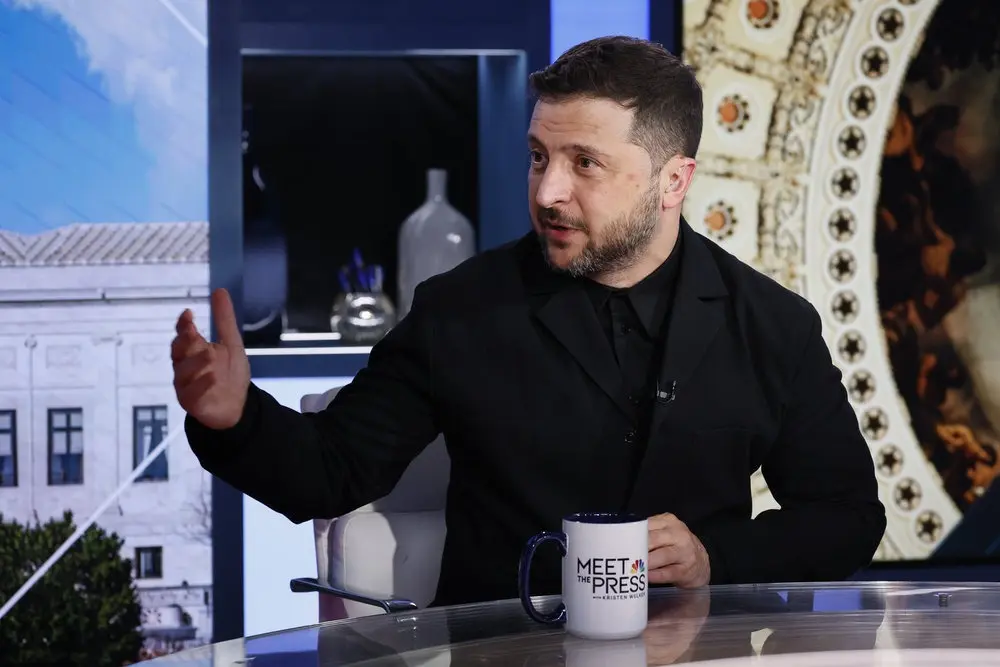
Appearing on NBC’s Meet the Press on Sunday, October 18, 2026, Ukrainian President Volodymyr Zelenskyy directly addressed rumors that had circulated among defense analysts for days. In a candid assessment of bilateral ties, Zelenskyy confirmed that American intelligence-sharing mechanisms—specifically those utilized to provide early warning indicators for incoming Russian cruise and ballistic missile strikes—had undergone a temporary, unannounced interruption.
For a nation bracing for daily aerial bombardment, the sudden loss of high-fidelity telemetry and early warning radar data was more than a procedural inconvenience; it created immediate tactical vulnerabilities. However, Zelenskyy offered a note of immediate relief during the broadcast, stating that the intelligence pipeline had been re-established.
"We are very thankful for this," Zelenskyy said through an interpreter. "Now it works."
Despite this restoration, the temporary blackout directly contradicted earlier assertions by President Donald Trump, who maintained that intelligence cooperation had never experienced any interruption. Ukrainian field reports, however, had documented multiple instances during the blackout window where large-scale Russian missile barrages struck civilian and military infrastructure with noticeably reduced warning times.
Bessent’s Evasion and Economic Friction
The tension was further compounded later in the same broadcast segment when Treasury Secretary Scott Bessent took questions from moderator Kristen Welker. Asked directly whether the United States officially regards Ukraine as an ally, Bessent declined to use the designation—repeating his hesitation across three separate prompts.
"I’m not the secretary of state. I’m not the president," Bessent demurred, pointing instead to ongoing material assistance and intelligence channels while framing the administration’s core objective as achieving a negotiated settlement to the war.
Zelenskyy used his platform to press back against broader shifts in Washington’s economic policy toward Moscow. He harshly criticized the administration’s decisions to permit the import of Russian diesel and to waive newly contemplated sanctions packages. The Ukrainian leader warned that such economic lifelines handed to the Kremlin directly undermine his country’s war-fighting capabilities.
"If the United States will officially take the side of Russia," Zelenskyy warned, "we will not prevail and we will not be able to stand."
The Starshield Disruption and Congressional Counter-Offensive
While intelligence feeds were ultimately restored, a parallel crisis was brewing regarding battlefield communications. Ukrainian frontline units heavily rely on SpaceX’s Starshield—a secure, military-grade iteration of the Starshield/Starlink satellite constellation—to coordinate troop movements, direct artillery fire, and operate uncrewed aerial systems.
Reports of sudden throttling and unexplained service drops across the frontlines prompted immediate alarm in Washington. Secretary of State Marco Rubio publicly insisted that the White House had issued no direct orders to slow down or interfere with Ukrainian satellite terminals. However, this explanation was swiftly rejected by senior lawmakers.
Appearing on CBS’s Face the Nation, Representative Mike Turner (R-Ohio) dismissed the administration’s reassurances outright. When asked if Rubio’s explanation was sufficient, Turner was unequivocal:
"Absolutely not. There needs to be a congressional investigation."
Turner warned that degrading communications capabilities directly imperils the lives of Ukrainian soldiers on the ground and urged the White House to reverse course on its lenient approach toward Russian sanctions.
Supporting Context & Metrics: The Mechanics of Modern Warfare
To fully understand the gravity of the October 2026 intelligence and communication cutoffs, one must examine the degree to which Ukraine’s defense architecture is integrated with Western technological systems.
1. The Value of U.S. Early Warning Intelligence
Ukraine’s air defense grid—a patchwork of Soviet-era systems, Western-donated batteries like Patriot and NASAMS, and mobile gun teams—operates under severe constraints regarding radar horizon and detection range. Ground-based radars struggle to detect low-flying cruise missiles and drones launched from deep within Russian territory or from airframes over the Caspian Sea.
The U.S. intelligence apparatus, leveraging space-based infrared satellite constellations (such as the Space-Based Infrared System, or SBIRS) and advanced signals intelligence (SIGINT), provides the critical minutes of advanced warning required to clear airspace, sound civilian air-raid sirens, and position interceptors. A sudden cutoff of this data stream turns modern, network-centric defense into a reactive, high-casualty scramble.
2. Starshield as the Central Nervous System of the Frontline
Since the earliest days of the full-scale invasion, commercial and military satellite internet terminals have served as the central nervous system for the Ukrainian Armed Forces. Traditional tactical radio networks are routinely jammed, intercepted, or destroyed by Russian electronic warfare (EW) units.
The transition to high-throughput, low-Earth-orbit satellite terminals allowed Ukrainian commanders to maintain encrypted, real-time situational awareness platforms—such as the digital combat management system Kropiva. Any degradation, throttling, or localized blackout of this network, whether administrative or technical in origin, immediately degrades artillery response times and fractures tactical unit cohesion.
3. Economic Lifelines and Sanctions Waivers
The debate over Russian diesel imports and waived sanctions highlights a growing friction point between Washington’s stated desire to end the conflict and its willingness to exert maximum economic pressure on Moscow. Independent commodity trackers note that despite nominal prohibitions, refined petroleum products originating from Russian crude frequently find their way into global markets via third-party intermediaries. By waiving specific targeted sanctions, the administration has signaled a pivot away from total economic isolation toward transactional diplomacy—a shift that Kyiv views as an existential threat.
Official Statements and Political Reactions
The cascading events of mid-October triggered sharp divisions across the American political landscape, drawing responses from the executive branch, Capitol Hill, and international observers.
| Official / Figure | Position / Affiliation | Key Statement / Stance | Context / Venue |
|---|---|---|---|
| Volodymyr Zelenskyy | President of Ukraine | Confirmed temporary intelligence cutoff; warned that siding with Russia ensures defeat. | NBC’s Meet the Press |
| Scott Bessent | U.S. Treasury Secretary | Declined three times to call Ukraine an "ally"; pointed to ongoing aid and peace negotiations. | NBC’s Meet the Press |
| Marco Rubio | U.S. Secretary of State | Denied that the White House ordered any intentional slowdown of Starlink/Starshield terminals. | Media briefings / Press statements |
| Mike Turner | U.S. Representative (R-Ohio) | Rejected Rubio’s explanation; demanded a formal congressional investigation into Starshield disruptions. | CBS’s Face the Nation |
| Donald Trump | President of the United States | Previously maintained that intelligence-sharing with Ukraine had never experienced an interruption. | Prior public statements & press queries |
The political fallout extended beyond traditional news programs. The satirical sketch show SNL UK lampooned the unfolding diplomatic crisis, featuring a comedic recreation of Zelenskyy’s meetings with European leaders interrupted by a caricature of U.S. leadership offering help with everything—"provided it’s not help with war." While satirical, the sketch reflected a profound global anxiety regarding the predictability and reliability of American commitments.
Future Outlook: Strategic Implications for the Conflict
As the winter months of late 2026 approach, the revelations regarding intelligence and communication interruptions point toward a dangerous new phase in the Russia-Ukraine war. Several key trajectories emerge from this crisis:
- Heightened Congressional Oversight: Representative Turner’s call for a formal investigation into the Starshield disruptions signals that Capitol Hill will not quietly acquiesce to backchannel policy shifts. Bipartisan blocs committed to Ukrainian victory are expected to draft legislative hurdles aimed at preventing the executive branch from unilaterally withholding intelligence or communication support.
- The Erosion of Trust: Even though early warning data feeds were restored following Zelenskyy’s public confirmation, the episode has inflicted lasting psychological and strategic damage. Kyiv must now factor the persistent risk of sudden American technological withdrawal into its long-term operational planning.
- The Pivot Toward Self-Reliance: Driven by the unpredictability of foreign partners, Ukrainian defense industries are accelerating efforts to domesticate critical technologies—ranging from indigenous electronic warfare countermeasures to independent encrypted tactical communications nodes and domestic satellite capabilities.
- The Shape of Future Negotiations: With Treasury Secretary Bessent explicitly framing U.S. policy around achieving a negotiated settlement, the tightening or loosening of intelligence and economic valves is likely to be deployed by Washington as coercive leverage. Whether this pressure forces Kyiv to the negotiating table on unfavorable terms, or instead hardens its defensive resolve, will define the geopolitical landscape of Eastern Europe for years to come.