

Published: October 18, 2026
Dateline: WASHINGTON, D.C.
Executive Overview
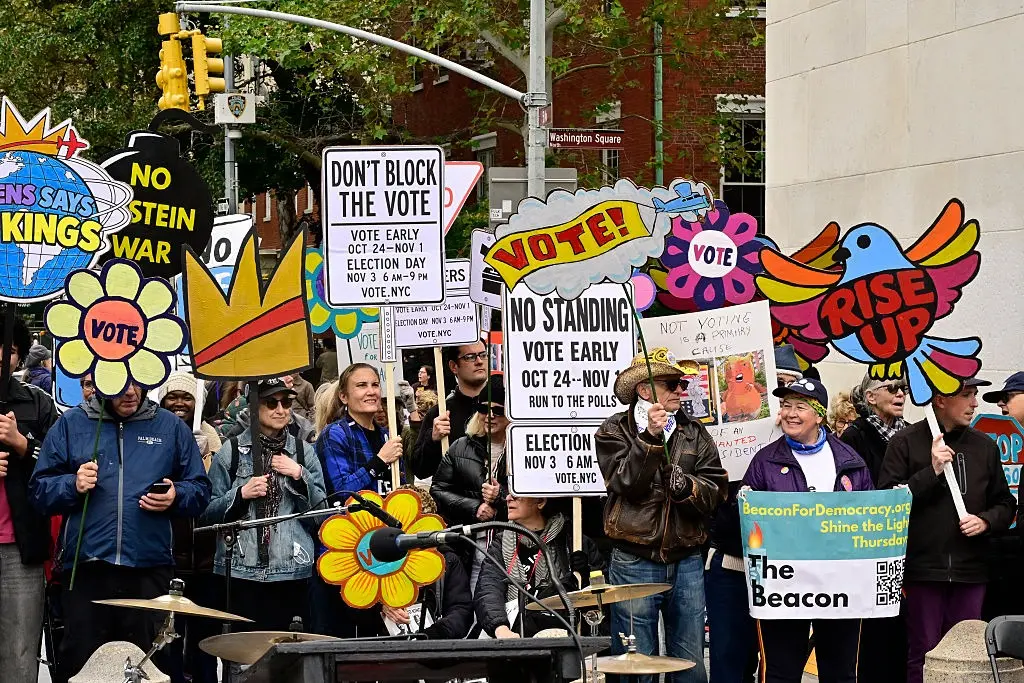
The nationwide "No Kings" movement, which emerged as a formidable wave of street protests following President Donald Trump’s return to the White House, underwent a strategic metamorphosis on Saturday, October 18, 2026. Shifting its focus away from traditional marches and direct confrontation, the coalition mobilized hundreds of thousands of demonstrators across the United States to encourage early voting ahead of the critical November 3 midterm elections.
Billed officially by national organizers as a strictly nonpartisan initiative aimed at increasing voter participation and safeguarding election integrity, Saturday’s rallies exposed an underlying tension within the grassroots coalition. While leadership emphasizes civic duty and democratic resilience, many grassroots participants made no secret of their partisan intentions: a direct push to strip the Republican Party of its congressional majorities and check the power of the Trump administration.
This strategic pivot coincides with an increasingly contentious national political landscape, marked by aggressive federal interventions in local election administration and fierce debates over ballot access. As early voting windows open in states across the country, the "No Kings" mobilization serves as a primary test of whether sustained street-level discontent can be successfully funneled into high-volume electoral turnout.
Detailed Chronology: A Nationwide Day of Mobilization
The nationwide early-voting push unfolded across major metropolitan centers and historic civic landmarks on Saturday, reflecting a coordinated effort to dominate the weekend news cycle just over two weeks before Election Day.
Washington, D.C.: The National Focal Point
In the nation’s capital, demonstrators converged on the National Mall, gathering near the base of the Lincoln Memorial. Bearing prominent signage that read "VOTE EARLY," "HANDS OFF MY VOTE," and "DEFEND DEMOCRACY," speakers at the Washington rally framed the upcoming midterms as a referendum on executive overreach.
"We spent months marching to make our voices heard in the streets, but the ultimate accountability happens inside the voting booth," said regional organizer Marcus Vance during the morning briefing. "The message of ‘No Kings’ is that power belongs to the people, and today we begin the work of transferring that power to the ballot box."
Coast-to-Coast Demonstrations
Simultaneous rallies drew significant crowds in key media markets and battleground regions:
- New York City: Thousands gathered in Manhattan, featuring speeches from labor leaders, civil rights advocates, and local politicians emphasizing the importance of securing mail-in and early ballots.
- Los Angeles: Southern California participants filled public plazas, organizing peer-to-peer voter registration drives and distributing nonpartisan guides on polling locations and drop-box security.
- Atlanta: In Georgia—a perennial battleground state—City Councilman Michael Julian Bond delivered a fiery address to a packed assembly, invoking popular culture to emphasize civic empowerment. "You don’t see Superman giving up his power," Bond told the cheering crowd, as reported by The Associated Press. "You don’t see Black Panther giving up his power. You shouldn’t give up yours."
- Alexandria, Virginia: Demonstrations in the Washington suburb took a sharply explicit turn, illustrating the friction between national messaging and grassroots sentiment.
Supporting Context & Metrics: Navigating the Nonpartisan Mandate
The internal debate over the movement’s identity remains one of the most defining characteristics of the "No Kings" evolution. National organizers have maintained strict guidelines to preserve the coalition’s tax-exempt and nonpartisan status, explicitly barring the endorsement of individual candidates or political parties.
However, on the ground, the distinction between civic participation and partisan warfare often dissolved. In Alexandria, Virginia, multiple participants interviewed by Fox News Digital openly rejected the nonpartisan framing, stating that their primary goal was a Democratic sweep of Capitol Hill.
"We’ve got to take the power away from Trump, from the Republicans," one demonstrator remarked, echoing sentiments shared by contingents in other cities.
This divergence presents both a communications challenge and a legal tightrope for movement leadership. Eunic Epstein-Ortiz, a national spokesperson for "No Kings," forcefully defended the coalition’s structural integrity, emphasizing its peaceful and broad-based nature. Legal experts note that while individual protesters are legally permitted to express personal partisan preferences, organizational adherence to nonpartisan guidelines shields the national coalition from campaign finance violations.
The Backdrop of Legal and Administrative Friction
The early voting push also occurs against a backdrop of escalating legal battles between the federal government and state election authorities over voting rules and ballot rolls.
Just days before the nationwide rallies, on Thursday, October 15, the Trump administration’s Department of Justice filed a high-profile lawsuit against California election officials. The federal complaint targeted mail-in ballots originating from individuals whom federal authorities identified as potential noncitizens. Following the lawsuit, the Justice Department issued sweeping warnings to local election officials nationwide regarding potential criminal investigations into improper voter registration and ballot processing.
Civil rights groups and state attorneys general swiftly condemned the DOJ actions as voter intimidation and an eleventh-hour attempt to suppress turnout in Democratic-leaning states. These escalating tensions have served as an unintended catalyst for the "No Kings" movement, galvanizing early voters who view the federal actions as a direct threat to democratic norms.
Official Statements and Responses
The dual nature of the "No Kings" pivot—balancing institutional nonpartisanship with intense anti-administration animus—has drawn reactions from across the political spectrum.
National Coalition Leadership:
"Our core mission has always been defending the foundational premise of American democracy: that no individual, executive, or president is above the law. By pivoting to the ballot box, we are channeling the energy of millions of Americans into the most effective mechanism for structural change. Voting is the ultimate expression of the ‘No Kings’ ethos."
— Eunic Epstein-Ortiz, National Spokesperson
Local Municipal Leadership:
"The power of the community is forged when people realize that civic engagement is not a spectator sport. You don’t see Superman giving up his power. You don’t see Black Panther giving up his power. You have the ultimate power in your hands on November 3rd, and you must use it."
— Michael Julian Bond, Atlanta City Councilman
Political Analysts and Observers:
Political strategists tracking the midterm landscape note that voter mobilization groups often face a tension between broad coalition-building and raw partisan motivation. While a nonpartisan framework allows "No Kings" to draw in moderate independents alienated by executive expansion, the raw energy driving foot soldiers into the streets remains deeply tied to partisan opposition to President Trump.
Future Outlook: The Road to November 3 and Beyond
With the early voting window now wide open across a majority of states, the immediate test for the "No Kings" movement will be measurable turnout. Organizers have transitioned from staging public spectacles to running aggressive, localized "get-out-the-vote" (GOTV) operations, utilizing text-banking, phone banks, and volunteer carpools to transport voters to early-voting centers.
The ultimate impact of Saturday’s rallies will not be quantified by crowd sizes or media coverage, but by electoral metrics:
- Early Turnout Rates: Whether the rallies successfully surge early and mail-in voting numbers compared to previous midterms.
- Battleground Impact: How effectively grassroots networks mobilize voters in crucial suburban districts in states like Georgia, Arizona, Pennsylvania, and Virginia.
- Post-Midterm Cohesion: Whether the "No Kings" coalition can maintain its operational infrastructure past November 3, transitioning into a permanent accountability watchdog regardless of which party controls the 110th Congress.
As the clock ticks down to the November 3 general election, the "No Kings" movement has crossed its Rubicon. By moving the fight from the public square to the ballot box, it has staked its entire identity on a singular premise: that structured, high-volume voter participation remains the most potent antidote to executive overreach in modern American politics.