

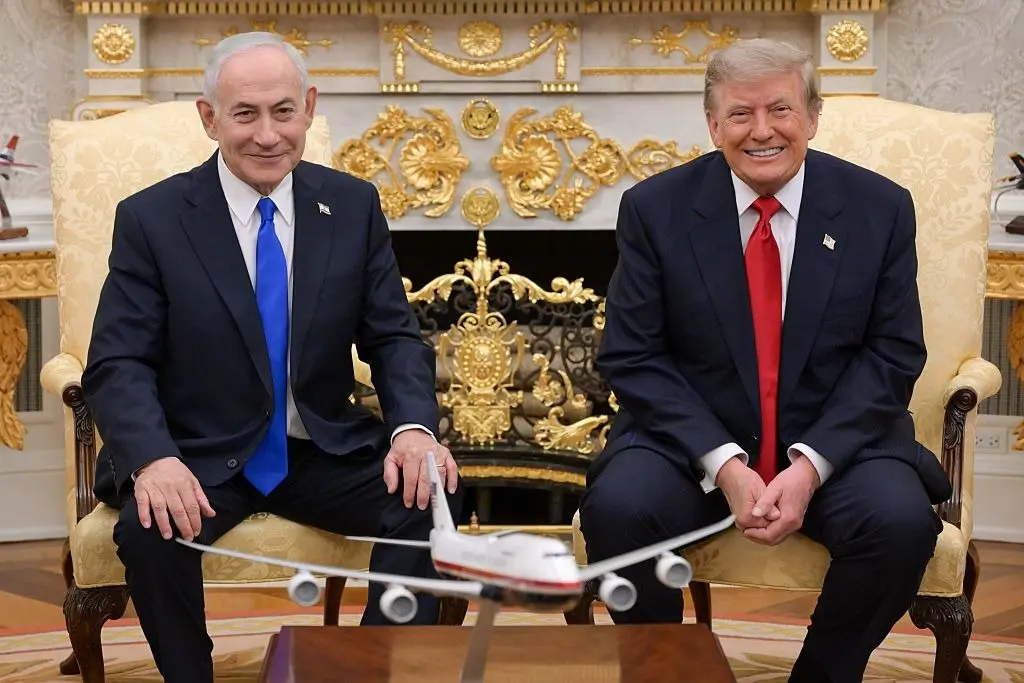
Published: October 18, 2026
Dateline: WASHINGTON & JERUSALEM
Executive Overview
With just nine days remaining before Israel’s fiercely contested national election, President Donald Trump has broken months of public ambiguity to deliver a sweeping endorsement of Prime Minister Benjamin Netanyahu. Released via a lengthy statement on Truth Social, Trump’s declaration did more than back a longtime political ally; it explicitly tethered the future of United States military intervention in the Middle East to the outcome of the Israeli ballot box.
Warning Israeli voters against choosing the "wrong Leader"—defined pointedly as anyone other than Netanyahu—Trump asserted that a change in Israel’s leadership would force Washington to shoulder the burden of neutralizing threats from Tehran unilaterally. This bold, interventionist stance marks a striking departure from historical diplomatic norms regarding foreign elections and injects the weight of the American presidency directly into Israel’s domestic political arena.
The endorsement arrives at a critical juncture. Israelis are preparing to head to the polls on October 27 for their first national referendum since the devastating October 7, 2023, attacks by Hamas. Against the backdrop of an ongoing, multi-front regional conflict—spanning hostilities with Iran, military campaigns in Lebanon, and protracted ceasefire negotiations in Gaza—Netanyahu finds himself locked in a tight race against a formidable opposition bloc. For the incumbent prime minister, Trump’s backing is a potent political lifeline; for international observers, it signals a high-stakes realignment of Washington’s strategic calculus in the Middle East.
Detailed Chronology: From Diplomatic Distance to Unabashed Backing
A Relationship Defined by Tension and Alliance
The path to Trump’s October 18 endorsement was neither direct nor guaranteed. For the better part of a year, the relationship between the two leaders has navigated periods of distinct strain. Despite their historical partnership—cemented during Trump’s first term through landmark moves such as the relocation of the U.S. Embassy to Jerusalem and the brokering of the Abraham Accords—recent geopolitical realities have sown friction.
The nearly eight-month war with Iran, escalating military operations in Lebanon, and persistent disagreements over the terms of a durable ceasefire in Gaza have tested the limits of their alliance. Earlier this month, Trump appeared to deliberately distance himself from Israeli domestic politics. In an interview published by Time magazine on October 1, 2026, when flatly asked whether he supported Netanyahu’s reelection bid, Trump maintained a guarded stance: "I’m not involved in politics anymore."
The Sudden Pivot on Truth Social
That diplomatic distance vanished on Sunday, October 18. In a strongly worded social media post, Trump performed an about-face, embracing Netanyahu as a "Great Warrior Prime Minister" and framing him as an indispensable partner in the ongoing confrontation with Iran.
The core of Trump’s argument rested on a blunt ultimatum to the Israeli electorate. In the statement, Trump wrote:
"If Israel has the wrong Leader, which would be anyone other than Bibi, America will have to do this work ourselves, and I am not inclined to do so."
Beyond endorsing Netanyahu’s political survival, Trump issued a stern, direct threat to the Iranian leadership, warning that Washington would "soon finish the job" against Tehran unless its regime changes course rapidly.
Swift Reception and Campaign Fallout
Prime Minister Netanyahu moved quickly to capitalize on the endorsement, recognizing its immense gravity among right-leaning and security-focused Israeli voters. Taking to social media platforms, including X (formerly Twitter), the Israeli leader expressed profound gratitude.
"President Trump, my friend Donald — thank you for your extraordinary endorsement," Netanyahu posted. "Israel has never had a greater friend in the White House. Together we will never let Iran’s regime get nuclear weapons. Thank you for your clarity, courage and unwavering support."
Netanyahu’s ruling Likud party immediately amplified the momentum, circulating a campaign video highlighting the close rapport and historical alignment between the two leaders.
Supporting Context & Metrics: The Israeli Electoral Landscape
The Domestic Opposition and Parliamentary Math
Trump’s late-stage intervention drops into an intensely volatile domestic political ecosystem. Israel’s upcoming October 27 election represents a historic turning point, marking the nation’s first trip to the polls in the shadow of the existential security crisis triggered by Hamas in late 2023.
Netanyahu faces a united and highly competitive opposition. Led by prominent figures such as former military chief of staff Gadi Eisenkot and former Prime Minister Naftali Bennett, opposition parties have capitalized on public exhaustion with the prolonged conflict, economic strain, and questions surrounding national security preparedness.
Recent pre-election polling data underscores the precariousness of Netanyahu’s political standing:
- The Majority Threshold: To form a governing coalition in Israel’s 120-member unicameral parliament (the Knesset), a party or bloc must secure a minimum of 61 seats.
- Current Projections: Aggregate tracking polls indicate that Netanyahu’s right-wing governing bloc is consistently tracking just below the magic number, hovering between 55 and 59 projected seats.
- The Kingmaker Dynamic: The shortfall suggests that even with Trump’s high-profile endorsement, Netanyahu will likely be forced to rely on marginal factional parties to scrape together a functional coalition, deepening the polarization within the electorate.
Shifting U.S. Norms in Foreign Interventions
Trump’s explicit endorsement of Netanyahu reflects a broader, systemic shift in his political strategy regarding foreign democracies. Traditionally, U.S. presidential administrations have rigorously adhered to a diplomatic protocol of neutrality, avoiding direct endorsements in foreign elections to prevent blowback and preserve long-term bilateral relations regardless of who wins.
Over recent years, however, Trump has repeatedly upended this playbook. He has openly waded into foreign electoral politics to back favored conservative and nationalist leaders across the globe, registering prominent interventions in countries such as Hungary, Japan, and Argentina. By drawing a direct line between Israeli voting patterns and American military restraint, Trump’s endorsement of Netanyahu takes this interventionist model to an unprecedented geopolitical scale.
Official Statements and Diplomatic Reactions
The convergence of U.S. electioneering and Israeli domestic politics has sent shockwaves through international diplomatic circles, drawing sharp contrasts between enthusiastic supporters and cautious critics.
Washington and the Trump Administration
While the White House and State Department have traditionally maintained a diplomatic buffer against open electoral interference, Trump’s unfiltered messaging bypassed standard channels entirely. The underlying doctrine of the endorsement—an "America First" conditionality tied to foreign leadership—reinforces Trump’s core foreign policy narrative: that U.S. military commitments abroad must be offset by strong, capable, and ideologically aligned local proxies.
Supporters of the endorsement argue that Trump is demonstrating refreshing diplomatic clarity. Proponents contend that a fractured Israeli leadership or a center-left coalition could falter in the face of Iranian aggression, leaving Washington with no viable alternative to direct military engagement.
Israeli Political Reactions
Inside Israel, the reaction was deeply polarized, reflecting the country’s broader societal schism:
- The Likud Perspective: Likud lawmakers hailed the endorsement as proof of Netanyahu’s unmatched international stature and his unique ability to secure vital American backing for Israel’s existential military campaigns.
- The Opposition View: Critics and opposition leaders condemned the intervention as an unwarranted external pressure campaign designed to sway voters through fear of American abandonment. Opponents argued that national security policy should be dictated by the collective will of the Israeli public and the resilience of its institutions, rather than the personal political preferences of a U.S. president.
Future Outlook: Implications for Regional Stability
As Israelis prepare to cast their ballots on October 27, the stakes could not be higher. Trump’s endorsement has fundamentally transformed the narrative of the election, shifting the debate from domestic governance and post-war reconstruction to the stark realities of regional war and peace.
Scenario Analysis: Netanyahu’s Victory
Should Netanyahu defy the polls and secure a governing majority—bolstered in part by right-wing voters galvanized by Trump’s warning—the immediate outcome will likely be an intensification of aggressive containment policies toward Iran and its regional proxies. Buoyed by Washington’s implicit partnership, a returning Netanyahu administration would likely feel empowered to complete ongoing military objectives in Lebanon and Gaza, secure in the knowledge that the White House remains ideologically aligned against Tehran. However, such an outcome could also deepen regional instability and complicate future multilateral ceasefire frameworks.
Scenario Analysis: An Opposition Victory
Conversely, if the Israeli electorate rejects Netanyahu in favor of the opposition coalition led by figures like Eisenkot or Bennett, Washington will face an immediate diplomatic test. True to Trump’s stated warning, an administration in Jerusalem untethered to Netanyahu could prompt a strategic recalibration in Washington. Whether Trump would follow through on his threat to withhold direct U.S. military initiatives against Iran—or whether institutional defense structures within the Pentagon would compel intervention regardless—remains one of the most volatile uncertainties in modern geopolitics.
Ultimately, October 27 will decide more than the makeup of the next Knesset; it will test the durability of the U.S.-Israel alliance and determine whether the future security of the Middle East is forged by local leadership or dictated from Washington.