

Executive Overview
The digital landscape of the twenty-first century is littered with the ghosts of once-dominant tech brands. Few names, however, carry the specific, nostalgic, and slightly infamous cultural weight of LimeWire. To a generation of internet users who came of age in the early 2000s, LimeWire was synonymous with peer-to-peer (P2P) file sharing, the wild west of MP3 downloads, and, inevitably, a minefield of computer viruses.
Today, that narrative has undergone a radical metamorphosis. Reimagined from the ground up, the modern iteration of LimeWire has successfully transitioned from a controversial music-sharing client into a cutting-edge, blockchain-integrated AI content publishing platform known as LimeWire AI Studio.
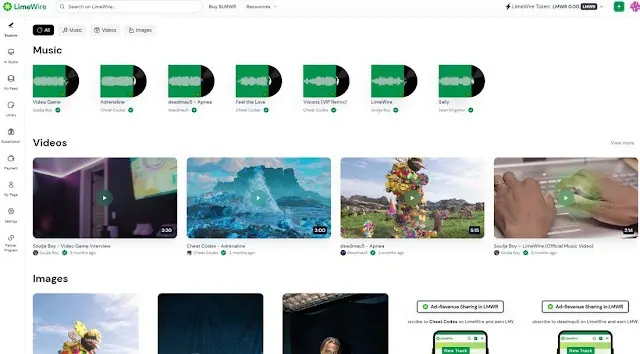
By merging generative artificial intelligence—specifically advanced text-to-image engines—with Web3 infrastructure like automated NFT minting and utility tokenomics, LimeWire is positioning itself at the intersection of creativity, decentralization, and monetization. Prominent artists, musicians, and digital creators, including mainstream cultural figures like Deadmau5, Soulja Boy, and Sean Kingston, have already gravitated toward the platform to publish tokenized media. This in-depth investigative report explores LimeWire’s technological architecture, its disruptive creator-economy models, tokenized revenue streams, and what the future holds for this unexpected tech resurrection.
Detailed Chronology: The Evolution of LimeWire
To understand LimeWire’s current positioning in the generative AI market, it is vital to trace its trajectory from a legal battleground to a modern technological hub.
Phase 1: The P2P Era (2000–2010)
Founded in 2000 by Mark Gorton, LimeWire was written in Java and allowed users to share files over the Gnutella network. At its peak, it was the most popular file-sharing client in the world. However, its decentralized architecture made it a primary vehicle for copyright infringement, leading to a protracted and devastating legal battle with the Recording Industry Association of America (RIAA). In October 2010, a federal judge ordered LimeWire to shut down its file-sharing operations, seemingly ending the brand’s lifespan.
Phase 2: The Web3 Pivot (2022)
More than a decade after its court-ordered shutdown, the LimeWire brand was acquired by Austrian entrepreneurs Julian and Paul Zehetmayr. Rather than attempting to resurrect the defunct P2P software, the new leadership recognized the immense cultural equity remaining in the brand name. In 2022, they relaunched LimeWire as a digital collectibles marketplace for music and art, utilizing blockchain technology to legally bridge creators and fans.
Phase 3: The Generative AI Integration (2023–Present)
As the generative AI boom accelerated, LimeWire pivoted once more, integrating advanced text-to-image tools into its ecosystem. Transforming into LimeWire Studio, the platform bridged the gap between effortless content creation and decentralized monetization. Today, it serves as a hybrid generative AI workspace and social marketplace where users can conceptualize, mint, publish, and monetize digital assets seamlessly.
Technological Architecture: Inside LimeWire AI Studio
At the core of the modern LimeWire experience is its robust AI image generation engine. Designed to cater to both novices and professional digital artists, the platform supports several of the industry’s most powerful open-source and proprietary models.
Multi-Model Support and Flexibility
Unlike platforms locked into a single proprietary engine, LimeWire Studio provides users with direct access to a diverse suite of state-of-the-art generative models, including:
- Stable Diffusion 2.1
- Stable Diffusion XL (SDXL)
- DALL-E 2
This multi-model integration allows creators to experiment with different underlying neural architectures depending on their specific artistic requirements—whether they are looking for hyper-realistic cinematic renders or stylized fantasy illustrations.
Granular Creative Controls
LimeWire does not merely offer a simple text box; it provides a comprehensive digital studio suite. Users can leverage advanced tools such as:
- Style Switchers: Instantly shift aesthetics between cinematic, digital art, pixel art, anime, analog film, and 3D render styles.
- Samplers and Customization: Fine-tune the inference steps, detail levels, and aspect ratios of generated outputs.
- Prompt Guidance: Built-in optimization aids assist users in writing more descriptive prompts to achieve high-fidelity results.
Furthermore, platform developers have confirmed that LimeWire is actively engineering its own proprietary AI model, signaling a transition from an aggregator of third-party tools to a primary developer of generative infrastructure.
Web3 Integration: Automated NFTs and Creator Monetization
What truly separates LimeWire from traditional AI art generators like Midjourney or Adobe Firefly is its native integration with blockchain technology and decentralized finance (DeFi) principles.
Frictionless NFT Minting
Once a user generates an image, music track, or video clip on LimeWire, they are given the option to publish it directly to the LimeWire Studio feed. Upon publication, the platform automatically mints the creation as a Non-Fungible Token (NFT) on either the Polygon or Algorand blockchain.
This automated process removes the technical hurdles typically associated with Web3 development—such as gas fee management, smart contract deployment, and wallet configurations—allowing everyday creators to establish immutable digital ownership of their work with a single click.
Dual Distribution Models: Public vs. Exclusive
Creators retain absolute sovereignty over how their tokenized content is distributed:
- Public Release: Content is made discoverable across the global LimeWire feed, allowing casual viewers to browse, interact with, and trade the associated NFTs on the secondary market.
- Subscriber-Only Exclusivity: Creators can gate their content, making it accessible exclusively to paying monthly subscribers. This fosters intimate creator-fan ecosystems reminiscent of Patreon or OnlyFans, but backed by tradeable digital assets.
The Royalty Economy
When digital collectibles are traded within the LimeWire community, original creators are hardcoded to receive a 2.5% royalty on secondary sales. This ensures a continuous passive income stream as an artist’s community and portfolio grow in value.
Tokenomics and Revenue Sharing
LimeWire operates on a progressive economic model designed to reward active participants through ad-revenue sharing and its native cryptocurrency token, LMWR.
70% Ad-Revenue Sharing Model
When content is published on LimeWire and viewed by other platform users, generated ad revenue is funneled directly back to the creator. Depending on the creator’s tier, they can receive up to 70% of all ad revenue generated by their images, music, and videos.
The LMWR Utility Token
All financial distributions on LimeWire are settled in LMWR, the platform’s native ERC-20 cryptocurrency.
- Monthly Distributions: Earnings are paid out monthly in LMWR tokens.
- Exchange Liquidity: LMWR is listed on several prominent global cryptocurrency exchanges, including Kraken, ByBit, and Uniswap, allowing users to easily convert their digital earnings into fiat currency.
- Platform Utility: Beyond cashing out, creators can use LMWR tokens directly on the platform to purchase additional prompt credits for their generative AI workflows.
Subscription Pricing Tiers and Metrics
LimeWire operates on a freemium model designed to lower the barrier to entry while scaling capabilities for power users and professional design agencies.
| Tier Name | Monthly Cost | Credits / Month | Est. Image Generations | Ad Revenue Share | Key Perks |
|---|---|---|---|---|---|
| Free Plan | $0 | 10 credits | ~20 images | 50% | Basic model access, community feed access. |
| Basic Pro | $9.99 | 1,000 credits | ~2,000 images | 50% | Pro badge, creation history, ad-free, faster generation. |
| Advanced Pro | $29.00 | 3,750 credits | ~7,500 images | 60% | Early access to new AI models, higher revenue share. |
| Elite Pro | $49.00 | 5,000 credits | ~10,000 images | 70% | Maximum ad-revenue share, priority generation queues. |
| Master Pro | $99.00 | 11,250 credits | ~22,500 images | 70% | Enterprise-grade allocation, highest tier priority support. |
Note: All paid tiers automatically strip platform advertisements, provide full creation histories, grant Pro profile badges, and offer accelerated processing speeds during peak platform hours.
Official Statements and Industry Perspective
Leadership within the LimeWire ecosystem has consistently emphasized that the platform’s core mission is the democratization of art and digital entrepreneurship.
"We are building an ecosystem where imagination translates directly into ownership," noted a representative close to the platform’s development. "By combining the accessibility of state-of-the-art generative AI with the economic sovereignty of Web3 and automated NFT minting, we are removing the traditional gatekeepers of the creative industries. Artists no longer just share content; they own, trade, and monetize their digital intellectual property directly with their audiences."
Industry analysts have observed that while platforms like OpenSea pioneered digital collectibles and tools like Midjourney pioneered AI art, the convergence of both technologies under a unified social publishing network represents a uniquely holistic approach to the modern creator economy.
Future Outlook: Beyond Image Generation
As the generative AI race intensifies, LimeWire is far from resting on its laurels. The platform’s roadmap outlines aggressive expansion into multi-modal content creation.
Upcoming Audio and Video Generation Tools
While LimeWire Studio is currently anchored by text-to-image capabilities, platform developers have announced imminent expansions into AI-powered music and video generation. This strategic evolution will allow musicians, filmmakers, and digital storytellers to harness the same accessible prompt-based workflows to produce complex auditory and motion-picture assets.
Expanding the Web3 Footprint
As blockchain infrastructure matures and gas fees on layers like Polygon and Algorand remain negligible, LimeWire aims to further integrate decentralized identity (DID) solutions and cross-chain interoperability. This will allow creators to effortlessly export their LimeWire-minted assets to external marketplaces while retaining native platform benefits.
Conclusion
LimeWire’s journey from a controversial P2P software client in the 2000s to a sophisticated generative AI and Web3 publishing platform is one of the most fascinating brand pivots in technology history. By successfully identifying the convergence of artificial intelligence, blockchain ownership, and creator monetization, LimeWire has carved out a distinct and highly functional niche in the modern digital economy.
For casual hobbyists looking to experiment with generative art for free, or professional designers seeking a robust ecosystem that rewards their output through ad-revenue sharing and automated NFTs, LimeWire AI Studio offers a compelling, comprehensive toolkit. As the platform prepares to launch its highly anticipated music and video generation suites, LimeWire stands firmly at the vanguard of the next wave of digital creativity.
