

Executive Overview
When NASA’s Voyager 2 spacecraft made its historic, solitary flybys of Uranus in 1986 and Neptune in 1989, it sent back data that baffled planetary scientists. Instead of the orderly, dipole magnetic fields characteristic of Earth and Jupiter—where magnetic north and south align reasonably close to the planet’s rotational axis—these two outer ice giants displayed wildly distorted, profoundly tilted, and offset magnetic personalities. For nearly four decades, the mechanisms driving these bizarre configurations remained one of the solar system’s most stubborn planetary enigmas.
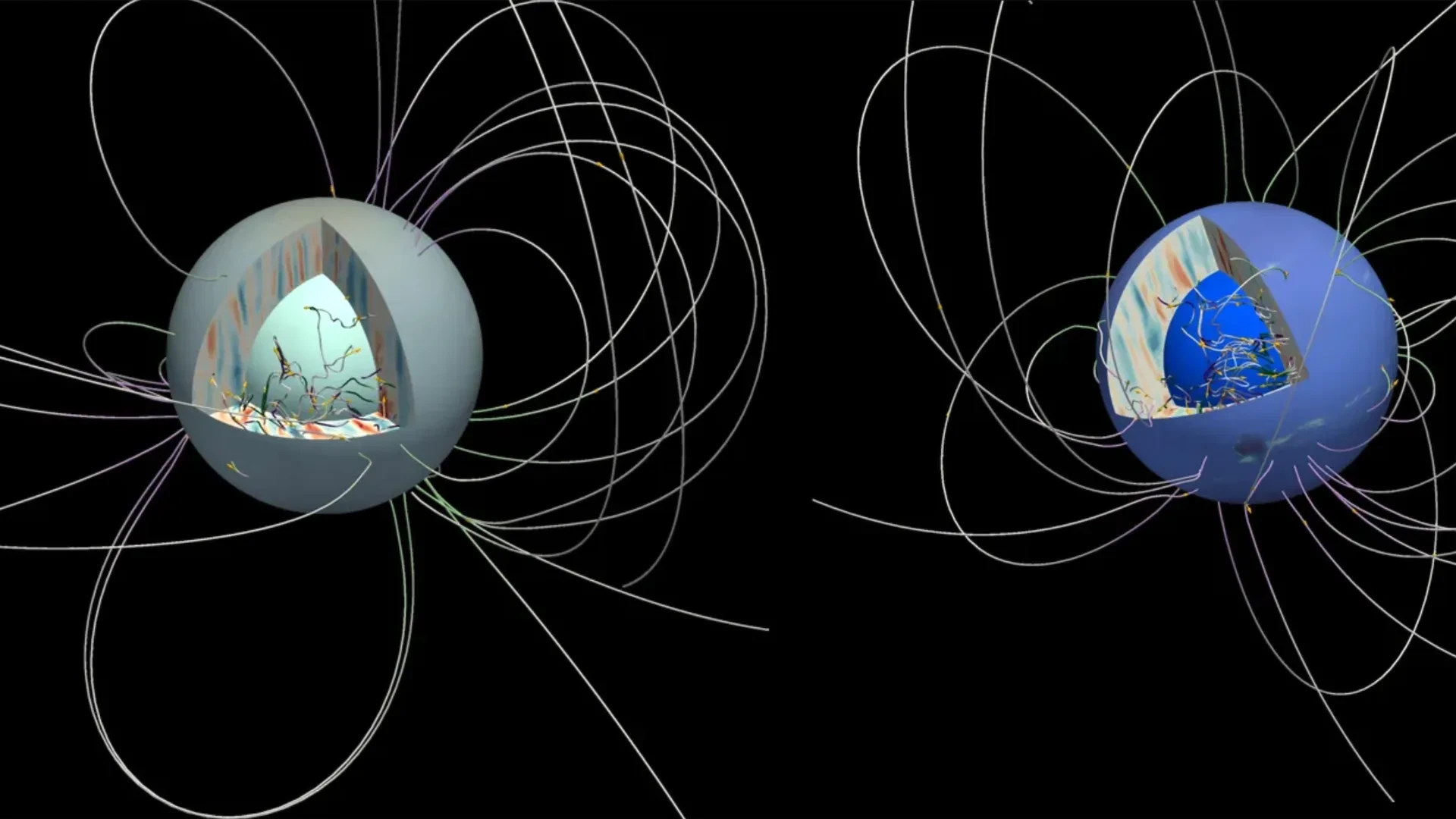
Now, a groundbreaking study published in Communications Physics offers a compelling solution. Spearheaded by researchers at The University of Texas at Austin in close collaboration with the University of California, Los Angeles, Imperial College London, and Northumbria University, the new research points deep into the internal dynamics of these massive worlds. By examining how extreme pressure and temperature alter the electrical conductivity of materials in the planets’ interiors, scientists have constructed advanced computer simulations that successfully replicate the strange dynamos of Uranus and Neptune.
Even more provocative than the explanation of their current states is the study’s prediction of dynamic instability: the magnetic fields of Uranus and Neptune may not be static, slowly drifting features like Earth’s. Instead, computational models suggest they can swing by tens of degrees over the span of mere decades. This radical variability implies that the magnetic architectures of Uranus and Neptune today could look entirely different from the snapshots captured by Voyager 2 over thirty years ago. As researchers turn the infrared gaze of the James Webb Space Telescope (JWST) toward the auroras and ionospheres of these distant worlds, humanity stands on the brink of verifying whether these dynamic planetary engines are shifting in real-time.
Detailed Chronology of Discovery and Research
To appreciate the gravity of the recent findings, it is essential to trace how our understanding of planetary magnetism has evolved from Voyager’s initial discoveries to the sophisticated multi-institution collaboration of today.
The Voyager Era: Upending Planetary Magnetism (1986–1989)
Before the mid-1980s, planetary scientists had a relatively straightforward paradigm for how planetary magnetic fields worked. Earth, Jupiter, and Saturn all possessed primary magnetic fields dominated by a strong axial dipole—meaning their magnetic axes were tilted at relatively modest angles relative to their rotational axes (Earth’s dipole is tilted by a mere 11 degrees).
When Voyager 2 swept past Uranus in January 1986, it discovered a magnetic shock. Uranus’s magnetic dipole was tilted at a staggering 59 degrees relative to its rotational axis, and it was significantly offset from the planet’s geometric center. Three years later, when Voyager 2 encountered Neptune in August 1989, history repeated itself: Neptune’s magnetic dipole was tilted by 47 degrees and similarly offset. Furthermore, neither planet’s magnetic field matched the simple bar-magnet structure familiar to terrestrial science. Instead, their fields possessed powerful quadrupole and octupole components, suggesting that the dynamo generation mechanism was operating much closer to the surface or within unconventional fluid layers than previously imagined.
Decades of Impasse and Theoretical Modeling (1990s–2010s)
In the years following the Voyager encounters, theorists attempted to model these strange configurations. Because Uranus and Neptune are classified as "ice giants"—worlds roughly four times the diameter of Earth, rich in volatile compounds like water, ammonia, and methane, compressed under extreme planetary depths—researchers initially struggled to pin down their internal physical states.
Traditional dynamo models, which successfully explained Earth and the gas giants, fell short when applied to ice giants. The exact equations of state for water and other "ices" under megabar pressures were poorly understood. Scientists knew that high pressures could ionize fluids, making them electrically conductive, but how that conductivity varied radially throughout the core and mantle remained a black box. Consequently, theories ranged from sluggish, non-convecting core structures to multi-layered fluid dynamos, yet none could consistently reproduce the extreme tilts without making unrealistic assumptions about fluid velocities or interior compositions.
The Breakthrough: The UT Austin-Led Study (Present)
The impasse began to clear when a team led by Chi Yan, a research associate at the UT Jackson School of Geosciences, approached the problem by questioning standard assumptions about electrical conductivity gradients. Rather than treating electrical conductivity as uniform or simply scaling linearly with depth, the researchers incorporated advanced models of material behavior under extreme pressures.
By running complex magnetohydrodynamic computer simulations that incorporated depth-dependent electrical conductivity, the research team achieved what previous models could not: self-consistent dynamos that naturally produced highly tilted, offset magnetic fields resembling those of Uranus and Neptune. This breakthrough bridges the gap between the bulk chemical composition of ice giants and the magnetic phenomena observed at their surfaces.
Supporting Context & Metrics
Understanding the mechanics of these worlds requires examining the profound physical differences between terrestrial planets, gas giants, and ice giants.
Planetary Compositions and Structural Metrics
To grasp the scale of Uranus and Neptune, consider their fundamental metrics:
- Size and Mass: Both planets have equatorial radii roughly four times that of Earth. Neptune is slightly smaller in radius than Uranus (about 24,622 km vs. 25,362 km), but it is denser and possesses a higher mass due to a more compact, rock-heavy core.
- Internal Zoning: Unlike gas giants (Jupiter and Saturn), which are dominated by hydrogen and helium from top to bottom, ice giants are thought to feature a three-layer architecture: a rocky silicate/iron core, a thick, fluid "mantle" composed of superionic water, ammonia, and methane fluids (often colloquially referred to as "ice," though it exists in high-pressure liquid or plasma states), and a relatively thin outer envelope of hydrogen and helium.
- The Dynamo Process: On Earth, the geodynamo is driven by thermal and compositional convection in the liquid iron outer core. The Coriolis force, resulting from Earth’s rotation, organizes these swirling molten metal currents into columns, aligning the magnetic field along the axis of rotation. In contrast, the mantles of Uranus and Neptune undergo extreme thermodynamic states where water molecules dissociate into mobile hydrogen and oxygen ions.
The Physics of Depth-Dependent Conductivity
The core innovation of the new study lies in how electrical conductivity changes throughout the mantle. Chi Yan and colleagues modeled scenarios where materials become increasingly electrically conductive as depth—and consequently pressure and temperature—increases.
When fluids exhibit this depth-dependent conductivity, the boundary layers where the dynamo operates shift. Instead of a deep-seated core generating the field, the magnetic forces are generated across a broader, more heterogeneous shell. This variation in electrical properties disrupts the clean alignment with the rotational axis, forcing the dipole to tilt and twist into the extreme configurations observed by Voyager 2.
Comparative Planetary Magnetic Metrics
| Planet | Rotational Axis Tilt | Magnetic Dipole Tilt | Dominant Dynamo Region | Field Stability (Observed/Modeled) |
|---|---|---|---|---|
| Earth | 23.5 degrees | 11 degrees | Outer Core (Molten Iron) | Highly stable; slow secular drift. |
| Uranus | 97.8 degrees (rolling on its side) | 59 degrees | Deep Fluid Mantle (Ionized "Ices") | Highly dynamic; potential decadal shifts. |
| Neptune | 28.3 degrees | 47 degrees | Deep Fluid Mantle (Ionized "Ices") | Highly dynamic; potential decadal shifts. |
Official Statements and Expert Analysis
The implications of the research extend far beyond the specific characteristics of Uranus and Neptune, offering new frameworks for understanding exoplanetary magnetic fields throughout the galaxy.
"Deep inside Uranus and Neptune, pressures and temperatures become extremely high," explained Chi Yan, lead author of the study from the UT Jackson School of Geosciences. Elaborating on the transition of materials under these pressures, Yan noted that conditions "can cause water molecules to break apart into ions, the material may become increasingly electrically conductive with depth."
Discussing the surprising instability predicted by their models, Yan contrasted the ice giants with our home planet: "Earth’s magnetic tilt drifts by only a degree or so over 50 years. Our models show the ice giants can behave very differently. In some stretches the tilt swings by tens of degrees within decades. In others it shifts only slightly over the same span."
The observational validation campaign relies heavily on remote sensing via space-based observatories. Tom Stallard, a professor at Northumbria University who led the James Webb Space Telescope observation campaign and reviewed the paper for Communications Physics, emphasized the utility of atmospheric diagnostics:
"We are busy working on what’s contained within these observations, but the shape and structure of the aurora, as well as other weird patterns in the ionosphere, promises to provide us with a way of understanding how the magnetic fields have changed, an important stepping stone."
Stallard and his colleagues are systematically analyzing infrared signatures from the ionospheres of Uranus and Neptune. Because auroral ovals are pinned to the magnetic poles where charged solar wind particles funnel into a planet’s upper atmosphere, any significant migration of the magnetic poles will visibly distort the geometry of the auroras over time.
Future Outlook and Next Steps in Ice Giant Exploration
As planetary scientists digest the conclusions of the UT Austin-led study, the field stands on the threshold of a new observational and exploratory era. The coming decades will likely see a convergence of advanced telescope data, refined laboratory experiments, and potentially, dedicated space missions to the outer solar system.
Leveraging the James Webb Space Telescope (JWST)
The immediate testing ground for the new dynamo models is the JWST. By capturing high-resolution infrared spectra and imagery of Uranus and Neptune, researchers can map the distribution of molecular hydrogen emission and hydrocarbon ions in the ionosphere. If the computer simulations are correct—and the magnetic fields are shifting by tens of degrees over decades—current JWST observations should reveal auroral locations and morphologies that deviate measurably from the maps constructed using Voyager 2 data collected in the 1980s.
Laboratory Astrophysics and Extreme States of Matter
To further refine the computer models, physicists are turning to high-power laser facilities (such as the National Ignition Facility) to recreate the extreme pressures and temperatures found deep inside ice giants. By subjecting water and ammonia samples to shock compression, researchers can measure their electrical conductivity and equation of state with empirical precision, replacing theoretical estimates with hard laboratory data.
The Case for a Dedicated Ice Giant Mission
While computer models, laboratory experiments, and JWST observations provide vital indirect evidence, planetary scientists universally agree that resolving the mysteries of Uranus and Neptune ultimately requires an in-house inspection. Both the planetary science decadal survey commissioned by NASA and the European Space Agency (ESA) have identified an orbiter and probe mission to Uranus or Neptune as a top priority for future flagship exploration.
A dedicated spacecraft equipped with modern magnetometers, gravity-sounding instruments, and atmospheric probes could spend years orbiting an ice giant, directly measuring temporal changes in its magnetic field, mapping its interior structure, and verifying whether its dynamo is undergoing the rapid, chaotic shifts predicted by the latest simulations.
Until such a mission launches, the combination of brilliant theoretical modeling, advanced supercomputing, and the unprecedented sensitivity of space-borne telescopes like JWST represents humanity’s best path forward. In unlocking the magnetic secrets of Uranus and Neptune, scientists are not only solving a quirk of our own solar system—they are decoding universal principles of planetary physics that govern countless ice-rich worlds orbiting distant stars across the galaxy.
