

Executive Overview
The abrupt shuttering of the Tesla Cybertruck production line marks more than just the commercial failure of an eccentric vehicle; it serves as a symbolic epitaph for a distinct, chaotic epoch in American socio-technical history. When Tesla CEO Elon Musk officially announced in November 2026 that the company was winding down manufacturing of its polarizing electric pickup to pivot toward the autonomous "Cybercab," it drew the curtain on a three-year experiment in automotive hubris.
From its initial deliveries in late 2023 to its quiet execution, the Cybertruck was never merely a car. It was a rolling monument to a get-rich-quick culture, an artifact of deep-seated societal paranoia, and the personal vanity project of the world’s wealthiest individual. While Tesla sold roughly 70,000 units—falling woefully short of Musk’s bombastic, initial prediction of 250,000 units annually—the vehicle’s footprint extended far beyond sales figures.
It became a lightning rod for ideological alignment, a physical manifestation of late-stage techno-solutionism, and an object of intense public derision. This investigation explores the rise and fall of the Cybertruck: its engineering catastrophes, its entwining with toxic political movements, and what its ultimate demise reveals about the shifting sands of Silicon Valley and American culture.
Detailed Chronology: From Brooklyn Novelty to Corporate Retreat
1. The Early Days: Novelty on the Streets of New York
In early 2024, spotting a Cybertruck in the wild was an exercise in surrealism. In neighborhoods like Williamsburg, Greenpoint, Bedford-Stuyvesant, and Crown Heights, the appearance of a matte-black variant bearing a "To the Moon" cryptocurrency decal was a rare spectacle. At the time, these angular behemoths were treated as rolling novelties—singular pieces of evidence that consumers were actually biting on Musk’s high-priced, sci-fi-inspired sales pitch.
2. The Scaling Reality and Engineering Quagmires
As the months pressed on, the novelty wore off, replaced by the mundane and often comical realities of poor vehicle manufacturing. Built at the ironically named Gigafactory in Texas, the Cybertruck was engineered to resemble a dystopian war vehicle, complete with stainless-steel body panels and bullet-resistant doors. Yet beneath the aggressive exterior lay a cascade of mechanical and software failures.
- Water Vulnerability: Early adopters quickly discovered that exposing the vehicle to heavy rain could trigger catastrophic electrical failures, occasionally causing the trucks to brick completely.
- Utility Deficits: The awkward geometry of the exoskeleton rendered the bed largely impractical for traditional hauling, loading, or heavy towing.
- The Cold-Weather Crises: In early 2025, Tesla was forced to recall 46,000 units after discovering that exterior side panels had a dangerous tendency to detach in cold weather. Professional mechanics and automotive vloggers repeatedly exposed shoddy body panel alignment and substandard assembly standards.
3. The Political Pivot and the Shadow of DOGE
Simultaneously, Elon Musk’s public profile underwent a radical metamorphosis. Following the Cybertruck’s launch, Musk plunged headfirst into partisan politics, pouring nearly $300 million into the America PAC and other dark-money ventures to support Donald Trump’s 2024 presidential campaign.
As his online rhetoric intensified—targeting marginalized communities, immigration, and diversity initiatives while facing mounting workplace discrimination and sexual harassment lawsuits at his companies—the public perception of his flagship vehicle shifted irrevocably. When Trump took office in 2025, Musk assumed leadership of the Department of Government Efficiency (DOGE), a bureaucratic wrecking ball named after a 2010s internet meme. DOGE proceeded to slash thousands of federal jobs, paralyze regulatory bodies, and gut agencies like USAID, contributing directly to humanitarian crises and preventable disease outbreaks overseas.
4. The End of the Line
By late 2026, the cultural backlash was inescapable. Owners desperate to avoid public vandalism resorted to aftermarket bumper stickers reading, "I bought this before Elon went crazy." Others leaned aggressively into the culture war, wrapping their trucks in right-wing iconography and American flags. Driving a Cybertruck had ceased to be a simple consumer choice; it was an involuntary political declaration.
Recognizing a sinking ship—and bowing to the realities of low commercial adoption—Musk announced the termination of Cybertruck production to redirect corporate resources toward the Cybercab.
Supporting Context & Metrics: By the Numbers
To understand the Cybertruck’s trajectory is to examine the intersection of inflated corporate valuation, systemic regulatory loopholes, and viral marketing.
| Metric / Event | Data Point / Detail |
|---|---|
| Total Production Run | ~70,000 units (November 2023 – November 2026) |
| Initial Sales Target | 250,000 units per year (as predicted by Elon Musk) |
| Major Recall (2025) | 46,000 units recalled due to detached exterior panels in cold weather |
| Political Contributions | Nearly $300 million channeled into America PAC and allied ventures (2024) |
| Underlying Mechanics | Electric architecture plagued by software bugs, water sensitivity, and structural impracticality |
The vehicle’s design catered directly to the anxieties of a population destabilized by generations of economic precarity. It was electric to assuage climate anxiety; it was bulletproof to appeal to extremist gun culture and a pervasive fear of civil unrest; and it was styled like a video-game toy to capture the imaginations of a demographic raised on recycled superhero franchises.
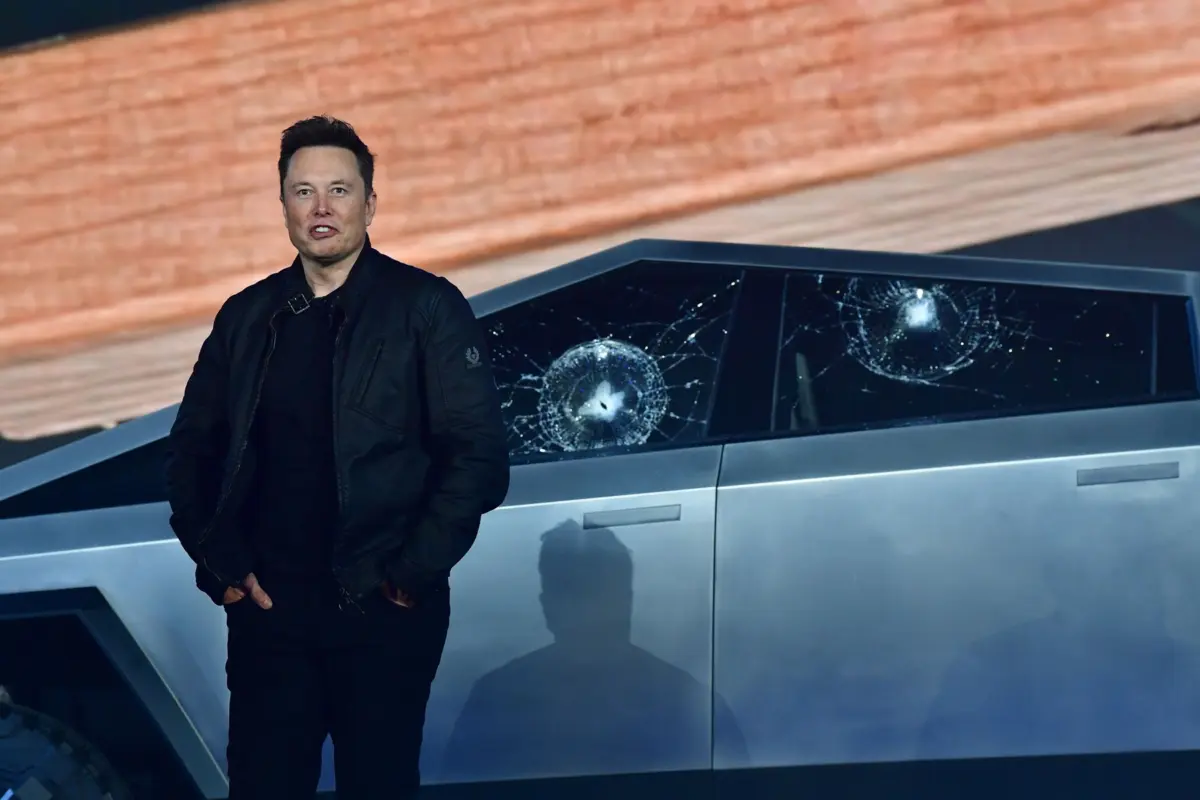
Yet, this aesthetic was underpinned by a business model reliant on government subsidies, aggressive stock manipulation, and a relentless stream of hollow promises. From the 2017 unfulfilled pledge of cross-country, fully autonomous road trips to the exaggerated durability tests on stage, the Cybertruck was the culmination of Musk’s career as a nihilistic salesman willing to bend reality to move inventory.
Official Statements and Industry Reactions
The wind-down of the Cybertruck production line has elicited sharp commentary from industry analysts, former insiders, and cultural observers.
In a brief corporate statement accompanying the November 2026 earnings call, Tesla management framed the pivot to the Cybercab as a "forward-looking transition toward scalable, autonomous urban mobility." The company emphasized that lessons learned from the Cybertruck’s stainless-steel architecture and low-voltage electrical systems would inform future platforms, though analysts remain skeptical.
Transportation safety advocates, however, offered a starkly different evaluation. In a joint statement released shortly after the cancellation announcement, urban safety coalitions highlighted the dangers posed by the Cybertruck’s rigid, unyielding exoskeleton:
"The Cybertruck represented a fundamental abdication of basic pedestrian safety principles. Its heavy, sharp-edged stainless-steel body panels were incompatible with modern urban infrastructure and standard safety regulations. Its departure from the market is a welcome relief for pedestrian advocacy groups and municipal planners alike."
Financial analysts pointed out that the vehicle was a massive capital sink that ultimately damaged Tesla’s broader brand equity among eco-conscious consumers—a demographic that historically formed the bedrock of the company’s customer base.
Future Outlook: Relics of a Dark Era
As the final Cybertrucks roll off the assembly line in Texas, the question turns to what will become of these angular leviathans.
In the immediate future, many will likely linger on suburban streets, maintained by enthusiasts or repurposed as moving billboards for political statements and crypto fortunes. Within a decade, however, automotive historians and environmental experts suggest a less glamorous fate. Many will sit on blocks in rural driveways, their stainless-steel skins gathering rust while massive lithium-ion battery packs slowly degrade, posing environmental hazards to nearby industrial sites and water tables.
Elon Musk, insulated by sovereign contracts, circular stock buybacks, and an endless pipeline of state capital, will remain immensely wealthy. His corporate empire will continue to adapt to shifting political winds, regardless of electoral outcomes or democratic erosion.
Yet, the Cybertruck will endure in the cultural memory as a masterclass in hubris—a physical manifestation of a uniquely broken era. It stands as a warning against the dangers of unchecked techno-authoritarianism, proving that no amount of marketing spin or bullet-resistant steel can permanently shield a bad idea from the unyielding laws of economics, engineering, and reality. Someday, society may look back upon the Cybertruck not as a harbinger of a bold, futuristic tomorrow, but as a bizarre, cautionary relic of a turbulent past we managed to survive.
