

Executive Overview
In the rapidly accelerating landscape of artificial intelligence and digital innovation, brand resurrections are rarely straightforward. Yet, few transformations match the dramatic pivot executed by LimeWire. Once synonymous with the 2000s peer-to-peer file-sharing era—a digital frontier defined by legal battles and copyright controversies—the brand has re-emerged as a sophisticated, Web3-integrated AI content publishing platform.
Today’s LimeWire is a far cry from its controversial ancestor. It positions itself as a comprehensive generative AI studio, empowering creators, digital artists, musicians, and everyday users to conceptualize, produce, and monetize digital media. By merging advanced generative AI architectures—such as Stable Diffusion and DALL-E—with blockchain-based automated minting and native cryptocurrency rewards, LimeWire has carved out a unique niche in the creator economy.
This deep-dive investigative report explores LimeWire’s technological architecture, its innovative monetization and royalty structures, its integration of non-fungible tokens (NFTs), and its strategic roadmap as it transitions from a specialized image generator into a multi-modal creative powerhouse.
Detailed Chronology: The Evolution of LimeWire
To understand LimeWire’s current market positioning, it is essential to trace its historical trajectory and the strategic pivot that brought it into the generative AI era.
Phase 1: The P2P Era (2000–2010)
Founded in 2000 by Mark Gorton, LimeWire was a dominant force in the early days of digital media distribution. Operating on the Gnutella network, it allowed millions of users worldwide to share music, movies, and software via decentralized peer-to-peer connections. However, the platform became the epicenter of the music industry’s copyright infringement wars. Following a landmark 2010 federal court ruling in Arista Records LLC v. Lime Group LLC, the platform was permanently shut down, cementing its legacy as a cultural artifact of early internet piracy.
Phase 2: The Web3 Rebirth (2022)
More than a decade after its shutdown, LimeWire was acquired by Austrian entrepreneurs Julian and Paul Zehetmayr. Rather than attempting to revive the legacy file-sharing service, the new ownership recognized a shifting digital paradigm. In 2022, LimeWire re-launched not as a piracy tool, but as a legitimate digital collectibles marketplace focused primarily on music and art NFTs. This strategic maneuver laid the groundwork for the platform’s subsequent technological pivot.
Phase 3: The Generative AI Pivot (2023–Present)
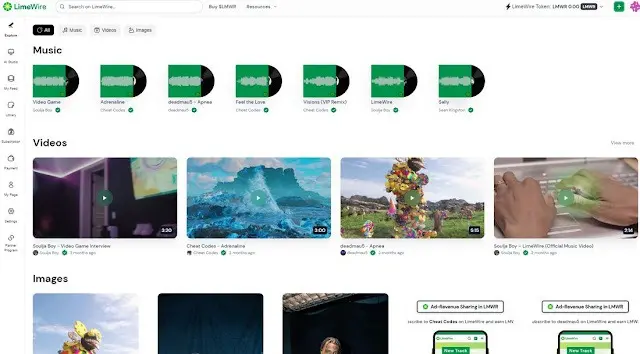
Capitalizing on the explosion of generative artificial intelligence, LimeWire integrated advanced text-to-image models directly into its platform, creating LimeWire AI Studio. This evolution transformed the platform from a passive marketplace into an active content-creation ecosystem. Today, prominent mainstream artists—including Deadmau5, Soulja Boy, and Sean Kingston—utilize LimeWire to publish, manage, and monetize AI-generated images, music, and multimedia assets, proving the platform’s viability as a mainstream creative hub.
Supporting Context & Metrics: Inside the LimeWire AI Studio
At the core of the modern LimeWire ecosystem is its generative AI suite. Designed to cater to both novices and professional digital artists, the platform integrates several industry-leading AI models alongside proprietary developments.
Advanced AI Models and Customization
LimeWire AI Studio currently supports a robust array of generative architectures, including:
- Stable Diffusion 2.1 & XL: Known for their fine-grained detail, high photorealism, and prompt adherence.
- DALL-E 2: Renowned for its conceptual range and artistic flexibility.
Users can initiate creations using simple text prompts or intricate multi-parameter instructions. Furthermore, the platform allows creators to effortlessly toggle between diverse visual styles:
- Cinematic
- Digital Art & Pixel Art
- Anime & Illustration
- Analog Film
To give creators granular control over their output, LimeWire incorporates advanced features such as samplers, negative prompting, and prompt-guidance scales. This ensures that the platform remains versatile enough for professional commercial designers while remaining accessible to casual users.
The Tokenomics of Creativity: LMWR and Revenue Sharing
What truly distinguishes LimeWire from standalone AI generators like Midjourney or DALL-E is its deeply integrated monetization framework. The platform operates on a dual-incentive model combining ad-revenue sharing and blockchain-based asset ownership.
- Ad-Revenue Sharing: Creators who publish their AI-generated images, music, and videos on LimeWire are eligible to receive up to 70% of the ad revenue generated when other users view their content. This creates a passive income stream for active community members.
- LMWR Utility Tokens: Earnings are distributed monthly in LMWR, LimeWire’s native utility cryptocurrency. LMWR can be traded on major centralized and decentralized exchanges—including Kraken, ByBit, and Uniswap—or reinvested directly back into the platform to purchase additional prompt credits.
Automated NFT Minting and Blockchain Integration
Every piece of content created and published on LimeWire can be automatically minted as a Non-Fungible Token (NFT) on eco-friendly, high-speed blockchains such as Polygon or Algorand.
This automated minting process provides creators with verifiable digital signatures, ensuring authentic ownership in decentralized environments. Creators retain full autonomy over distribution:
- Public Releases: Content is discoverable by the entire LimeWire community, maximizing exposure, engagement, and secondary market trading.
- Subscriber-Only Exclusivity: Creators can restrict access to their posts, offering premium content exclusively to paid subscribers.
To foster long-term creator sustainability, LimeWire implements a 2.5% royalty structure, ensuring that original creators receive a payout every time their digital collectible is traded on the secondary market.
Subscription Tiers and Pricing Matrix
LimeWire operates on a tiered subscription model designed to accommodate varying levels of creative output:
- Free Tier:
- Cost: $0 / month
- Credits: 10 credits daily (up to 20 image generations per day)
- Ad Revenue Share: 50%
- Basic Tier:
- Cost: $9.99 / month
- Credits: 1,000 monthly credits (up to 2,000 image generations)
- Perks: Early access to new AI models, 50% ad revenue share, Pro profile badge, and zero ads.
- Plus Tier:
- Cost: $29 / month
- Credits: 3,750 monthly credits (up to 7,500 image generations)
- Perks: Early access to models, 60% ad revenue share, Pro badge, full creation history.
- Pro Tier:
- Cost: $49 / month
- Credits: 5,000 monthly credits (up to 10,000 image generations)
- Perks: Early access to models, 70% ad revenue share, faster generation speeds.
- Advanced Pro Tier:
- Cost: $99 / month
- Credits: 11,250 monthly credits (up to 22,500 image generations)
- Perks: Maximum generation priority, 70% ad revenue share, exclusive community features.
Official Statements and Industry Reception
The strategic pivot of LimeWire has drawn significant attention from both the fintech and digital art sectors. Industry analysts view the platform as a fascinating case study in brand rehabilitation through emerging technologies.
In statements regarding the platform’s modern vision, the leadership team has consistently emphasized the democratization of creative tools. “Our objective has never been to look backward, but to look toward where digital expression is heading,” company representatives have noted in platform briefings. “By combining generative AI with true digital ownership via Web3 infrastructure, we are building an environment where artists are not just consumers of software, but stakeholders in their own success.”
Independent digital creators and early adopters have lauded the platform’s revenue-sharing mechanics. While traditional social media and image-hosting platforms often monetize user-generated content exclusively for corporate gain, LimeWire’s model redirects capital directly back to the creators via LMWR tokens and secondary market royalties.
However, industry watchdogs also emphasize the inherent volatility of cryptocurrency rewards and the intense competition within the generative AI market, where platforms must constantly innovate to maintain user retention.
Future Outlook: Beyond Image Generation
As LimeWire solidifies its position in the current digital landscape, its strategic roadmap points toward aggressive multi-modal expansion.
While the platform’s current generative capabilities are primarily focused on text-to-image processing, official development pipelines indicate impending expansions into AI music generation and video synthesis tools. By incorporating audio and motion media into the LimeWire Studio ecosystem, the platform aims to provide a unified workspace for multi-disciplinary artists.
Furthermore, ongoing development of LimeWire’s proprietary AI models signals a shift away from sole reliance on third-party open-source architectures. This internal innovation promises to yield bespoke styles, faster processing times, and enhanced safety guardrails for commercial content creators.
Conclusion
LimeWire’s evolution from a controversial 2000s file-sharing client into a state-of-the-art generative AI and Web3 publishing platform represents one of the most remarkable corporate pivots of the digital age. By dismantling traditional barriers to artistic production, automating blockchain authentication, and establishing a robust creator-first monetization model, LimeWire has successfully redefined its legacy.
For digital artists, musicians, and designers seeking an all-in-one ecosystem to create, share, and monetize their work, LimeWire AI Studio stands as a compelling, forward-looking platform poised at the intersection of artificial intelligence and the decentralized economy.
