

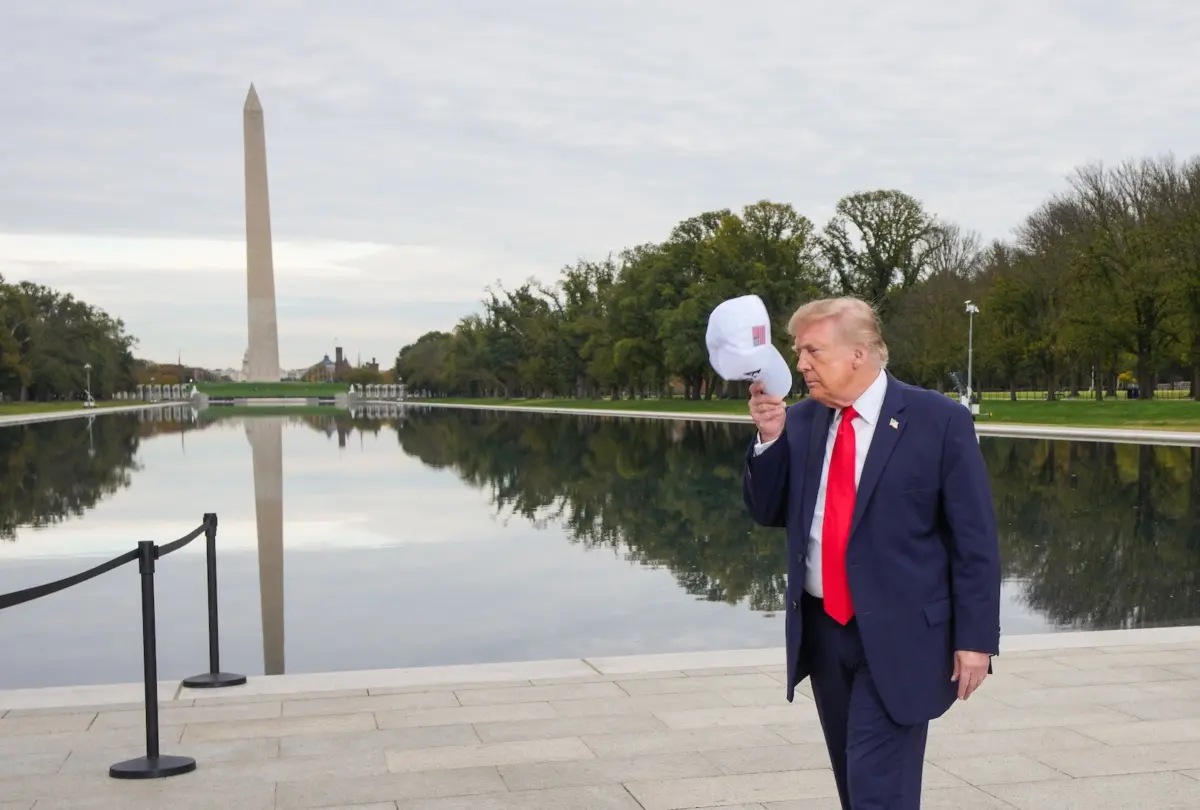
WASHINGTON — On the eve of the 2026 midterm elections, President Donald Trump delivered a sprawling, hour-long address before the Lincoln Memorial Reflecting Pool in Washington, D.C. Blending grievance with a closing pitch to save the Republican congressional majority, the president spent the opening portions of his speech fixated on local D.C. construction projects, monument restoration controversies, and jokes about renaming the iconic landmark in his honor.
When Trump finally pivoted to the impending elections more than 23 minutes into his remarks, his tone shifted from eccentric local commentary to stark alarmism. Forecasting potential major losses for the GOP in both the House and the Senate, he characterized the contest as "the most important midterm, I believe, in our lifetime."
Against the backdrop of record-shattering early voter turnout nationwide and final polling indicators pointing toward a substantial Democratic sweep, the president’s closing rally underscored the profound political peril facing his administration’s remaining two years in office.
Executive Overview
The final 24 hours of the 2026 midterm cycle have brought a collision of unprecedented early voting metrics and aggressive political rhetoric. President Trump’s address at the Lincoln Memorial encapsulated the anxieties of a sitting executive staring down the historical headwinds of a midterm referendum. While roughly 50 million Americans have already cast their ballots—shattering historic midterm benchmarks in states like Texas, Ohio, and South Carolina—final surveys from organizations like the New York Times/Siena University and the Cook Political Report suggest that a Democratic wave could be building.
According to projections, Democrats hold leads in all seven battlegrounds central to Senate control and are positioned to pick up 15 to 25 seats in the House. Should these numbers hold, the opposition party could secure its strongest legislative majority since 2009. Trump’s speech served as both a rallying cry for his base and an early acknowledgment of the daunting electoral map confronting Republicans as millions of remaining voters head to the polls on Election Day.
Detailed Chronology: The Final Campaign Push
The timeline leading up to the November 3, 2026, elections has been defined by historic logistical milestones and fierce partisan rhetoric.
Weeks Leading to Election Eve: The Early Vote Surge
Throughout October, election administrators nationwide reported unprecedented participation levels. In Texas, early voting numbers surpassed the total turnout records set during the landmark 2018 midterms, with over 7.7 million ballots cast before Election Day. Similar surges were documented across the Rust Belt and the South, including heavy turnouts in South Carolina and Ohio. Analysts noted an uptick in registered Democratic participation within key battleground regions, though pollsters cautioned that up to half of the total expected electorate planned to vote in person on Election Day itself, making pre-election margins volatile.
November 2, 2026: The Lincoln Memorial Address
In the shadow of the Capitol on Monday evening, President Trump took to the podium at the Lincoln Memorial Reflecting Pool—a site that has seen its share of administrative controversy throughout his second term. Speaking to a crowd of supporters on the final day of campaigning, Trump opened with unconventional tangents. He riffed on local District of Canada infrastructure projects, critiqued Washington contractors, and resurrected prior conspiracy theories regarding monument vandalism.
It was not until deep into the hour-long address that the president addressed the existential stakes facing the Republican Party. Acknowledging the historical trend wherein sitting presidents routinely suffer losses in midterm elections, Trump urged his base to defy political gravity.
"If the people that voted for me and voted in the last election where we had such a great victory, if they go out and vote, just a good portion of them, we will win in a landslide," Trump told the crowd. "Now that doesn’t happen because usually whoever the sitting president is, Republican or Democrat… for some reason the sitting president doesn’t win the midterms, but we gave this a very strong shot."
Supporting Context & Metrics: Polling and Turnout Realities
The final pre-election data paints a challenging picture for the GOP as they attempt to defend their narrow majorities in the House and Senate for the remainder of Trump’s second term.
The Senate Battlegrounds
Final polling data released by the New York Times and Siena University indicated that the Democratic Party has seized momentum in the legislative map’s most crucial contests. The polling aggregate reported that Democrats held leads across all seven states deemed most likely to determine control of the upper chamber: Michigan, Kansas, Texas, Maine, Ohio, and narrower advantages in Alaska and Iowa.
House Projections
In the lower chamber, the Cook Political Report’s final analysis forecasted a significant shift. Predictions pointed toward Democratic pickups ranging from 15 to 25 seats, which would secure a robust 230- to 240-seat majority. If realized, such an outcome would grant Democrats their largest legislative leverage in the House since the 2009 legislative cycle.
Turnout Dynamics
National early voting totals crossed the 50-million mark by the eve of the election. While the sheer volume of early ballots eclipsed historic benchmarks, political scientists emphasized that the ultimate outcome hinges heavily on Election Day turnout. With roughly half of the projected electorate waiting until Tuesday to cast their ballots, campaigns on both sides deployed extensive last-minute get-out-the-vote operations.
Official Statements and Rhetoric
President Trump’s rhetoric during his Washington address leaned heavily on polarizing framing, directly targeting the Democratic opposition and attempting to energize disaffected voters.
"When you vote, remember a party that hates America cannot be allowed to rule over the people who built our country," Trump declared to the gathering at the Reflecting Pool.
Escalating his attacks, the president alleged that Democrats sought to destabilize the nation’s political institutions, asserting that the opposition wanted to "blow all of this up by electing communist jihadists."
The remarks drew immediate condemnation from Democratic campaign committees and independent watchdogs, who argued the language reflected an increasingly desperate attempt to distract from vulnerabilities on key legislative issues, including the economy, reproductive rights, and infrastructure funding. Conversely, defenders of the president maintained that his words were intended to highlight stark ideological differences between the two parties ahead of a high-stakes legislative pivot.
Future Outlook: Governing in a Divided or Shifted Washington
The results of the 2026 midterms carry profound implications for the final two years of Donald Trump’s second term.
Should the final vote counts mirror the projections of the Cook Political Report and Siena University polls, the president faces the prospect of navigating a deeply hostile Capitol Hill. A Democratic takeover of both the House and the Senate would fundamentally alter the balance of federal power, likely bringing an immediate halt to the administration’s legislative agenda, initiating aggressive congressional investigations, and setting up a protracted series of budgetary showdowns.
Conversely, an unexpected late surge by Republican voters on Election Day—defying historical midterm trends and countering early voting indicators—would cement the GOP’s legislative grip and empower the administration to advance its remaining policy objectives unchecked.
As polling stations open across the country, the nation stands on the precipice of a pivotal electoral verdict, one that will define the trajectory of American governance well into the decade.