

Executive Overview
For freelance writers navigating the high-stakes world of content creation, efficiency is the ultimate currency. Producing a comprehensive 1,000-word article often requires more than just stringing words together; it demands rigorous research, meticulous outlining, and—most crucially—conducting insightful interviews with subject matter experts (SMEs). Historically, capturing these conversations meant choosing between two painful compromises: frantically taking shorthand notes that compromised the flow of the interview, or recording the audio and spending up to an hour manually transcribing every 20 minutes of dialogue.
Enter automated transcription software. Among the crowded field of artificial intelligence-powered audio tools, Otter.ai has established itself as a staple for independent media professionals since its widespread adoption around 2020. Priced at roughly $100 per year for its Pro tier, the platform promises real-time voice transcription, AI-powered chat search capabilities, and seamless calendar integration.
This investigative review examines whether Otter.ai genuinely delivers on its productivity promises, analyzing its technical limitations, return on investment (ROI) metrics, alternative solutions, and overall value proposition for modern freelance writers.
Detailed Chronology: The Evolution of Freelance Transcription
To understand the transformative impact of tools like Otter.ai, one must examine how the workflow of long-form and interview-based journalism has evolved over the past decade.
The Era of Manual Note-Taking and Analog Recording
Before cloud-based, real-time AI transcription tools became widely available, freelance journalists and content writers relied on digital voice recorders, smartphone memos, or desktop applications like QuickTime. While these devices captured pristine audio, they left the heavy lifting of documentation entirely to the writer.
A standard 20-minute conversation with an industry expert yields dense, technical dialogue that easily translates to 3,000 or more words of raw transcript. Without immediate textual translation, writers had to scrub back and forth through an audio file five or six times just to verify a single quote or reconstruct a complex technical explanation. A single 20-minute interview routinely demanded a minimum of 60 minutes of tedious, manual transcription work.
The Rise of Human Transcription Services
As budgets permitted, some writers turned to human-powered transcription agencies. While these services offered superior accuracy—often capturing nuances, regional accents, and specialized jargon better than early software—they introduced a severe operational bottleneck: turnaround time.
Human transcription services typically required three to five days to deliver a finished document. For a freelance writer operating under tight publishing deadlines—such as securing an expert interview, drafting an outline, writing, and editing a piece within a single week—waiting days for a transcript was rarely viable. Expediting the process required paying steep "rush fees," which heavily cut into an article’s profit margins.
The AI Transcription Revolution (2020–Present)
The landscape shifted dramatically with the maturation of automated speech recognition (ASR) and natural language processing (NLP). Platforms like Otter.ai introduced instant, machine-generated transcripts available the exact moment a virtual meeting or call concludes. Over the last five years, these tools have evolved from novelty transcription apps into sophisticated workplace ecosystems featuring AI chat assistants, automated meeting summaries, and speaker identification algorithms. For freelance writers managing multiple clients and recurring interview schedules, AI transcription has transitioned from a nice-to-have luxury into an indispensable core utility.
Supporting Context & Metrics: Breaking Down the ROI
For any independent professional, software expenditures must be justified by hard metrics. At roughly $100 per year (billed annually for the Pro plan), Otter.ai represents a nominal overhead cost, but how does its return on investment actually materialize in a writer’s daily routine?
The Time-Savings Equation
Consider a standard freelance assignment: an in-depth, 1,000-word article featuring a dedicated SME interview, commissioned at a standard rate of $1,200. The typical workflow breaks down as follows:
- Research: ~1 hour
- Outlining and Drafting: ~3 hours
- Interview & Transcript Management: Historically ~1 hour of manual transcription and cleanup.
Total investment: 5 hours, resulting in an effective hourly rate of $240.
By introducing Otter.ai into the workflow, the manual transcription hour is eliminated. While the raw AI output requires a brief review—typically about 10 minutes of cleanup to verify accuracy and fix specialized terminology—the time spent wrestling with audio files drops drastically.
- New Workflow: 4 hours total per article.
- New Effective Rate: $300 per hour.
For a writer producing three to four interview-driven articles per month, the time saved accumulates rapidly. The platform essentially pays for itself within the first month of operation.
Feature Analysis: What Drives the Value?
Beyond basic transcription, several key features contribute to Otter.ai’s utility for writers:
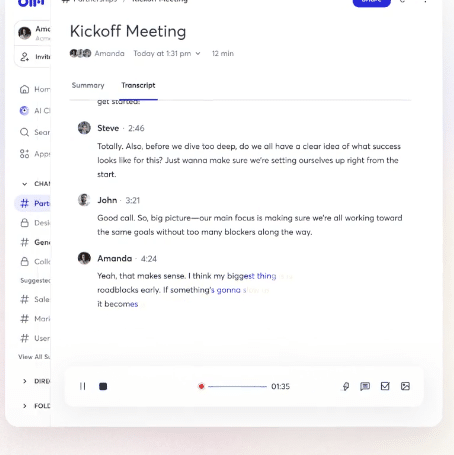
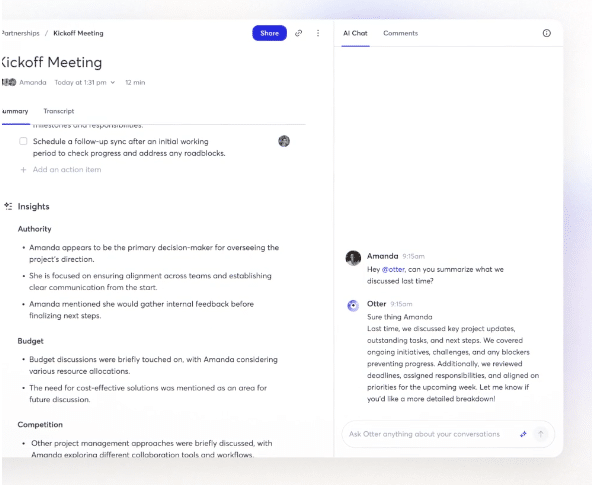
- AI Chat Search: Once a transcript is generated, users can query the document using natural language prompts. If an expert discussed "credit card fraud" or "artificial intelligence personalization" amidst a sprawling, hour-long conversation, the chatbot instantly surfaces relevant excerpts alongside concise summaries. This eliminates the need to manually skim thousands of words to find a specific quote.
- Linked Audio Playback: Clicking on any line of text within the digital transcript instantly triggers the audio player to jump to that exact timestamp. This cross-referencing mechanism makes fact-checking effortless when a technical term or company name appears garbled in the text.
- The Freemium Entry Point: The platform offers a Basic (free) tier providing 300 minutes per month, with a 30-minute cap per individual recording. This allows writers to test the software thoroughly against real-world interview conditions before committing financial capital.
Technical Limitations and Real-World Friction Points
While the productivity benefits are substantial, Otter.ai is not without its operational quirks and limitations. Understanding these friction points is essential for determining whether the tool matches a specific writing workflow.
The "Speaker Mode" Hardware Catch
One of the most notable technical constraints involves audio capture mechanics. If a user has headphones plugged into their computer during a recorded call, Otter.ai will typically capture only the user’s voice, entirely missing the remote interviewee. The software relies on the computer’s internal speakers and microphone to process both sides of a conversation simultaneously.
While this works seamlessly in a quiet home office or a private workspace, it presents privacy and acoustic challenges in public environments, coffee shops, or shared coworking spaces where speakerphone use is discouraged.
Accuracy Variances in Specialized Niches
While marketing materials often cite high recognition rates, real-world accuracy during specialized SME interviews generally hovers around 80% to 85%. In niche sectors—such as fintech, healthcare, legal tech, or advanced engineering—proprietary jargon, acronyms, and unfamiliar surnames are frequently mangled by the transcription engine.
Consequently, professional writers cannot rely blindly on the raw text. Verification against the source audio remains a mandatory step before publishing direct quotes. Fortunately, because responsible journalists verify quotes regardless of how they were captured, this step represents a natural part of the editing process rather than an entirely new burden.
Inconsistent Speaker Identification
In multi-party calls or webinars, Otter.ai attempts to segregate dialogue by speaker, labeling participants as Speaker 1, Speaker 2, and so on. However, when voices share similar frequencies or when recording external panels where the user is not actively moderating, attribution errors frequently occur. Writers must exercise diligence when attributing quotes from complex group interviews.
Pricing Tiers and Strategic Recommendations
Choosing the right tier depends entirely on the volume of interview-heavy content a writer produces.
- Basic (Free):
- Cost: $0
- Limits: 300 monthly minutes, 30-minute max per conversation.
- Best for: Beginners or writers who conduct fewer than two interviews per month, offering a risk-free testing ground.
- Pro ($8.33/month, billed annually at ~$100/year):
- Limits: 1,200 monthly minutes, 90-minute max per conversation, advanced export options, custom vocabulary.
- Best for: The sweet spot for most full-time freelance writers. It accommodates regular interview schedules and longer conference recordings without hitting minute caps.
- Business ($19.99/month, billed annually):
- Limits: 6,000 monthly minutes, 4-hour max per conversation, centralized team billing, admin controls.
- Best for: Content agencies, multi-writer publications, or media companies managing high-volume collaborative projects.
Future Outlook: The Trajectory of AI in Media Production
As artificial intelligence continues to reshape the digital media landscape, transcription tools are rapidly evolving from passive text-generators into active editorial partners. Future iterations of tools like Otter.ai are expected to feature deeper semantic understanding, automated headline generation based on interview transcripts, real-time sentiment analysis, and instantaneous translation capabilities across global markets.
For freelance writers, adopting these tools early is no longer about chasing fleeting tech trends; it is a fundamental adaptation to modern industry standards. By automating the mechanical burden of transcription, writers can reclaim hours of valuable time each week, shifting their focus toward what matters most: investigative depth, compelling storytelling, and high-quality prose.