

Executive Overview
For decades, frontend web development has operated under an unwritten rule: if a feature is complex, mission-critical, or absent from core JavaScript, you install a dependency. Whether it was parsing relative dates, grouping array data, spinning up accessible dialog modals, or orchestrating HTTP requests, the default reflex of the modern developer was to reach for npm.
Once installed, these dependencies frequently fossilize inside the package.json. They do their job, the integration tests pass, and engineers move on. However, the underlying web platform has not remained static. Modern browsers have evolved at an unprecedented pace, quietly absorbing features that once required heavy, specialized third-party libraries.
In a typical mid-sized JavaScript application today, developers routinely shoulder between 60KB and 90KB (minified and gzipped) of redundant dependencies that native browser platforms can now handle natively. This phenomenon represents a growing disconnect between what the modern web platform is natively capable of and the legacy dependency management habits of engineering teams.
Enter Baseline—a cross-industry initiative designed to bring clarity, predictability, and safety to web platform feature availability. By leveraging Baseline standards, engineering teams can systematically audit their codebases, eliminate dead-weight npm packages, and significantly shrink their JavaScript bundle sizes without sacrificing functionality or user experience.
Detailed Chronology: The Evolution from Polyfill Culture to Native Platform Dominance
To understand how web development arrived at this bloated crossroads, one must examine the historical context of browser fragmentation.
The Era of Polyfills and Fragmentation (Early 2010s)
In the early-to-mid 2010s, web development was plagued by severe inconsistencies across browser engines. Internet Explorer, legacy Microsoft Edge, early versions of Chrome, and Safari implemented specifications at drastically different speeds. To build a robust application, developers relied heavily on polyfills, utility libraries like Lodash, and robust framework wrappers (such as axios for HTTP requests) simply to establish a predictable runtime environment.

During this era, dependencies were defensive shields. If the browser couldn’t reliably format currency, parse lists with an Oxford comma, or safely trap focus inside a modal overlay, the developer had to supply the logic.
The Rise of Modern Component Architecture (Late 2010s)
As Single Page Applications (SPAs) gained dominance via frameworks like React, Vue, and Angular, the npm ecosystem exploded. The mindset shifted from "use sparingly" to "there’s an npm package for that." Specialized micro-libraries emerged for virtually every granular UI interaction—scrolling locks, deep cloning, time ago stringifiers, and custom dropdown positioning. While these tools accelerated feature delivery, they introduced a silent performance tax: compounding bundle weight, increased parsing times on mobile devices, and complex supply chain vulnerability vectors.
The Standardization and the Birth of Baseline (2023–Present)
Recognizing the friction caused by ambiguous browser compatibility metrics, the WebDX Community Group—comprising major browser vendors including Google, Mozilla, Apple, and Microsoft—introduced Baseline.
Baseline provides clear, standardized definitions for when a web feature is safe to use across all major browser engines. Features are tracked across two distinct states:
- Newly Available: Supported across all major browser engines, marking the beginning of a safe usage window.
- Widely Available: Having cleared a critical threshold (typically 30 months after becoming Newly Available), these features are safe to use universally without conditional checks or polyfills.
This structural tracking eliminated the guesswork of platform adoption, providing the exact empirical foundation needed to safely sunset legacy npm dependencies.
Supporting Context & Metrics: Deconstructing the Bloat
When auditing a modern application, performance bottlenecks rarely stem from a single monolithic library. Instead, they accumulate across specific functional clusters.

The Bundle Math: Breaking Down the Clusters
- Internationalization (Intl Namespace):
Historically, libraries liketimeago.js,pluralize,numeral, andhumanize-durationwere staples for localization. Today, the nativeIntlnamespace—encompassingIntl.RelativeTimeFormat,Intl.NumberFormat, andIntl.ListFormat—is widely available. Combined, these legacy libraries can account for roughly 14 KB gzipped of entirely redundant code. - HTTP Clients:
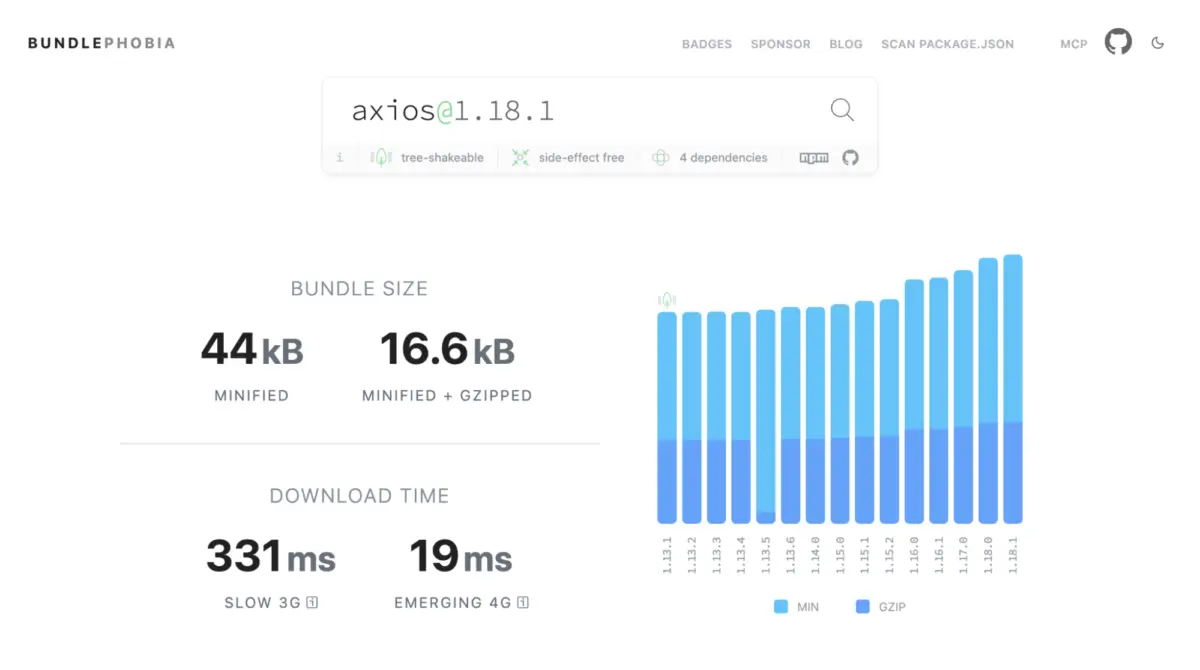
Heavyweight abstraction layers likeaxios(17 KB gzipped) andsuperagent(19 KB gzipped) are frequently deployed for basic REST operations. With the nativefetchAPI paired withAbortSignal.timeout()achieving universal support, standardizing on native primitives can immediately strip out nearly two decades of wrapper overhead for simple GET and POST operations. - UI Primitives & Accessibility:
Historically, managing modal accessibility required an intricate web of dependencies:a11y-dialog,focus-trap,body-scroll-lock, and floating element positioning libraries liketippy.js(which bundles Popper). The convergence of the native<dialog>element, the Popover API, and CSS Anchor Positioning replaces upwards of 24 KB gzipped of UI dependency overhead while delivering superior native accessibility semantics. - Utility Lodash Functions:
While full-scale imports of Lodash (25 KB gzipped) have waned due to tree-shaking, standalone micro-packages likelodash.clonedeepandlodash.groupbystill populate numerouspackage.jsonfiles. Native alternatives such asstructuredClone(),Object.groupBy(), and nativeSetoperations (intersection(),union(),difference()) eliminate the need for these utility imports.
+---------------------------+------------------------+--------------------------+
| Functional Cluster        | Legacy npm Dependency  | Native Platform Counterpart |
+---------------------------+------------------------+--------------------------+
| Time Formatting           | timeago.js             | Intl.RelativeTimeFormat  |
| Array Grouping            | lodash.groupby         | Object.groupBy()         |
| Deep Object Copying       | lodash.clonedeep       | structuredClone()        |
| Modal Focus Trapping      | focus-trap             | <dialog> element         |
| HTTP Requests             | axios                  | fetch()                  |
+---------------------------+------------------------+--------------------------+
The Nuance of Caution: When Not to Drop Dependencies
Not every platform feature is ready for blind adoption. A prime example is the long-awaited Temporal API, designed to replace JavaScript’s legacy Date object. While Temporal offers exceptional time-zone handling and immutable design, it is not yet universally Baseline-supported across all stable releases (notably pending stable Safari deployment).
Adopting Temporal today via the official polyfill (@js-temporal/polyfill) requires injecting roughly 44 KB gzipped into your bundle—significantly heavier than lightweight alternatives like dayjs (3 KB gzipped). A rigorous dependency audit must weigh raw native capability against polyfill payload costs to prevent accidental performance regression.
Official Statements and Industry Perspective
Engineering leaders and core web platform architects have increasingly emphasized the strategic importance of aligning development workflows with native browser capabilities.
"The gap between ‘you need a library for this’ and ‘the browser does this natively’ is closing faster than at any point in web history," note web platform advocates. "Teams fail to optimize not out of laziness, but because dependency audits are traditionally framed around security vulnerabilities via tools like
npm audit, rather than capability obsolescence."
Industry benchmarking highlights that heavy JavaScript bundles disproportionately impact users on emerging markets, mobile devices, and constrained hardware networks. By transitioning from third-party abstractions to native platform capabilities, organizations see measurable improvements in Time to Interactive (TTI), First Contentful Paint (FCP), and overall JavaScript execution overhead.
Furthermore, standards bodies emphasize that native browser implementations of UI primitives (such as the <dialog> element and the Popover API) inherently outperform hand-rolled or third-party JavaScript implementations in accessibility and screen-reader compatibility. Because these features operate directly within the browser’s native rendering tree and Top Layer, they bypass complex z-index wars and manual focus-management bugs.

Future Outlook: The Next Wave of Platform Capabilities
As the web platform continues to mature, the horizon promises even greater convergence between native capabilities and developer tooling. Looking ahead to the coming years, several emerging features are poised to render additional categories of libraries obsolete:
- Native CSS Nesting and Scope: Reducing the reliance on preprocessors and complex CSS-in-JS runtime injection libraries.
- Subgrid and Advanced Layout Primitives: Streamlining complex grid layouts without needing specialized layout calculation scripts.
- Expanded Internationalization (Intl.DurationFormat): Transitioning toward complete, native duration formatting as it achieves wide Baseline availability.
Implementing a Quarterly Audit Cadence
To maintain a lean application architecture, engineering organizations must establish sustainable operational habits:
- Inventory Production Dependencies: Regularly run
npm ls --omit=dev --depth=0to inspect production-bound modules. - Analyze Real Bundle Impact: Utilize tools like
source-map-exploreror Vite bundle visualizers to measure post-treeshaken and minified/gzipped weights. - Cross-Reference with Baseline: Consult
webstatus.devor MDN documentation badges to evaluate whether native platform features can securely replace specific dependencies. - Apply Progressive Enhancement: For Newly Available features, implement runtime feature detection (
typeof feature === 'function') coupled with conditional fallbacks to protect users on legacy devices.
By treating the web platform itself as the primary framework, development teams can permanently shed unnecessary kilobytes, accelerate application performance, and build more resilient, accessible web experiences for the future.