

Executive Overview
The introduction of sweeping regulatory frameworks often triggers a predictable wave of corporate anxiety, sensationalist headlines, and operational panic. Over the past week, technology and legal sectors alike have buzzed with alarms regarding "drastic measures," "monumental fines," and the "sweeping new AI rules" taking effect across the European Union. However, a closer, more pragmatic examination of the policy reveals a far more focused and sensible reality. Rather than throttling innovation, the EU’s transparency mandates target a singular, vital objective: making artificial intelligence unmistakably transparent precisely when clarity matters most—especially concerning AI-generated or synthetically manipulated content.
Taking effect on August 2, 2026, the European Union’s AI labelling requirements establish a strict legal framework for any enterprise serving EU citizens. Much like the European Accessibility Act (EAA), this legislation transcends geographic borders. It is not constrained to EU-headquartered entities; rather, it binds any organization worldwide that deploys AI outputs destined for consumption by individuals within the EU.
As digital landscapes become increasingly saturated with synthetic text, imagery, and audio, distinguishing between human craftsmanship and machine generation is no longer just a best practice—it is a legal obligation. This article explores the core of these regulations, examining what requires labelling, where the lines are drawn between human editing and machine creation, why ubiquitous UI "sparkles" fall short of compliance, and how global compliance is rapidly solidifying into a universal design pattern.
Detailed Chronology: The Road to the 2026 Mandates
Understanding the current regulatory landscape requires tracing the deliberate steps taken by European policymakers over recent years to establish accountability in the digital ecosystem.
- April 2021: The European Commission introduces its initial proposal for the Artificial Intelligence Act (AI Act), laying the groundwork for a risk-based regulatory framework.
- December 2023: Provisional political agreement is reached between the European Parliament and the Council on the comprehensive text of the AI Act, signaling a consensus on balancing technological growth with fundamental rights.
- March – June 2024: Formal adoption of the AI Act by the European Parliament and the Council of the European Union, setting the clock ticking for staggered enforcement milestones.
- Late 2024 – 2025: The European Commission collaborates with industry stakeholders, legal experts, and UX specialists to draft Codes of Practice regarding AI-generated content, culminating in the release of standardized AI icon sets and implementation guidelines.
- August 2, 2026: The Enforcement Milestone. Transparency obligations under Article 50 of the AI Act officially take effect. Organizations worldwide interacting with the EU market must comply with explicit labelling and disclosure mandates or face severe legal and financial repercussions.
What Actually Needs Labelling?
The fundamental philosophy driving the EU’s labelling requirements is user empowerment. Anyone exposed to artificial intelligence output must be able to recognize, clearly and unmistakably, that the content has been artificially generated or manipulated.
According to Article 50(4) of the EU AI Act, explicit disclosure obligations apply across several distinct use cases:

- Synthetic Media (Deepfakes and Altered Imagery): Any AI-generated or manipulated image, audio, or video file that resembles existing persons, places, objects, or events and could reasonably be mistaken for authentic reality.
- Text Published to Inform the Public: AI-generated text published with the explicit intent of informing the public on matters of public interest (unless subjected to substantive human editorial review).
- Chatbots and Conversational Agents: Users interacting with automated conversational systems must be informed that they are communicating with an AI, unless it is blatantly obvious from the context.
Providers vs. Deployers: Shared Legal Responsibility
Under the framework, legal obligations fall upon both providers (the entities that build, train, or supply the AI system) and deployers (the enterprises and organizations that integrate and use the system in real-world workflows).
Drawing a parallel to the General Data Protection Regulation (GDPR) and the European Accessibility Act, a company cannot evade Article 50 liabilities simply by licensing a third-party, off-the-shelf AI tool. If your organization serves EU citizens and deploys that third-party output outward, compliance responsibility rests squarely on your shoulders.
Supporting Context & Metrics: The Scope of Human Intervention vs. Automation
Despite the broad reach of the regulation, a widespread misconception persists: that all AI-assisted work must feature explicit warning labels. In practice, the vast majority of day-to-day productivity enhancements driven by AI remain untouched by these transparency rules.

The Human-in-the-Loop Exception
The disclosure obligation does not apply where AI-generated text has undergone genuine, substantive human review and editing, with a named person or corporate entity taking formal editorial responsibility for the final output.
However, defining where "assistance" ends and "generation" begins has been a point of intense discussion.
- Exemptions (Assisted Work): Minor assistive edits—such as automated spellcheck, grammar correction, formatting, basic image cropping, color correction, and AI-driven translation—do not constitute AI generation. Fine-tuning a sentence or paragraph originally drafted by a human generally remains exempt.
- Triggers (AI Generation): Conversely, AI-generated summaries, composite imagery, substantive rewrites, and algorithmic additions or removals from photographic assets are classified as AI generation.
Furthermore, the European Commission is unequivocal: a superficial review—such as a human quickly skimming an entirely AI-generated article before publishing—does not qualify as an editorial review. True editorial control requires substantive intellectual engagement and a designated human or corporate entity taking accountability.

Navigating "Public Interest" and Commercial Content
The definition of "public interest" within the guidelines covers health, safety, the environment, the economy, finances, politics, science, and culture. If AI-generated product claims or marketing copy touch upon these pillars, disclosure rules apply.
For commercial content, legal counsel universally advises a conservative approach: realistic AI-generated illustrations, marketing photos, or promotional posters must carry visible disclosures if they depict plausible real-world scenes or individuals.
Official Statements and Industry Standards
As organizations scramble to update their design systems, the European Commission and UX governance bodies have issued critical guidance regarding how AI must be visually communicated.

Why AI Sparkles Are Not Enough
For years, the technology sector has relied on a ubiquitous shorthand: the "sparkle" icon ($tau$) or magic wand to denote artificial intelligence features within software interfaces. However, UX research—including studies by the Nielsen Norman Group (NNG)—reveals that the sparkle icon is fundamentally ambiguous.
Users frequently interpret sparkles as a signal for an "AI-powered feature" rather than an admission that "this specific piece of content was generated by a machine." Because the sparkle fails to communicate the provenance of individual pieces of content clearly and distinguishably, relying on it alone violates the spirit—and potentially the letter—of the new regulations.
The Official EU AI Icon Set
To bridge this gap, the European Commission published an official EU AI icon set alongside its Code of Practice. These standardized marks distinguish between basic AI interaction, fully AI-generated content, and partially AI-modified assets.

Crucially, the European Commission explicitly notes that simply dropping an icon into an interface does not establish legal compliance by itself.
- A barely visible icon buried in a web footer,
- Text tucked away in an obscure terms-of-service page, or
- A notification label that flashes for a fraction of a second
…will all be deemed non-compliant by regulators.
Best Practices for Compliant UI Design
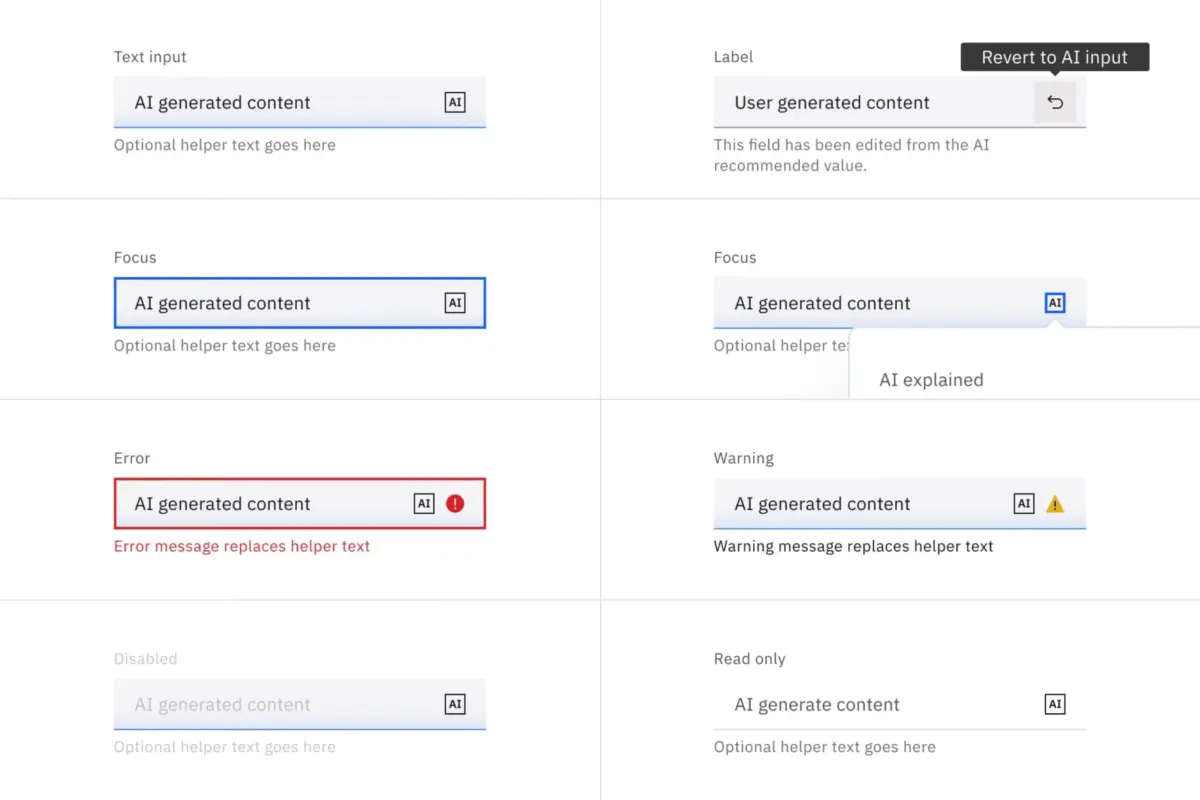
To achieve absolute compliance, design systems (such as IBM’s Carbon Design System and emerging EU guidelines) recommend the following practices:

- Explicit Text Pairing: Always pair visual icons with clear, plain-language text labels such as "AI-generated" or "Synthetically modified."
- Persistence: Labels and metadata must persist when content is downloaded, shared, or embedded across external platforms.
- Accessibility: Disclosure labels must be fully accessible to assistive technologies (screen readers, high-contrast modes), ensuring equitable access for all users.
Future Outlook: A Global Paradigm Shift
While European businesses view August 2, 2026, as a hard deadline, industry analysts emphasize that the EU AI Act is merely the most comprehensive iteration of a global regulatory pattern. Similar transparency requirements are proliferating worldwide:
- United States: State-level statutes are rapidly emerging, focusing on synthetic human performers (digital replicas), political advertising, and deceptive automated communications.
- Asia-Pacific: Jurisdictions including China, South Korea, and Singapore have enacted or proposed robust algorithmic transparency laws requiring watermarking and clear labelling of generative outputs.
Rather than viewing these developments as isolated bureaucratic hurdles, forward-thinking product teams are treating transparency as a core design pattern.
Summary Takeaway
The underlying mandate driving these global regulations can be summarized in a single, elegant principle:

When artificial intelligence content can easily be mistaken for human-created reality, creators and deployers must disclose it—clearly, obviously, and unambiguously.
By embracing transparent design patterns early, organizations can avoid regulatory penalties while building profound trust with their users, effortlessly separating authentic human craftsmanship from automated output.