When a modern digital branding project stumbles, founders and product teams almost always perform post-mortems on the wrong phase. They dissect the execution—blaming an inadequate logo, an uninspired color palette, or a clumsy design system. Yet, experienced design directors know that the root of systemic branding failure almost always occurs months earlier, deep within the nebulous strategy phase.
It happens the moment a cross-functional team agrees on vague, highly subjective buzzwords like “modern,” “trustworthy,” “premium,” “friendly,” and “disruptive” without ever unpacking what those adjectives actually look like in practice.
This pervasive lack of definition creates a hazardous chasm between what a brand is supposed to communicate strategically and what a designer is expected to conjure up visually. To bridge this divide, design studios are increasingly formalizing a critical, yet frequently overlooked, stage in the product lifecycle: the “pre-concept” phase.
Positioned directly after the project kickoff and stakeholder interviews, but well before the first vector is drawn in Figma, the pre-concept phase serves as the structural anchor of brand identity design. By rigorously researching brand context, exposing hidden stakeholder assumptions, mapping competitive perception, and turning abstract directions into a concrete visual foundation, teams can eliminate guesswork. The result is not a rigid cage for creativity, but rather a razor-sharp design problem that empowers designers to take calculated creative risks with absolute confidence.
Detailed Chronology: Navigating the Pre-Concept Roadmap
To successfully transition from strategic intent to visual execution, brand architects must guide stakeholders through a methodical, multi-stage evolution. Moving from unvarnished business goals to a concrete design system requires a structured process that transforms passive clients into active, aligned participants.
Stage 1: Researching the Brand Context and Perception Audits
Standard brand workshops inevitably cover foundational discovery metrics: business models, long-term goals, product specifications, competitive landscapes, and target demographics. While essential, these fact-finding missions miss the psychological bullseye. They collect facts when they should be clarifying perception.
Because a brand ultimately exists entirely within the subjective mind of its audience—as famously defined by Marty Neumeier as a person’s “gut feeling about a product, service, or company”—discovery must focus on crafting shared perception.
Consider a real-world case study involving a high-growth health-tech enterprise. During early intake, the executive team uniformly declared that their brand identity needed to feel "modern," "trustworthy," and "disruptive." On paper, these words sounded like an aggressive mandate for a bold, highly unconventional visual language.
However, deeper qualitative interviews revealed a vital contextual nuance: their primary enterprise clients were deeply conservative government medical institutions. In that risk-averse sector, a visually loud, rebellious, or experimental brand identity would actively erode credibility, signaling instability rather than innovation. Their version of “disruptive” had to be expressed through extreme clarity, operational efficiency, and quiet confidence. The linguistic baseline was identical, but the contextual interpretation was fundamentally traditional.
Words alone are notoriously slippery. To bridge the gap between strategic language and visual translation, design teams must employ interactive exercises that force stakeholders to think through tangible metaphors, imagery, and relative positioning.
As GV’s Jake Knapp famously notes in The Three-Hour Brand Sprint, the primary objective of these workshops is simple: make the abstract idea of “our brand” into something concrete. Active participation replaces passive agreement, bringing underlying biases and ideological fractures to the surface before they can derail a formal concept presentation.
Competitor Perception Mapping: Before running the workshop, facilitators gather visual touchpoints from across the competitive landscape—marketing websites, product UI screenshots, and social assets. During the session, stakeholders map these references across a two-axis grid. The axes are tailored to the core tensions the brand must resolve (e.g., Understated vs. Bold and Accessible vs. Exclusive). This exercise highlights how the client actually reads their market: exposing what they perceive as generic, overly conservative, or visually vacant territory ripe for colonization.
The Visual Brand Driver Exercise: Moving inward from the category to the brand itself, stakeholders are asked to assign the company to a series of unrelated conceptual categories—transportation, typefaces, furniture, architecture, animals, and drinks. Crucially, participants are instructed to select images that represent the company’s systemic truth, not their personal aesthetic preferences. Following image selection, participants defend their choices with four to five descriptive adjectives. A quiet electric car, a high-speed bullet train, and a private jet each evoke radically different attributes of speed, structure, mass accessibility, or exclusivity. This process successfully decouples brand identity from superficial visual decoration.
Stage 3: Constructing the Visual Foundation
Once the workshop has surfaced baseline assumptions and ideological tensions, the subsequent alignment meeting translates this strategic consensus into a working visual foundation. This layer is strategically divided into three distinct, progressive tiers:
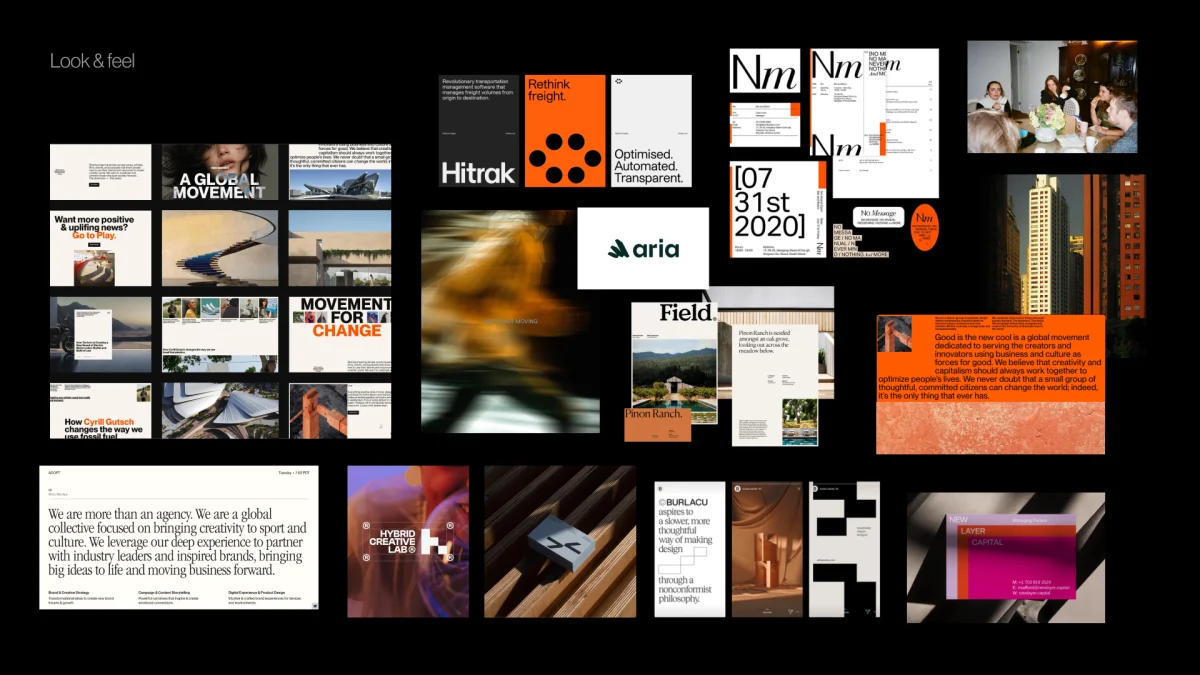
Look and Feel Boards: Rather than assembling mood boards of aesthetically pleasing imagery, designers curate perception boards. These collections explicitly mirror the brand character, category tensions, and stakeholder nuances uncovered during discovery. If a brand must embody accessible innovation, the board dictates whether that accessibility reads as warm and organic or clinical and precise.
Design Code: This layer translates abstract core ideas into actionable visual principles. For instance, a parenting app’s strategic pillar of "Parenting is messy and magical" translates into design codes featuring soft gradients, fluid organic shapes, and playful irregularities, whereas "Research-backed support for real life" introduces clean data snapshots, infographics, and editorial white space to guarantee institutional credibility.
Brand Asset Direction: The final tier drills down into the literal building blocks of identity: typographic pairings, color psychology, logo styling, and photographic treatment. Stakeholders can finally debate whether a serif or sans-serif typography better reflects their corporate voice, establishing firm creative boundaries long before concept execution begins.
The financial and operational implications of skipping the pre-concept phase are severe. Industry benchmarks across digital product design and brand architecture consistently indicate that projects lacking structured pre-design alignment suffer from alarming inefficiencies:
The Revisit Rate: Design agencies report that branding projects lacking a formal pre-concept phase require an average of 3.4 additional revision rounds compared to those utilizing structured stakeholder alignment frameworks.
Time-to-Market Delays: Misaligned stakeholder expectations during initial concept reviews routinely extend total project timelines by 25% to 40%, frequently resulting in missed product launch dates.
Subjectivity Reduction: Projects anchored by explicit "Design Codes" and "Perception Maps" experience a 65% decrease in feedback based purely on arbitrary personal preferences ("I don’t like blue"), shifting evaluation toward objective strategic alignment ("Does this visual element communicate our commitment to security?").
Official Industry Perspectives
Prominent design leaders and product strategists emphasize that the evolution of branding demands rigorous pre-design frameworks to survive competitive digital ecosystems:
"The point of these exercises is to make the abstract idea of ‘our brand’ into something concrete."
— Jake Knapp, Author and Design Partner at GV (formerly Google Ventures)
"A brand is a person’s gut feeling about a product, service, or company. If the brand ultimately lives in someone else’s perception, discovery has to clarify what perception the team is trying to create before a single designer touches a vector tool."
— Marty Neumeier, Brand Theorist and Author of The Brand Gap
Future Outlook: The Evolution of Pre-Design Strategy
As digital products increasingly rely on dynamic, AI-generated assets, responsive design systems, and multi-channel brand experiences, the pre-concept phase will only grow in strategic importance.
In the near future, we can expect brand identity teams to integrate automated sentiment analysis and interactive digital perception mapping directly into collaborative workshops. By leveraging real-time data from customer feedback loops and competitive market scans, pre-concept frameworks will transition from static Figma mood boards into living, data-backed design tokens.
Ultimately, the future of branding belongs to organizations that recognize design not as an isolated artistic exercise, but as the ultimate manifestation of rigorous strategic alignment. By mastering the pre-concept phase, design teams can banish guesswork, elevate stakeholder discourse, and ensure that every visual identity launched into the market carries undeniable purpose and enduring commercial impact.