

Executive Overview
In what has crystallized as a defining moment
for the progressive wing of the Democratic Party, Dr. Abdul El-Sayed has emerged victorious in Michigan’s fiercely contested open U.S. Senate race. Projected to defeat his Republican opponent, former U.S. Representative Mike Rogers, by a comfortable seven-point margin, El-Sayed’s decisive win was officially called by the Associated Press at approximately 2:00 a.m. on Wednesday, November 4, 2026.
The race, which captured national attention, served as the crowning jewel of a remarkably successful night for progressive candidates across the United States. El-Sayed—a physician, epidemiologist, and former executive director of the Detroit Health Department—successfully galvanized a diverse coalition of working-class voters, young people, and progressive activists. His campaign focused heavily on transformative policy proposals, including universal healthcare access, aggressively tackling the cost-of-living crisis, and robust environmental protections.
However, the path to the Senate chamber was far from straightforward. The high-stakes general election contest was defined not only by traditional ideological clashes with Rogers—a seasoned Republican operative and former House Intelligence Committee chairman closely aligned with President Donald Trump—but also by internal Democratic party turbulence. Just 48 hours before polls opened, El-Sayed weathered an unprecedented intra-party betrayal when fellow Democrat U.S. Representative Haley Stevens endorsed Rogers over her former primary rival. Despite this late-breaking political earthquake, El-Sayed’s grassroots apparatus mobilized with historic speed, turning a potential vulnerability into a powerful rallying cry that ultimately propelled him across the finish line.
Detailed Chronology of a High-Stakes Contest
The Primary Battle and the Seeds of Division
The drama surrounding Michigan’s 2026 Senate seat began long before the November showdown. When long-serving Democratic Senator Gary Peters announced his retirement, the state immediately transformed into one of the most consequential battlegrounds of the midterm cycle.
The ensuing Democratic primary featured a brutal, multi-candidate race that exposed deep ideological fault lines within the party. On one side stood the moderate establishment wing, championed by high-profile figures like Rep. Haley Stevens, who campaigned on centrist pragmatism and continuity. On the other side stood Dr. Abdul El-Sayed, representing the energized, policy-driven progressive movement that sought to fundamentally reshape the party’s platform around economic and social equity.
Following a grueling campaign trail across the state’s urban centers, suburban enclaves, and rural outposts, El-Sayed emerged victorious in the August primary, narrowly defeating Stevens. While primary contests routinely leave bruised egos in their wake, the transition from intra-party combat to a unified general election front typically follows a predictable script of reconciliation. In Michigan, however, that script was dramatically torn apart in the campaign’s final moments.
The October Surge and Final Stretch
Entering the final week of October, public and private polling indicated a tight race between El-Sayed and Mike Rogers. Rogers, leaning heavily on his background as a former congressman and intelligence leader, sought to frame himself as an economic realist focused on manufacturing revitalization, tax reductions, and national security. He frequently tied El-Sayed to the far-left flank of the national Democratic Party, attempting to paint his progressive platform as out of touch with Michigan’s swing-state sensibilities.
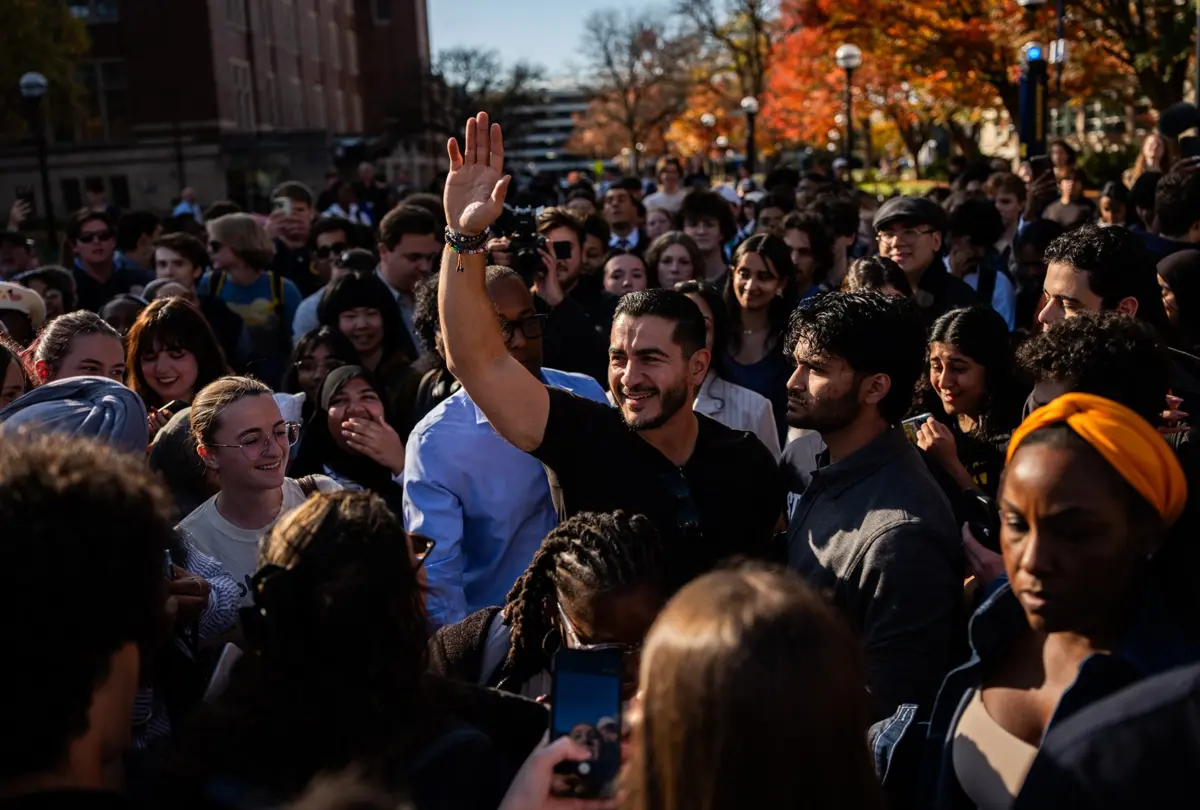
Conversely, El-Sayed leaned into retail politics, logging heavy hours at polling precincts on university campuses—such as the University of Michigan in Ann Arbor—and working-class neighborhoods alike. His message emphasized structural reform: reducing the cost of prescription drugs, investing in green infrastructure, and strengthening labor unions. By the final weekend of the campaign, over 2.3 million Michiganders had already cast their ballots through early voting and mail-in options, setting the stage for what pundits expected to be a nail-biting finish.
The Sunday Surprise: Rep. Haley Stevens’ Defection
The political landscape was upended on Sunday, November 1—just two days before Election Day—when Rep. Haley Stevens made the stunning announcement that she was endorsing Republican Mike Rogers over her fellow Democrat, Abdul El-Sayed.
Speaking from the pulpit of a Detroit church, Stevens cited irreconcilable differences with El-Sayed regarding foreign policy, specifically his positions on Israel, as well as broader concerns over the ideological direction of his campaign. The endorsement sent shockwaves through the Michigan political establishment.
National and state Democratic leaders swiftly condemned the move, viewing it as an act of profound disloyalty that threatened to hand a critical Senate seat to the GOP. The fallout was immediate within Stevens’ own congressional office: several senior staffers announced their resignations in protest, publicly breaking with their boss to support El-Sayed.
The Campaign’s Resilient Response
Faced with a potentially catastrophic media firestorm in the final 48 hours of the race, the El-Sayed campaign executed a masterclass in crisis management. Rather than engaging in a prolonged public feud, El-Sayed pivoted immediately, directing his supporters to channel their frustration into mobilization efforts.
The strategy yielded immediate dividends. Grassroots donors rallied to the campaign with unprecedented fervor, driving a staggering $2.4 million in online donations on Sunday alone. Simultaneously, the Michigan Democratic Party reported a massive influx of volunteers who flooded phone banks and knocked on doors to counteract the negative narrative.
When the Associated Press officially called the race at 2:00 a.m. on Wednesday, November 4, with El-Sayed holding a decisive seven-point lead, it became clear that Stevens’ eleventh-hour maneuver had backfired, instead galvanizing an energized progressive base to secure an emphatic victory.
Supporting Context & Metrics
To fully understand the magnitude of Dr. Abdul El-Sayed’s victory, one must analyze the unique demographic, financial, and logistical dynamics that shaped the 2026 Michigan Senate race.
Voter Turnout and Early Voting Dynamics
Michigan’s 2026 midterm election cycle recorded remarkably high engagement. State election officials reported that over 2.3 million voters had participated before Election Day through mail-in ballots and early in-person voting sites. This robust early turnout proved crucial for El-Sayed, who built a formidable operational lead prior to the final weekend.
Analysts noted that youth turnout—particularly around major academic hubs like the University of Michigan, Michigan State University, and Wayne State University—surpassed historical midterm averages. El-Sayed’s targeted outreach to Gen Z and millennial voters, who consistently rank healthcare affordability and climate action as top priorities, served as a primary engine for his eventual seven-point margin of victory.
Financial Mobilization and Grassroots Power
The financial battleground of the race highlighted two distinct fundraising philosophies. Mike Rogers benefited from substantial support from traditional conservative political action committees (PACs), corporate donors, and external Super PACs funded by national Republican stakeholders.
El-Sayed’s campaign, however, relied primarily on a decentralized, small-dollar donor model supplemented by grassroots labor backing. The financial resilience of the campaign was most visibly demonstrated in the wake of the Stevens endorsement controversy, when small-dollar contributors poured $2.4 million into the campaign coffers within a 24-hour window. This influx of capital allowed the campaign to saturate television, digital, and radio markets across the state with closing arguments that countered Rogers’ economic messaging.
Official Statements and Reactions
The aftermath of the election brought forth a wave of commentary from political leaders, campaign surrogates, and analysts across the ideological spectrum.
In his victory speech delivered in Detroit early Wednesday morning, Dr. El-Sayed focused on unity, resilience, and the core tenets of his platform:
"Tonight, the people of Michigan have sent a clear message: we are ready to build an economy and a healthcare system that works for working families, not just the privileged few. This campaign proved that when we organize, when we refuse to be distracted by political theater, and when we stand up for one another, progress wins. My door is open to every Michigander, regardless of how you voted, because the work of fixing our broken systems begins today."
National progressive leaders hailed the outcome as proof that bold, progressive policies can win in critical Midwestern swing states. Several prominent figures within the Democratic caucus noted that El-Sayed’s victory provides a strategic blueprint for future statewide races, demonstrating that authentic populist messaging on healthcare and economic security resonates deeply across diverse demographics.
Conversely, Republican campaign operatives expressed disappointment over Mike Rogers’ defeat while pointing to the unprecedented nature of the final week’s events. In a statement addressing supporters, Rogers reflected on the hard-fought campaign:
"While the outcome is not what we hoped for, I am immensely proud of the race we ran and the conversations we started about Michigan’s economic future, manufacturing strength, and national security. Our state faces significant challenges ahead, and I wish the incoming senator success in addressing the pressing needs of hardworking Michiganders."
Haley Stevens’ office declined to issue an immediate post-election statement following the confirmation of El-Sayed’s victory, though political analysts anticipate that the intra-party fallout from her endorsement will have lasting repercussions for her political future within the state’s Democratic infrastructure.
Future Outlook: What El-Sayed’s Victory Means for Washington
Dr. Abdul El-Sayed’s transition from public health advocate and progressive organizer to the United States Senate marks a significant shift in the balance of power within the nation’s capital. As he prepares to take the oath of office, several key questions and expectations define his upcoming tenure:
- Legislative Priorities: El-Sayed enters the Senate with a clear mandate to champion federal healthcare reform, drawing heavily on his background as a physician and public health official. He is expected to introduce or co-sponsor legislation aimed at lowering prescription drug costs, expanding Medicare accessibility, and addressing structural healthcare disparities.
- Progressive Leadership in the Senate: Joining a dynamic cohort of progressive lawmakers, El-Sayed will instantly become a prominent national voice for economic populism. His ability to connect complex public health data with everyday kitchen-table issues positions him as an influential strategist within the Democratic caucus.
- Navigating a Divided Congress: Operating within a closely divided legislative body will require El-Sayed to balance his foundational progressive commitments with the pragmatic art of negotiation. His background in executive administration—managing a major urban health department—will be tested as he seeks to deliver tangible results for Michigan constituents.
- Intra-Party Healing in Michigan: Following the turbulence caused by the late-campaign endorsement controversy, repairing relations within the Michigan Democratic Party will be an immediate priority. El-Sayed’s decisive victory places him in a strong leadership position to unify the party apparatus ahead of future electoral cycles.
Ultimately, Dr. Abdul El-Sayed’s historic win in Michigan not only secures a vital Senate seat for the Democratic Party but also signals a resilient, highly motivated progressive movement capable of weathering internal dissent and external attacks to secure a resounding victory at the ballot box.