

Executive Overview
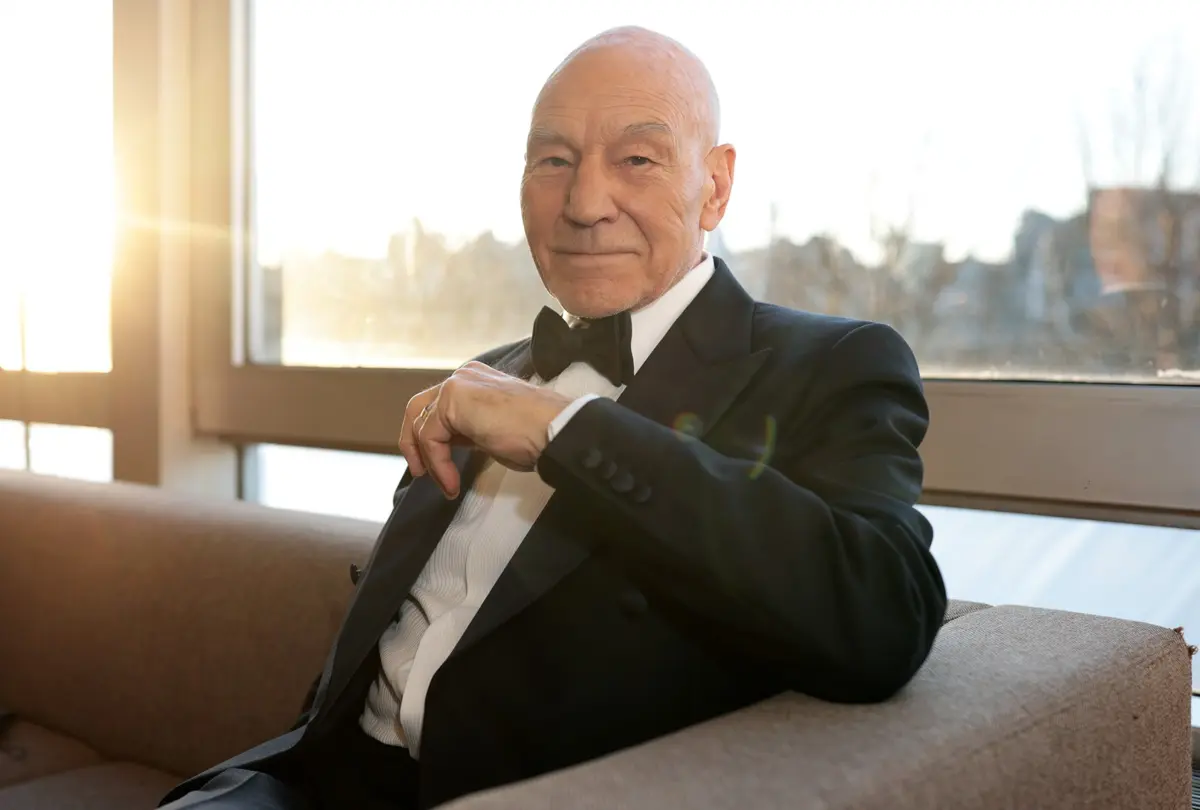
Sir Patrick Stewart, whose magnetic presence, unmistakable baritone, and commanding authority bridged the gap between classic Elizabethan theater and modern blockbuster cinema, passed away on Thursday at his home in Los Angeles at the age of 86. Longtime spokesperson Kelly Bush Novak confirmed that the legendary actor died following a battle with Alzheimer’s disease and Lewy body dementia—a complex neurodegenerative condition marked by cognitive decline and physical symptoms overlapping with Parkinson’s disease.
Surrounded by family, friends, and the comforting resonance of live music, prayer, and shared memories, Stewart’s passing marks the end of an extraordinary era in entertainment. From his humble beginnings in West Yorkshire to the ornate halls of the Royal Shakespeare Company, and ultimately to the bridge of the USS Enterprise and the halls of the Xavier Institute, Stewart redefined what it meant to be a classically trained actor in a commercial landscape.
While his striking bald head and resonant voice became globally recognized cultural touchstones, Stewart remained remarkably grounded. He leaves behind an indelible legacy spanning over six decades, characterized by artistic integrity, political activism, and a late-career cultural renaissance that cemented his status as a beloved household name. He is survived by his wife, American singer Sunny Ozell, whom he married in 2013, and his children, Daniel and Sophie.
Detailed Chronology: From West Yorkshire to the Final Frontier
Formative Years and Classical Roots (1940–1986)
Born on July 13, 1940, in the small industrial town of Mirfield, West Yorkshire, Patrick Stewart experienced a working-class upbringing marked by both hardship and resilience. In a 2023 interview with The Guardian, Stewart opened up about a violent childhood—experiences that heavily informed his internal discipline and emotional depth as an actor. He found his escape and ultimate calling in performance, joining local drama groups before eventually securing a spot at the Bristol Old Vic Theatre School.
Stewart’s theatrical career took a monumental leap in 1966 when he was invited to join the prestigious Royal Shakespeare Company (RSC). During his tenure with the RSC, he immersed himself in the rich, complex language of the Bard, performing alongside luminaries of the British stage. It was during this period that he forged a lifelong friendship and professional partnership with fellow actor Sir Ian McKellen, a bond that would later transcend the stage and permeate global pop culture.
Despite building a sterling reputation as a versatile stage and television actor in the United Kingdom—appearing in esteemed British television productions such as I, Claudius—Stewart was virtually unknown to American audiences heading into the late 1980s.
The Sci-Fi Renaissance and Global Stardom (1987–1999)
That anonymity vanished overnight in 1987 when television mastermind Gene Roddenberry cast Stewart as Captain Jean-Luc Picard in Star Trek: The Next Generation. Initially met with skepticism by traditional Star Trek purists and Hollywood executives who doubted a classically trained British Shakespearean actor could anchor a sci-fi action series, Stewart quickly proved them wrong.
Infusing Picard with moral fortitude, philosophical curiosity, intellectual rigor, and quiet vulnerability, Stewart transformed the captain from a sci-fi archetype into a deeply human, universally admired leader. The Next Generation ran for seven successful seasons, spawning several feature films and turning Stewart into an international superstar.
During the 1990s, Stewart balanced his burgeoning American fame with his enduring love for classical theater. He earned critical acclaim, a Tony nomination, and two Laurence Olivier Awards for his powerhouse one-man stage adaptations, most notably Macbeth. Furthermore, his rich vocal talents earned him widespread recognition beyond the screen, including a 1996 Grammy Award for Best Spoken Word Album for Children for Prokofiev: Peter and the Wolf.
The Superhero Era and Later Tributes (2000–2026)
Just as his tenure with Star Trek appeared to be his definitive legacy, Stewart reinvented himself once more. In 2000, he stepped into the role of Professor Charles Xavier (Professor X) in Bryan Singer’s cinematic adaptation of X-Men. Alongside his old friend Ian McKellen (who played Magneto), Stewart helped spark the modern superhero movie boom, anchoring the lucrative franchise across nearly two decades through 2017’s Logan.
In recognition of his towering contributions to drama, entertainment, and charitable causes, Queen Elizabeth II knighted Stewart at Buckingham Palace in 2010, officially conferring the title of "Sir" upon the actor.
Never one to rest on his laurels, Stewart later returned to the role that made him a household name in the Paramount+ streaming series Star Trek: Picard (2020–2023), offering a poignant, reflective coda to the character’s decades-long journey. Reflecting on his improbable trajectory in his later years, Stewart candidly admitted to The Guardian in 2023: *"I think I’ve been in denial about my life for a very long time. I never really took on board how successful I had become. Even today I sometimes think, ‘You’re a lucky son of a b*ch, Patrick,’ when something unexpected or good happens to me."
His final on-screen film appearance will be as Professor Charles Xavier in the upcoming Marvel Cinematic Universe feature, Avengers: Doomsday.
Supporting Context & Metrics: A Legacy in Numbers and Awards
To understand the sheer scope of Sir Patrick Stewart’s impact, one must look beyond the box office and examine the critical benchmarks of a truly diverse career:
- Emmy Nominations: 4 (spanning both television acting and voice work)
- Laurence Olivier Awards: 2 wins for his monumental contributions to British theater
- Grammy Awards: 1 win (Best Spoken Word Album for Children, 1996)
- Tony Award Nominations: 1 (for his celebrated Broadway staging of Macbeth)
- Career Span: Over 60 years across stage, television, and film.
- Franchise Impact: Anchored two multi-billion-dollar global franchises (Star Trek and X-Men), fundamentally shaping contemporary nerd culture and mainstream cinema alike.
Official Statements and Tributes
The entertainment industry and global fans alike have poured out tributes honoring the late actor, celebrating both his artistic genius and his remarkable humanity.
Longtime spokesperson Kelly Bush Novak released a statement capturing the profound grace with which Stewart faced his final chapter:
"He has been held in the warm embrace of family and friends, surrounded by live music, prayer, tears, laughter and the kind of profound emotion that only he could inspire after a lifetime of devotion to us all. We will forever cherish the peaceful ease and reflection on his face, an enduring reminder of his invincible grace."
Colleagues, collaborators, and cultural figures are expected to release further statements as memorial plans are finalized. Given his immense contributions to the arts, his passing represents the loss of a genuine titan—an actor who proved that classical training and blockbuster entertainment are not mutually exclusive, but can instead elevate one another to create timeless art.
Future Outlook
As the world mourns the loss of Sir Patrick Stewart, cultural preservationists and entertainment historians are turning their focus toward honoring his monumental archive of work. From digitized recordings of his Royal Shakespeare Company performances to ongoing academic studies on his influence on science fiction television, Stewart’s institutional footprint in the performing arts is secure.
His final cinematic performance in Avengers: Doomsday will serve as a poignant final wave goodbye from an actor who spent over half a century welcoming audiences into new worlds. Whether commanding the bridge of the Enterprise, teaching a generation of mutants at his academy, or commanding a solitary stage with the words of Shakespeare, Sir Patrick Stewart leaves behind a legacy that will resonate across generations to come.