

Executive Overview
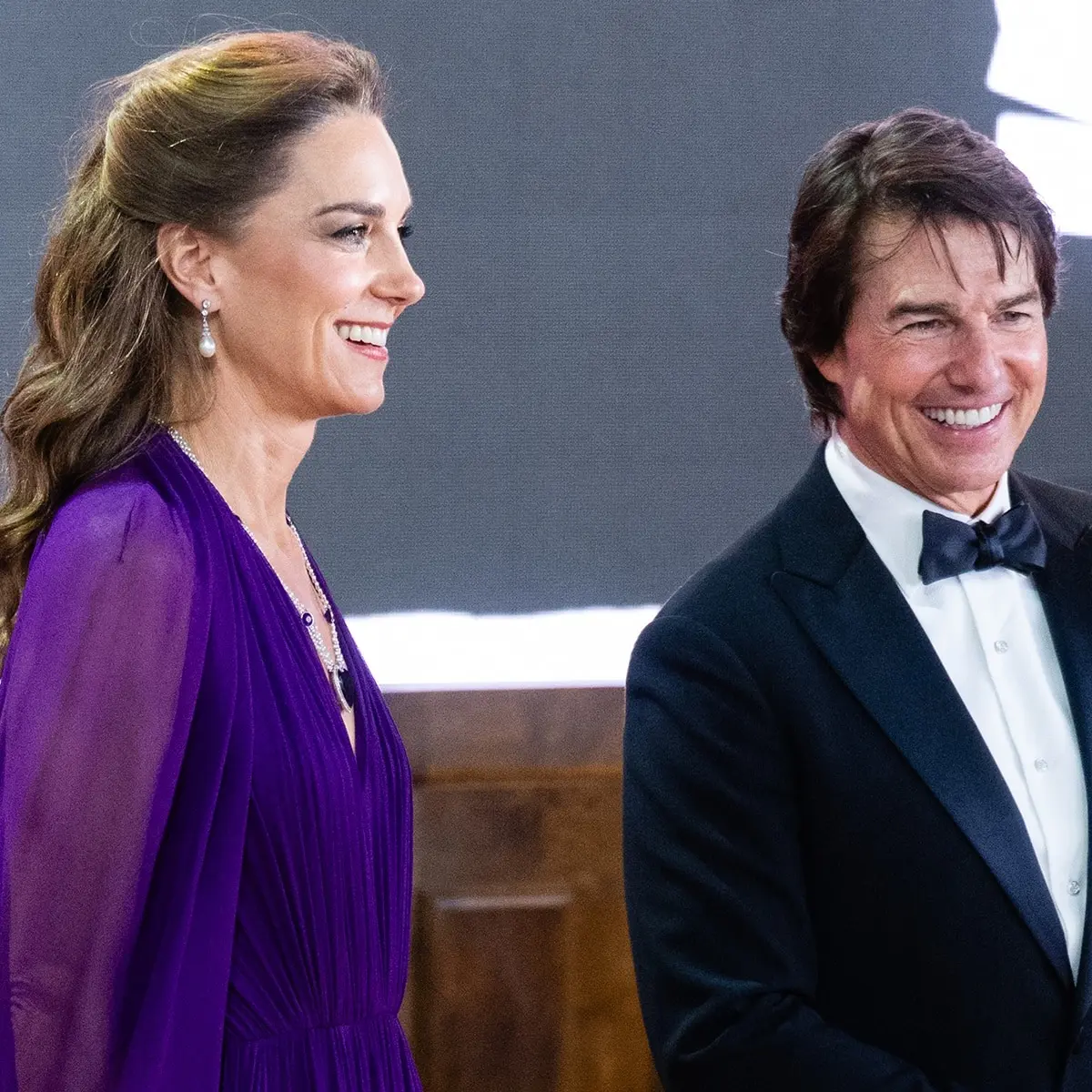
In an era where modern royalty frequently turns to contemporary designers and accessible fashion to bridge the gap with the public, Catherine, Princess of Wales, continues to masterfully anchor her style in the profound depths of royal history. On September 22, at the high-profile London premiere of Tom Cruise’s latest cinematic venture, Digger, the Princess delivered a masterclass in heritage styling. Accompanied by her husband, Prince William, Kate commanded global attention not merely for her striking end-of-summer blonde hair transformation and sweeping silhouette, but for a historic sartorial choice: she unlocked the royal vaults to wear the Queen Mother’s amethyst sautoir for the very first time.
This 103-year-old masterpiece—featuring a radiant heart-shaped amethyst pendant encased in diamonds, suspended from delicate strands of pearls—represents a rare intersection of sentimental family history and high-stakes diplomatic fashion. Marking the first public appearance of the necklace since 2012, when Queen Camilla famously donned it for the premiere of the James Bond film Skyfall, the moment underscores a broader, calculated shift within the House of Windsor. The Princess of Wales is increasingly serving as the custodian of the late Queen Mother’s most prized, vault-locked heirlooms. From the historic 2023 revival of the Strathmore Rose tiara to repeated deployments of the Lotus Flower tiara, Kate’s sartorial evolution is defined by a deep reverence for the past, seamlessly married to modern royal influence.
Detailed Chronology: From 1923 Origins to the London Red Carpet
To fully appreciate the significance of the Princess of Wales’s recent appearance, one must trace the remarkable 103-year journey of the amethyst sautoir through the twentieth and twenty-first centuries. The artifact’s lineage is deeply interwoven with the foundational years of the modern British royal family.
1923–1925: Acquisition and Initial Commission
The sautoir’s royal journey began in 1923, a pivotal year marked by the marriage of Lady Elizabeth Bowes-Lyon to Prince Albert, Duke of York (who would later ascend the throne as King George VI). As a welcoming gesture into the royal fold, the bride was gifted the exquisite diamond-framed, heart-shaped amethyst pendant and pearl strands by her future mother-in-law, Queen Alexandra.
While the necklace was put briefly on display during the high-profile wedding celebrations at Buckingham Palace, it quickly receded from the public eye. Royal jeweler records indicate that the piece was officially integrated into the future Queen Mother’s mourning wardrobe following Queen Alexandra’s passing in late 1925, establishing the sautoir as a piece reserved for moments of profound personal or national reflection.
2012: The Skyfall Revival Under Camilla
For nearly nine decades, the amethyst sautoir remained tightly guarded within the royal collection, rarely catching the flash of a public camera. That changed dramatically on October 23, 2012, when the then-Duchess of Cornwall (now Queen Camilla) stepped onto the red carpet for the royal world premiere of Skyfall at the Royal Albert Hall in London.
Camilla’s styling of the piece leaned into rich, autumnal drama. She paired the historic bauble with a floor-length, off-the-shoulder evening gown rendered in a deep, plush plum velvet. The pairing proved that the 1920s design could hold its own against contemporary red-carpet glamour, setting a high standard for future royal wearers.
September 22: Kate’s Modern Masterclass at the Digger Premiere
Thirteen years after Camilla’s notable outing, the sautoir re-emerged under the stewardship of Princess Catherine at the London premiere of Digger. Stepping out alongside Prince William, Kate curated a look that balanced regal authority with contemporary Hollywood glamour.
The Princess paired the 103-year-old necklace with a plunging, royal purple Jenny Packham gown featuring a dramatic, billowy skirt that caught the movement of the cameras. To complete the ensemble, she opted for subtle yet striking teardrop pearl earrings, allowing the intricate diamond framing of the central amethyst heart to remain the undisputed focal point of the look. Fashion historians noted that the color coordination between the purple gown and the violet gemstone demonstrated a sophisticated eye for monochromatic luxury, further cementing Kate’s status as a global style icon.
Supporting Context & Metrics: The Queen Mother’s Vault and Kate’s Archival Revival
The debut of the amethyst sautoir is far from an isolated incident. Over the past decade, and particularly since stepping into the role of Princess of Wales, Catherine has systematically breathed new life into pieces that had languished in obscurity for generations. An examination of her major jewelry milestones reveals a deliberate strategy of historical reclamation.
The Strathmore Rose Tiara (2023)
In late 2023, the fashion world watched in awe as Kate wore the Strathmore Rose tiara for a state banquet at Buckingham Palace. Crafted in the late 19th century and gifted to the Queen Mother upon her 1923 marriage, the delicate floral headpiece had not been seen in public for more than 90 years. Its revival was widely interpreted as a symbolic passing of the torch, signaling Kate’s readiness to carry the heavy mantle of royal representation into a new era.
The Lotus Flower Tiara
Long a favorite of the Princess, the Lotus Flower tiara—originally crafted from a dismantled necklace belonging to the Queen Mother—has been worn by Kate on three separate, high-profile occasions: state banquets in 2013, 2015, and 2022. The repeating motif of lotus flowers and diamond arches showcases the versatility of the Queen Mother’s collection, proving that these items can transition effortlessly from the Art Deco period of the 1920s to modern state dinners in the 2020s.
Comparative Metrics of Royal Heirlooms
| Heirloom Piece | Original Recipient / Era | Year of Last Known Public Sighting Prior to Kate | Year(s) Worn by Kate Middleton | Primary Designer / Associated House |
|---|---|---|---|---|
| The Amethyst Sautoir | Queen Mother (1923) | 2012 (Queen Camilla) | 2025 | Royal Collection Trust / Unattributed 1920s Jewelers |
| The Strathmore Rose Tiara | Queen Mother (1923) | c. 1930s | 2023 | Catchpole & Williams (Commissioned) |
| The Lotus Flower Tiara | Queen Mother (1920s) | 1990s (Princess Margaret) | 2013, 2015, 2022 | Garrard |
| Lover’s Knot Tiara | Queen Mary (1913) | 1990s (Diana, Princess of Wales) | Ongoing (2022–Present) | Garrard |
Official Statements and Curatorial Perspectives
While Kensington Palace maintains a strict policy of not commenting on the private monetary valuations of royal jewels—which are held in trust for the nation and the sovereign rather than owned privately—royal historians and fashion curators have been vocal about the cultural weight of these style choices.
"When the Princess of Wales reaches into the royal archives, she is doing much more than simply selecting an expensive accessory," notes royal historian Dr. Elizabeth Vance. "She is enacting a visual continuity. In times of institutional modernization and public scrutiny, displaying items that belonged to the Queen Mother—a figure of immense national comfort and resilience during the twentieth century—sends a powerful message of stability and tradition."
Furthermore, fashion critics have praised the partnership between Kate and luxury British designers like Jenny Packham and Alexander McQueen. By pairing centuries-old, irreplaceable gemstones with modern, bespoke British tailoring, the Princess ensures that the domestic fashion industry remains front and center on the global stage.
"The juxtaposition is brilliant," explains luxury fashion analyst Marcus Thorne. "You have a necklace that survived the roaring twenties, the Second World War, and the turn of the millennium, resting against a modern, plunging silk-chiffon gown. It bridges the gap between untouchable royal mystique and relatable, contemporary elegance."
Future Outlook: The Evolution of Royal Curation
As the British monarchy continues to navigate a transitional period under the reigns of King Charles III and Queen Camilla, the visual messaging projected by senior working royals is subject to intense global analysis. The strategic deployment of the royal vaults suggests a clear trajectory for the future of royal style under the Prince and Princess of Wales.
- Increased Archive Access: Industry insiders anticipate that as Kate takes on a more central role in state diplomacy, curators may grant her access to even more dormant pieces from the late Queen Elizabeth II and Queen Mother collections.
- The "Repeater" Philosophy: Kate’s well-documented penchant for recycling evening gowns—such as her frequent returns to Jenny Packham and Alexander McQueen creations—demonstrates a sustainable approach to royal fashion that resonates strongly with younger generations. Future engagements will likely see the continued pairing of historic jewels with familiar, beloved silhouettes.
- Soft Diplomacy: As international state visits ramp up post-transition, historical pieces with specific geopolitical or familial provenance will be deployed as instruments of soft power, reinforcing alliances and honoring shared heritage without the need for spoken rhetoric.
Ultimately, the debut of the 103-year-old amethyst sautoir is not merely a momentary red-carpet triumph; it is a chapter in an ongoing narrative. Through careful curation, profound respect for lineage, and an unerring eye for modern aesthetics, the Princess of Wales is ensuring that the glittering history of the House of Windsor remains as vibrant, relevant, and captivating as ever.