

Executive Overview
ISTANBUL — In a development closely watched by international human rights organizations, foreign governments, and domestic civil rights advocates, an Istanbul court ordered the release of four prominent journalists on Monday pending the outcome of their high-stakes trial. Among those freed were investigative reporters Ahmet Şık and Nedim Şener, who had spent 375 days behind bars without a conviction.
The defendants were swept up in the sprawling judicial proceedings tied to the alleged "Ergenekon" conspiracy—an ultra-nationalist shadow government purportedly plotting to overthrow the ruling, Islam-rooted Justice and Development Party (AK Party). Alongside Şık and Şener, defendants Coşkun Musluk and Sait Çakir were also released from custody.
While the court’s decision was welcomed by government officials as a corrective measure against overly prolonged pretrial detentions, the move underscores a deeply polarized landscape. Critics, international watchdogs, and the freed journalists themselves argue that the release is merely a superficial gesture in a judicial system that continues to heavily penalize dissent. With approximately 100 journalists still languishing behind bars, Turkey remains one of the world’s most restrictive environments for media workers, testing the boundaries between national security imperatives and fundamental democratic freedoms.
Detailed Chronology and Case Background
The Ergenekon Conspiracy and the Media Wing
The arrests of Ahmet Şık, Nedim Şener, and their co-defendants formed part of a sprawling, multi-year investigation into Ergenekon, a shadowy network allegedly comprised of military officers, secularist politicians, academics, and journalists accused of orchestrating terrorist acts and coup plots against the AK Party government.
While the initial targets of the Ergenekon trials were primarily retired military figures and hard-line nationalists, the investigation progressively widened to encompass journalists and media figures accused of acting as the intellectual or propaganda wing of the conspiracy. All defendants in the case have consistently and vehemently denied the allegations, characterizing the charges as fabricated conspiracy theories designed to intimidate the political opposition.
The Path to Release: Court Rationale
According to the semi-state-run Anatolia News Agency, the Istanbul court predicated its decision to release the four men on two primary legal grounds: the "likelihood of reclassifying the crime" and the substantial "time spent under custody."
For Şık and Şener, that time amounted to exactly 375 days of pretrial detention. Under Turkish law, pretrial detention has frequently stretched for years before the conclusion of a trial, a practice that domestic and international critics argue effectively transforms pretrial custody into a punitive sentence meted out before any formal conviction.
Despite the release of Şık, Şener, Musluk, and Çakir, six other defendants remain behind bars. Among them are the top editors of Oda TV, a hard-line secularist and fiercely critical online news publication known for its relentless investigative reporting targeting the AK Party administration.
The next pivotal hearing in the trial is officially scheduled for June 18, where the legal battle over the validity of the state’s charges will resume.
Supporting Context & Metrics
A Global Epicenter for Jailed Journalists
The plight of Turkey’s media workers has transformed the country into a global focal point for press freedom debates. According to comprehensive data compiled by the Committee to Protect Journalists (CPJ), Turkey possesses one of the highest numbers of jailed journalists in the world. Approximately 100 members of the press are either currently serving prison sentences following conviction or are being held on trial—a statistic that frequently places Turkey ahead of historically repressive nations like Iran, China, and Eritrea.
A significant proportion of these detained journalists are of Kurdish origin, often targeted under broad anti-terrorism statutes for their coverage of the Kurdish insurgency and regional political movements.
Investigative Targets: The Books and Articles That Sparked Arrests
The arrests of Ahmet Şık and Nedim Şener were not random occurrences; they followed high-profile investigative work that stepped on powerful institutional toes:
- Ahmet Şık: Prior to his detention, Şık was aggressively working on a manuscript investigating the alleged systematic infiltration of the Turkish police force and state apparatus by followers of Fethullah Gülen, a powerful, self-exiled Turkish Muslim preacher residing in Pennsylvania. Upon Şık’s arrest, police officers raided publishing offices and confiscated draft copies of the book in an unprecedented attempt to suppress its publication.
- Nedim Şener: A seasoned investigative reporter for the daily newspaper Milliyet, Şener had dedicated extensive investigative bandwidth to uncovering state negligence surrounding the tragic 2007 assassination of Armenian-Turkish journalist Hrant Dink. Şener’s work directly accused elements within the state security apparatus of willfully ignoring explicit, mounting intelligence signals that could have prevented Dink’s murder.
Official Statements and Reactions
Government Response: A Cautious Welcome
The release of the journalists prompted a swift, measured reaction from the highest levels of the Turkish government. Deputy Prime Minister Bülent Arınç addressed the developments during a televised speech, offering a conciliatory tone that contrasted sharply with the government’s previous defensive postures regarding the judiciary.
"It is pleasing," Arınç remarked, welcoming the release. "Long periods under custody should not turn into punishment."
Despite these remarks, government representatives continue to maintain that the imprisoned journalists are not being prosecuted for their journalistic output, editorials, or published books, but rather for alleged involvement in violent criminal conspiracies aimed at destabilizing the state.
The Voices of the Freed: Defiance and Demands for Systemic Reform
Moments after walking out of the gates of Silivri Prison on the outskirts of Istanbul, Ahmet Şık delivered a sharp critique of the Turkish legal system, framing his detention as part of a much broader assault on civic liberties.
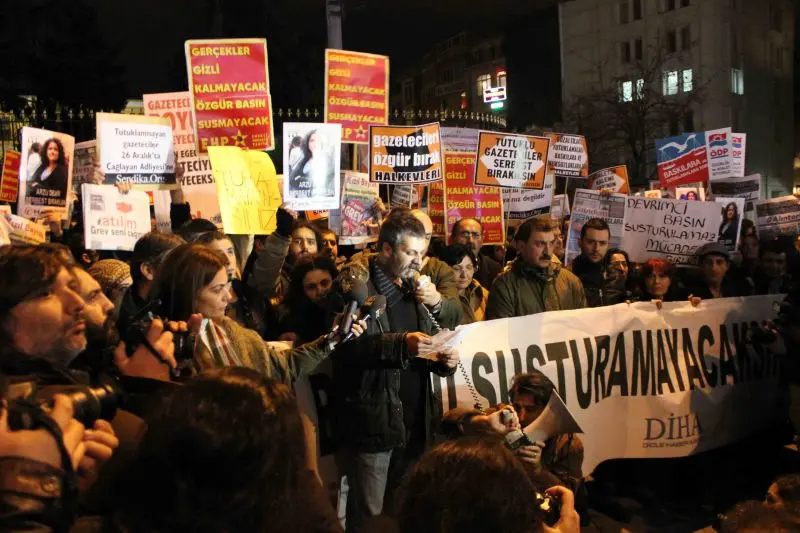
"This is not just about press freedom, this is about freedom of expression," Şık declared to a cheering crowd of supporters, journalists, and human rights activists waving Turkish flags and chanting, "Free press cannot be silenced."
Şık drew attention to the wider systemic crisis, noting that alongside the roughly 100 jailed journalists, approximately 60 students and thousands of ordinary Turkish citizens remain incarcerated under vague and draconian anti-terrorism laws designed to criminalize dissent.
"Justice will be served when those who made up these allegations against us are put in prison," Şık added, vowing accountability for the prosecutors and officials who orchestrated their arrests.
Nedim Şener struck a similarly defiant note in the prison parking lot, signaling his unwavering commitment to his previous investigations, particularly the unresolved dimensions of the Hrant Dink assassination.
"The truth cannot be imprisoned," Şener stated. "We will continue our work to shed light on what really happened."
International Pressure and Human Rights Condemnations
The AK Party government has faced sustained, intense criticism from Western allies, including the United States and the European Union—blocs with which Turkey maintains vital strategic and economic ties. Major international press freedom organizations have similarly ratcheted up pressure on Ankara to dismantle its restrictive legislative framework.
In an official statement released shortly after Monday’s court decision, the Committee to Protect Journalists acknowledged the releases while pushing back against the adequacy of the judicial gesture:
"The government must go beyond this mere gesture and release all journalists incarcerated under Turkey’s vague penal and anti-terror laws," the CPJ statement emphasized. "Fundamental reform of the country’s legislation to align it with international standards is also essential."
Future Outlook
As the dust settles on the immediate emotional scenes outside Silivri Prison, the broader implications for Turkish democracy remain deeply uncertain. While the release of Ahmet Şık, Nedim Şener, Coşkun Musluk, and Sait Çakir offers a glimmer of hope to families and colleagues who have endured months of legal limbo, the structural mechanisms that enabled their imprisonment remain entirely intact.
With six remaining defendants—including the leadership of Oda TV—still detained, and nearly a hundred other journalists facing trial or imprisonment, the June 18 court date will serve as the next crucial barometer. Observers will be watching closely to see whether the judiciary’s willingness to reconsider pretrial detention signals a genuine, long-term shift toward judicial reform and respect for human rights, or whether it represents a temporary tactical concession designed to appease international critics ahead of critical diplomatic engagements.
Until comprehensive legislative overhauls are enacted to narrow the dangerously broad definitions of terrorism and subversion in Turkish law, the sword of Damocles will continue to hang over the nation’s independent press corps.