

Executive Overview
In an era dominated by streaming fatigue, algorithmic content consumption, and digital saturation, a counter-cultural phenomenon is quietly playing out in the most unlikely of places: independent, brick-and-mortar comic book shops. Across the United States, weekly lines stretch past storefronts before doors even unlock. Physical graphic novels and standard single-issue comic books are experiencing a retail renaissance. At the heart of this movement is DC Comics’ "Absolute Universe"—a bold, politically charged publishing initiative that has completely upended industry expectations.
Launched in October 2024 with Absolute Batman, the line has rapidly expanded to include radical, reimagined iterations of Wonder Woman, Superman, and Martian Manhunter, with titles like Flash, Green Lantern, and Green Arrow rounding out a rapidly scaling rollout. Far from suffering the sophomore slumps or declining readership curves typical of long-running comic book continuity, the Absolute line has defied traditional retail metrics. Retailers report that issue sales are actually tripling initial launch numbers years into their runs, signaling a profound cultural alignment between DC’s flagship characters and the anxieties of a younger, digitally native audience.
By stripping DC’s iconic heroes down to their thematic bare essentials and rebuilding them within grim, hyper-realistic, and politically daring worlds, creators like Scott Snyder, Kelly Thompson, Jason Aaron, and Deniz Camp have tapped into a deep vein of contemporary socio-political consciousness. These are not the bright, uncomplicated defenders of yesterday; they are mythic figures forged in the fires of late-stage capitalism, institutional decay, political polarization, and the pervasive isolation of modern digital life.
Detailed Chronology: The Genesis and Ascent of the Absolute Universe
The seeds for the Absolute Universe were planted roughly four years prior to its launch, during a period of cultural malaise following the apex of the Marvel Cinematic Universe. To veteran writer Scott Snyder, a prevailing cultural conversation suggested that superheroes had run their course, that audiences were fatigued by formulas that had dominated global box offices for over a decade.

"It came from a place of anger about it," Snyder shares. "Those moments when larger popular culture feels as though they’re tired of superheroes, that’s usually when comics reinvent them."
Snyder’s pitch to DC was deceptively simple yet radically ambitious: establish an entirely separate publishing universe, running parallel to the primary continuity and initiated by the cosmic machinations of DC’s ultimate antagonist, Darkseid. In this darkened timeline, the cosmic scales are tipped definitively against humanity. Hope is scarce, systemic failures are absolute, and victory is measured not in permanent triumph, but in the sheer refusal to stop fighting.
The Flagship Trauma: Absolute Batman
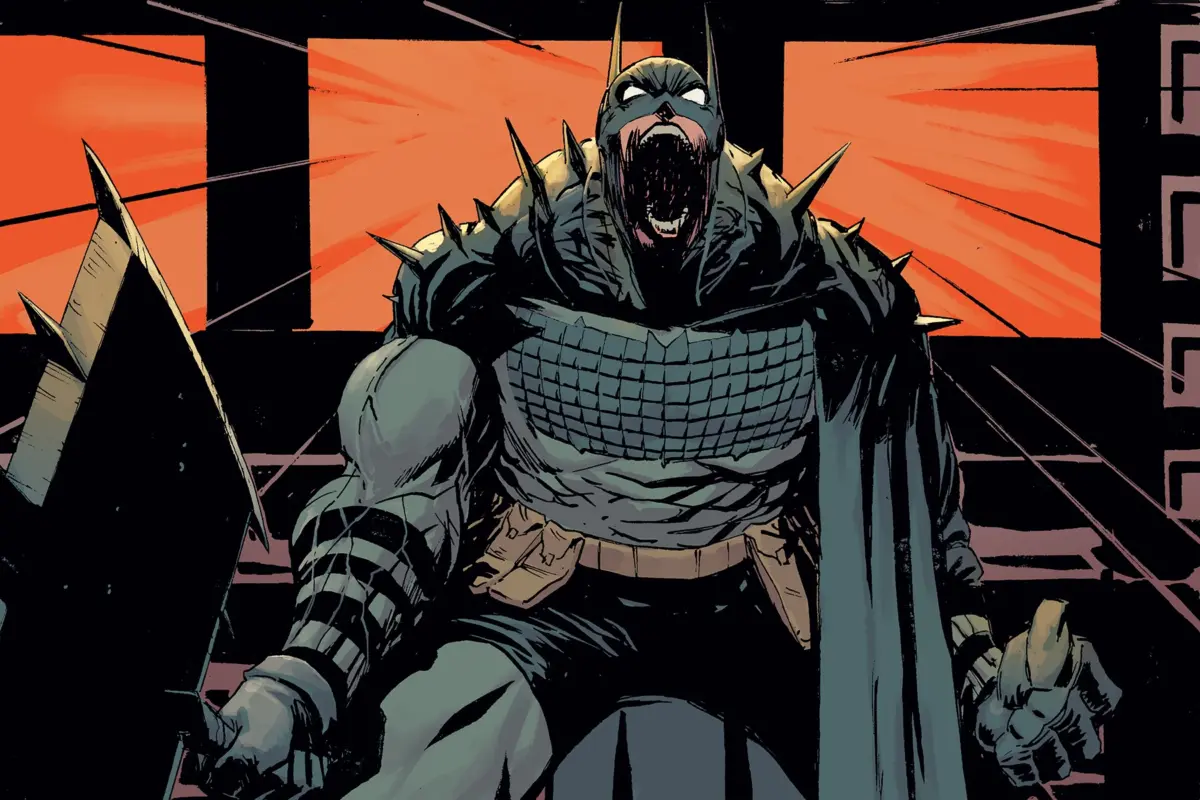
The publishing initiative officially kicked off in October 2024 with Absolute Batman, written by Scott Snyder and illustrated by Nick Dragotta. Eschewing the billionaire playboy archetype, this Bruce Wayne is a 24-year-old, 69-inch-tall, 420-pound blue-collar structural engineer raised by a teacher and a social worker. His origin story is explicitly anchored in modern trauma: a horrific mass shooting during a school field trip to the city zoo that claims the life of his father, Thomas.
The imagery deployed by Snyder and Dragotta is unflinchingly tied to the realities of 21st-century life. Dragotta notes that the depiction of school violence directly mirrors the harrowing "red dot drills" practiced by modern schoolchildren. The resulting Batman is a brutal, hyper-aggressive urban vigilante wrapped in spikes, wielding a chest insignia that doubles as a detachable battle-axe.

Expanding the Pantheon: Wonder Woman, Superman, and Martian Manhunter
Following the massive success of Absolute Batman (which sold nearly 400,000 copies to become the highest-selling comic of 2024), DC rapidly expanded the line:
- Absolute Wonder Woman (Kelly Thompson & Hayden Sherman): Eschewing the idyllic island of Themyscira, this version of Diana was raised in Hell by the sorceress Circe. She is an amputee who sacrificed her arm to save a mortal, wielding a conjured magical limb and a skyscraper-sized sword while carrying an unflappable optimism.
- Absolute Superman (Jason Aaron & Rafa Sandoval): A shorter, more reserved, and profoundly tortured Kal-El. Raised on Krypton well into his teens, he arrives on Earth devoid of the Kents or a Smallville upbringing, forced to navigate a harrowing immigrant’s journey of total cultural displacement.
- Absolute Martian Manhunter (Deniz Camp & Javier Rodriguez): A surreal, esoteric psychological thriller that fuses an alien consciousness directly into the mind of a down-on-his-luck, trauma-surviving FBI agent named John Jones, operating as an uneasy buddy-cop dynamic exploring free will, radicalization, and systemic prejudice.
Supporting Context & Metrics: A Retail Phenomenon
The commercial velocity of the Absolute line has stunned industry veterans who have spent decades behind comic shop counters. Retail trends in the comic book industry historically follow a predictable curve: issue #1 launches drive massive speculative numbers, followed by an immediate, steep decline in subsequent issues as readers drop off. The Absolute line has completely shattered this paradigm.
Dimitrios Fragiskatos, owner of Anyone Comics in Brooklyn, points to a reversal of conventional retail logic. "No store in their right mind would order more copies of Issue Number Two than they would of Issue Number One, but my orders for Number 25 are much higher than my initial orders for number one were. I would even say triple that."
Similarly, Mitch Cutler of St. Marks Comics in Brooklyn reports struggling to keep trade paperbacks on the shelves: "We got a giant reorder of the trades on Wednesday or Thursday, and they were all gone by Monday morning. We’re stocking this stuff deep, and it wasn’t enough."

This retail surge is mirrored by critical acclaim, with the Absolute titles sweeping multiple nominations and victories at the industry’s prestigious Eisner and Hugo Awards. But the true engine driving this growth is a demographic shift. Younger readers—particularly Gen Z—are embracing print media as a tactile counterweight to an all-digital, subscription-heavy lifestyle. Propelled by viral video breakdowns, aesthetic panels, and online community discourse on platforms like TikTok and Instagram, the Absolute Universe has successfully captured an audience that had previously written off superhero comics as impenetrable or outdated.
Official Statements and Creative Vision
The architects behind the Absolute Universe are remarkably candid about the socio-political underpinnings of their work. Rather than hiding behind corporate neutrality, the creative teams have deliberately leaned into contemporary anxieties, addressing topics that mainstream media often sanitizes.
"Week after week, people are lined up outside the door waiting for us to turn that key at 10 a.m.," says Jermaine Exum, owner of Acme Comics in Greensboro, North Carolina. "I’ve been behind the counter here for 30 years. I’ve seen a lot of Number One relaunches, but I’ve never seen anything quite like what is happening with the Absolute material."
For creators like Scott Snyder, the shift in tone reflects a generational passing of the torch regarding fear and parental anxiety.

"I wrote Batman the first time around as though it was me, and I was younger; it was like Batman is me going up against my own fears," Snyder explains. "But now, 15 years later, I’m a lot more afraid of the world that my kids are entering. You just see a much more difficult, more challenging, more fraught, much more frightening world [that] they’re entering on every front."
This philosophy extends across the entire editorial line. Deniz Camp, discussing the thematic weight of Absolute Martian Manhunter, points to an intentional diagnosis of modern societal fracturing:
"We have a loneliness epidemic in this country [and] internationally right now… The lack of connection with people makes you angry, and it makes you sad, and it also allows others to dehumanize groups very easily because you don’t have connections to them."
This direct confrontation with real-world issues—ranging from corporate labor exploitation and conspiracy-driven radicalization to immigration and systemic corruption—has resonated deeply with readers who feel alienated by sanitized escapism. As 20-year-old reader Asher Wilson notes, "They’re coming after topics that, obviously, people are afraid of, but also afraid to talk about."

Future Outlook: Sustaining the Momentum
As DC’s Absolute Universe enters its mature phase with expanded rosters featuring the Flash, Green Lantern, and Green Arrow, the central challenge shifts from initial disruption to long-term sustainability. Historical precedents exist for politically charged reinventions—such as Frank Miller’s seminal 1986 The Dark Knight Returns or the post-9/11 allegorical explorations of civil liberties in Marvel’s Civil War—proving that comics operate at their most potent when mirroring contemporary societal fractures.
However, the unprecedented velocity of the Absolute line relies heavily on maintaining absolute creative authenticity. Younger readers possess finely tuned detectors for corporate pandering or superficial soapboxing. The success of the initiative hinges on its underlying thesis: that heroism in a broken world is not about achieving swift, clean victories, but about the radical act of collective resistance and empathetic inclusion.
"The guiding principle and the secret of the series [is] that Batman, in this world, needs to learn that power is in collectivism," Snyder concludes. "Power is in letting more and more people in."
If DC Comics can maintain this delicate balance between uncompromising critique and resonant, character-driven hope, the Absolute Universe may well redefine the superhero genre for generations to come, proving once and for all that ink, paper, and profound storytelling remain formidable weapons against the void.