


Executive Overview
In the modern digital economy, written content serves as the primary engine for organic customer acquisition, brand equity, and direct-response conversions. However, a persistent disconnect exists between literary eloquence and commercial performance. Modern digital marketing data demonstrates that visually poetic or overly sophisticated prose often underperforms when evaluated against clear, concise, and conversion-focused copy.
Analysis of multi-million-dollar digital agencies and content platforms reveals a consistent pattern: sustainable online revenue is driven not by creative flourishes, but by systematic audience research, competitor ad decomposition, programmatic workflows, and rigorous attribution tracking. Written marketing channels—including search-engine-optimized blog infrastructure, targeted email sales funnels, and platform-specific social media copy—derive their utility from their ability to reflect prospect reality, answer core objections, and guide readers toward targeted economic actions.

This operational analysis breaks down the fundamental methodologies required to transition written copy from a creative exercise into a high-yield growth asset, outlining the ten essential pillars of commercial copywriting and the evolving integration of artificial intelligence within content workflows.
Detailed Chronology: The 10-Pillar Strategic Framework
                       +-----------------------------------+
                       |    THE ROI COPYWRITING ENGINE     |
                       +-----------------------------------+
                                         |
         +-------------------------------+-------------------------------+
         |                               |                               |
  [RESEARCH & INTEL]            [EXECUTION & PROCESS]          [METRICS & SCALING]
  1. Customer Discovery         4. Standardized Workflows       7. Platform Specialization
  2. Competitor Ad Audits       5. Applied Commercial Practice  8. GA4 & ROI Attribution
  3. Swipe File Curation        6. AI-Augmented Research        9. Expert Feedback Loops
                                                               10. Velocity vs. Patience
Pillar 1: Customer Discovery & Qualitative Intelligence
Effective direct-response copywriting requires an exhaustive understanding of the prospect’s psychological state. The primary objective of conversion-focused copy is to capture attention, establish trust, introduce a tailored solution, dismantle specific friction points, and induce a transaction. Achieving this requires systematic intelligence gathering across three primary dimensions:

- Current Pain Points: The precise, daily frustrations experienced by the target demographic.
- Desired Outcomes: The functional and emotional state the customer seeks to achieve.
- Core Objections: The internal scripts and hesitations that prevent purchase completion.
For instance, high-converting landing pages—such as those deployed for premium digital courses like Ramit Sethi’s Earnable—rarely rely on generic promises of wealth generation. Instead, they leverage hyper-specific observational copy that mirrors the reader’s daily routine: the 9-to-5 job structure, evening streaming consumption, mundane weekend errands, and compulsive social media scrolling. By articulating the reader’s current reality with precise fidelity, the copy establishes immediate authority and signals that the underlying product was constructed specifically for their scenario.
+-----------------------------------------------------------------------------------+
|                        QUALITATIVE RESEARCH METHODOLOGY                           |
+-----------------------------------------------------------------------------------+
|  1. Sales Rep Interviews     --> Extract recurring buyer friction & objections    |
|  2. Transcript Mining        --> Process raw calls via LLMs for phrase patterns   |
|  3. Social Listening         --> Analyze Reddit/Facebook sub-communities for tone |
+-----------------------------------------------------------------------------------+
From an operational standpoint, copywriters can extract qualitative data through three main avenues:

- Sales Call Transcripts: Analyzing recorded sales calls or interviewing account representatives to catalog recurring customer objections.
- LLM-Assisted Transcript Mining: Uploading customer interview transcripts into Large Language Models (LLMs) to identify statistical clusters of specific vocabulary and emotional markers.
- Community Social Listening: Auditing organic discussions on platforms such as Reddit, niche forums, and professional groups to capture unvarnished prospect dialogue and intent patterns.
Pillar 2: Competitive Intelligence & Paid Ad Deconstruction
Incumbent market leaders spend significant capital testing copy variations across paid acquisition channels. Rather than initiating campaign strategies in isolation, copywriters can utilize competitive intelligence to isolate high-performing market hooks.
Public ad repositories—such as the Meta Ad Library and LinkedIn Ads Transparency Center—provide real-time data on active ad campaigns across industries.

[Access Ad Library] ---> [Filter by Longest Active Run] ---> [Isolate Core Hook/Pain Point] ---> [Adapt to Copy Architecture]- Ad Longevity as a Performance Metric: Paid ads that maintain active spend over extended windows (e.g., 30 to 90+ days) generally reflect positive return on ad spend (ROAS) and validated messaging.
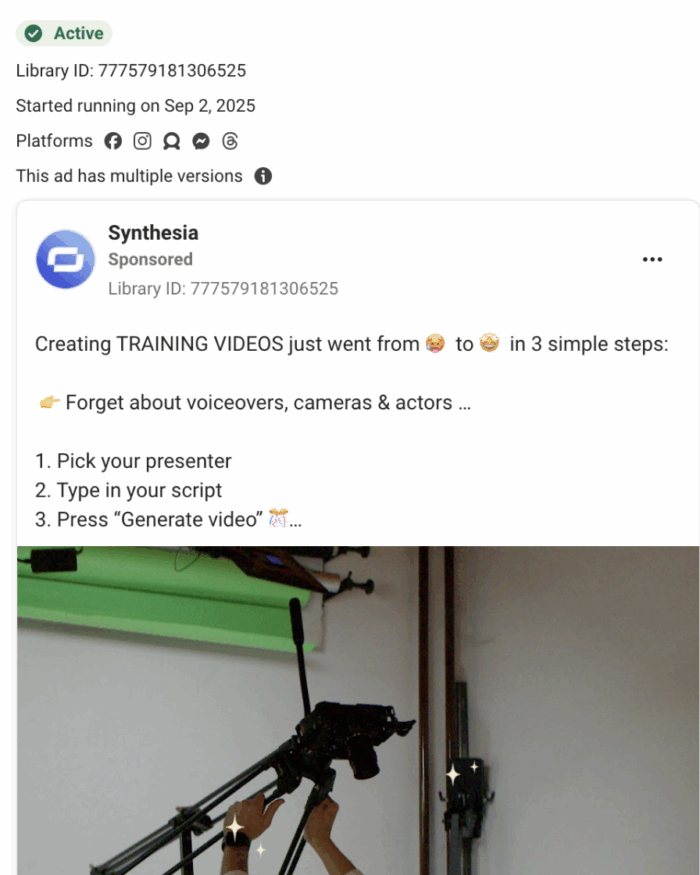
- Pain Point Deconstruction: Auditing long-running assets exposes core messaging angles. For example, enterprise video-creation platforms such as Synthesia frequently anchor long-running campaigns around the operational friction of coordinating physical shoots for corporate training videos. Similarly, customer relationship management (CRM) providers like HubSpot and Close structure ad copy around the financial losses stemming from fragmented lead data and organizational noise.
Pillar 3: Swipe File Curation & Pattern Recognition
A swipe file is a curated repository of proven advertising assets, headlines, email series, and landing page frameworks. Developing an organized internal swipe file allows writers to analyze macro-structures and structural cadence rather than starting from a blank page.
Beyond internal documentation, studying repositories managed by veteran direct-response copywriters—such as Neville Medhora’s SwipeFile.com—exposes writers to battle-tested frameworks across diverse market segments. Evaluating curated swipe files helps copywriters cultivate an objective analytical lens, distinguishing between visually pleasing creative work and structural mechanics designed to drive reader conversion.

Pillar 4: Standardized Workflow Engineering
High-performing copywriters rely on standardized, repeatable execution workflows. A structured process mitigates creative block and ensures that every published asset systematically incorporates necessary conversion architecture.
Blog Content Conversion Workflow:
+--------------------------------------------------------------------------------+
|                        STANDARD BLOG COPYWORKFLOW                              |
+--------------------------------------------------------------------------------+
|  Phase 1: Structural Outline                                                   |
|  - Define core H2/H3 architecture based on search intent & audience pain points|
|                                                                                |
|  Phase 2: Comprehensive Draft                                                  |
|  - Rapid generation of body copy focused on depth, clarity, and authority     |
|                                                                                |
|  Phase 3: Conversion Optimization                                              |
|  - Integrate strategic Call-to-Actions (CTAs) and address specific objections  |
+--------------------------------------------------------------------------------+
By enforcing a clear sequence—separating structural outline creation from draft generation and conversion refining—writers ensure that every asset addresses explicit search intent, includes relevant call-to-action (CTA) mechanics, and systematically dismantles prospect friction.

Pillar 5: Applied Commercial Practice & Purchase Intent Alignment
Theoretical understanding of copywriting principles must be validated through active market execution. Practicing copy in real-world environments provides immediate feedback loops regarding conversion efficacy.
Strategic Avenues for Practical Application:
- Personal Platform Building: Writing specialized social media content (e.g., LinkedIn, X) to build an audience directly tests hook generation and engagement mechanics while serving as a portfolio asset.
- Niche Search Engine Optimization (SEO): Launching affiliate platforms or specialized blogs tests the intersection of search intent, organic traffic generation, and affiliate conversion rates.
- E-Commerce & Digital Products: Operating small-scale direct-to-consumer (DTC) or dropshipping storefronts forces absolute clarity on buyer motivation.
[Informational Intent: "How to fix a product"]  ---> Yields support/service calls (Low Margin)
[Commercial Intent: "Best replacement parts"]  ---> Yields direct sales transactions (High Conversion)
Commercial Intent Case Study: Consider an e-commerce platform specializing in regional mechanical goods (e.g., traditional clock repair). Publishing content around general maintenance often attracts DIY enthusiasts seeking free repair guides. Conversely, shifting copy toward commercial purchase intent—such as specialized component replacements or professional restoration options—directly targets buyers ready to make a purchase, driving measurable top-line growth.

Pillar 6: Strategic AI Integration in Modern Copy Workflows
While generative AI tools can produce high volumes of text, relying on automated tools for end-to-end writing often results in generic, low-converting copy. Strategic AI usage positions the technology as an analytical research assistant rather than an authorial replacement.
| Use Case | Execution Methodology | Strategic Benefit |
|---|---|---|
| Pain Point Research | Prompting LLMs to aggregate common objections within specific audience niches. | Expedites topic ideation and surfaces underlying audience motivations. |
| Structural & Clarity Tuning | Submitting rough passages for syntactic simplification and alternative tone iterations. | Eliminates unnecessary complexity; sharpens copy conciseness. |
| Expert Quote & Source Discovery | Utilizing web-connected LLM queries to locate relevant industry citations and real-world discussions. | Validates claims with primary evidence, elevating domain authority. |
AI Prompt Example (Research):
"Identify the top 5 operational friction points experienced by B2B Sales Directors when migrating CRM platforms."

AI Prompt Example (Refinement):
"Rewrite this paragraph to remove passive voice, reduce word count by 20%, and emphasize reader ROI."
Pillar 7: Platform Specialization & Algorithmic Alignment
Copywriting performance varies across distribution channels. Writing style, formatting, and structural hooks must align with the target platform’s consumption habits and algorithmic incentives.
+-----------------------------------------------------------------------------------+
|                        PLATFORM-SPECIFIC COPY ARCHITECTURE                        |
+-----------------------------------------------------------------------------------+
|  LINKEDIN / X              | Focus: Thought Leadership, Personal Authority        |
|                            | Structure: Short paragraphs, punchy hooks, high scan  |
+----------------------------+------------------------------------------------------+
|  ORGANIC SEARCH (SEO BLOG) | Focus: Deep Intent Fulfillment, Problem-Solving       |
|                            | Structure: Detailed H2/H3 hierarchy, comprehensive depth|
+----------------------------+------------------------------------------------------+
|  EMAIL SALES FUNNELS       | Focus: Direct Response, Nurturing & Conversion        |
|                            | Structure: Story-driven, single clear CTA, intimacy   |
+-----------------------------------------------------------------------------------+
Mastering a single channel’s technical nuances—such as SEO keyword density and search intent matching for search engines, or retention hooks for social algorithms—allows copywriters to generate higher yield per asset and command premium market rates.
Pillar 8: ROI Measurement & Performance Attribution
To evaluate copy effectiveness, writers must look beyond superficial engagement metrics like generic impressions or passive likes. Professional copywriters track metrics directly tied to pipeline growth and conversion events.

Channel Attribution Metrics:
- Social & Ghostwriting Channels: Track qualitative profiles of engaged accounts. Comments from key decision-makers (e.g., VPs, Department Heads) indicate strong audience alignment. Implement "How did you hear about us?" fields on demo forms to capture multi-touch attribution.
- SEO Content & Blogs: Establish GA4 conversion tracking for lead magnet downloads, trial signups, and sales calls generated per article. Volume metrics without revenue correlation mask true content performance.
- Sales Pages & Email Sequences: Measure direct click-through rates (CTR), conversion rates (CR), and net revenue generated per recipient.
                  +-----------------------------------+
                  |   CONVERSION TRACKING FLOWCHART   |
                  +-----------------------------------+
                                    |
            +-----------------------+-----------------------+
            |                                               |
  [ORGANIC/SOCIAL ENTRY]                          [BLOG / LANDING PAGE]
            |                                               |
            v                                               v
  Qualitative Lead Scoring                        GA4 Event Trigger
  (Audience Seniority Check)                      (Form Submit / Purchase)
            |                                               |
            +-----------------------+-----------------------+
                                    |
                                    v
                       [REVENUE & PIPELINE ATTRIBUTION]
Pillar 9: Peer
Critique Networks & Feedback Optimization
Iterative feedback accelerates skill development. However, feedback quality varies depending on the reviewer’s background.

Writers should seek out structured feedback environments populated by proven practitioners rather than generalist peer groups. Reviewing copy alongside experienced marketers helps writers identify micro-flaws in value propositions, awkward structural transitions, and weak calls to action before launching campaigns.
Pillar 10: Velocity of Action vs. Patience for Results
Adopting foundational frameworks requires balancing execution speed with timeline expectations—a core principle articulated by investor Naval Ravikant: "Be impatient with action, and patient with results."

Applied to copywriting and content marketing, this strategy emphasizes high daily output—rapid drafting, continuous customer research, proactive platform testing, and iterative refining—paired with long-term timeline expectations. High-performing written assets and strong personal authority compound over extended periods; early campaign iterations serve as baseline data points for future optimization.
Supporting Context & Industry Metrics
The modern content marketing landscape has shifted significantly toward operational accountability. Historical models that prioritized high-volume, superficial blog production have yielded to high-intent content strategies focused on bottom-line attribution.

+-----------------------------------------------------------------------------------+
|                     CONTENT MARKETING PERFORMANCE METRICS                         |
+-----------------------------------------------------------------------------------+
| Metric Category            | Legacy Focus             | Modern ROI Focus          |
+----------------------------+--------------------------+---------------------------|
| Traffic Evaluation         | Total Pageviews          | Qualified Target Leads    |
| Engagement Measurement     | Impressions / Social Likes| Decision-Maker Comments   |
| Conversion Tracking        | Bounce Rate              | GA4 Custom Goal Events    |
| Workflow Model             | Manual Generation        | Human Strategy + AI Assist|
+-----------------------------------------------------------------------------------+
Recent B2B enterprise acquisition data highlights key metrics driving successful modern conversion writing:
- High Intent vs. High Volume: Articles targeting bottom-of-funnel decision keywords generate up to 8x higher conversion rates than broad, top-of-funnel educational terms, even with significantly lower overall search volume.
- AI Efficiency Metrics: Copywriting teams utilizing AI for qualitative research and outline generation report 30% to 40% reductions in production cycles, allocating more time to customer research and conversion optimization.
- Attribution Adoption: Companies tracking pipeline value per written asset via GA4 or CRM integrations are 2.5x more likely to sustain increasing content budgets year-over-year.
Official Statements & Expert Insights
Strategic approaches to copywriting emphasize measurable business impact over literary style.

"Becoming a better copywriter doesn’t mean you write more eloquently. In fact, the opposite is often true. Great copywriters are clear, concise, and ultimately convert readers into customers. Focus on how to generate more revenue from your words."
— Copywriting Director, Copyblogger
Industry practitioners stress the value of actionable, audience-driven research over purely theoretical advice:

"The most effective copy doesn’t create desire; it turns the existing desires, fears, and hopes of a target audience into purchasing action. You must mirror their exact reality back to them."
— Neville Medhora, Founder of SwipeFile.com
On the long-term execution framework required to achieve compounding returns:

"Be impatient with action, and patient with results."
— Naval Ravikant, Entrepreneur & Investor
Future Outlook & Strategic Roadmap
The landscape of written acquisition channels continues to evolve under the influence of search engine algorithm updates, search generative experiences (SGE), and changing social distribution models.

                                [FUTURE COPYWRITING LANDSCAPE]
                                              |
        +-------------------------------------+-------------------------------------+
        |                                     |                                     |
[AI Search Summarization]           [Rise of Original Thought]            [Direct Attribution Demands]
Adapting to zero-click searches     Prioritizing primary intelligence     Proving direct pipeline ROI
by writing hyper-specific copy.     and proprietary data points.         through integrated analytics.
Key Trends Shaping Conversion Copy:
- Information Gain & Proprietary Data: Search algorithms increasingly penalize synthesized, generic copy. Future high-converting copy must incorporate primary research, unique customer interviews, proprietary metrics, and verified expert insights to maintain organic visibility.
- Zero-Click Experience Adaptation: As search engines and social networks summarize top-level content natively within their platforms, copywriters must optimize hooks and early text blocks to capture attention instantly before readers scroll past.
- Hyper-Personalization at Scale: Modern marketing technology enables dynamic sales pages tailored to specific user segments, traffic sources, or past behavior. Copywriters who master modular messaging frameworks will be well-positioned to drive high conversion rates across targeted user segments.
Ultimately, while distribution tools, platforms, and AI systems continue to shift, the core psychological principles of copywriting remain constant: understanding customer pain points, communicating solutions clearly, establishing absolute trust, and proving business ROI.