

Executive Overview
In the digital product ecosystem, few challenges are as universally acknowledged yet persistently mismanaged as the act of naming. Whether it is a backend variable, an atomic design token, an overarching UI component, or an entirely new product feature, nomenclature serves as the foundational vocabulary of software engineering and digital design. The language teams adopt does more than merely label artifacts; it fundamentally shapes cognitive models, dictates the trajectory of cross-functional dialogue, and establishes the boundaries of system scalability.
For years, development and design teams have suffered from a silent productivity tax levied by linguistic friction. Designers speak in visual metaphors, developers rely on programmatic syntax, product managers lean into business vernacular, and users operate within the realm of practical utility. When these dialects collide, the result is pervasive confusion: colors are misidentified, icons are ambiguous, UI components lack standard definitions, and design systems fracture under the weight of bloated, inconsistent taxonomies.
This investigative feature explores the anatomy of digital naming. Drawing upon industry-leading methodologies, open-source resources, and enterprise case studies—ranging from Intuit’s multi-brand taxonomy to Vodafone UK’s sophisticated variable maps—this guide provides a rigorous blueprint for standardizing nomenclature across UI/UX engineering. By addressing the psychological traps of over-generic and hyper-specific naming, organizations can drastically reduce friction, enhance feature discoverability, and build future-proof design systems.

Detailed Chronology: The Evolution of Naming Best Practices in Digital Design
The evolution of how the web approaches naming reflects the maturation of digital design itself. In the early days of the web, naming conventions were largely ad-hoc, driven by individual preferences and primitive cascading style sheet (CSS) selectors.
Phase One: The Wild West of Code (Late 1990s – Early 2010s)
During the formative years of modern web development, naming was treated as an afterthought. Classes and identifiers (IDs) were coined on the fly based on immediate visual appearance rather than structural semantics (.red-box, .float-left, .big-text). This approach proved catastrophic as web applications scaled. A style change from red to blue rendered class names semantically absurd, forcing massive refactoring efforts.
Phase Two: Methodologies and Modularization (2010s – 2018)
Recognizing the unsustainable nature of ad-hoc naming, the industry pivoted toward strict methodologies. Frameworks like BEM (Block, Element, Modifier), SMACSS (Scalable and Modular Architecture for CSS), and OOCSS (Object-Oriented CSS) emerged. These systems introduced rigorous structural syntax, forcing teams to think about components in isolation. However, while these methodologies solved code-level specificity, they frequently widened the cognitive gap between design tools (such as early Sketch or Photoshop files) and production codebases. Designers and engineers still lived in separate semantic universes.

Phase Three: The Design System Era and Tokenization (2018 – Present)
With the advent of robust design systems and token-driven architectures, naming evolved from a local styling choice to a global enterprise taxonomy challenge. Design tokens—representing atomic design decisions like color palettes, typography scales, and spacing increments—demanded structured hierarchies capable of bridging Figma layers, multi-brand themes, and multi-platform codebases. Today, naming is understood as an architectural discipline in its own right, requiring governance, cross-functional dictionaries, and scalable taxonomies.
Supporting Context & Metrics: The Cost of Linguistic Friction
Linguistic ambiguity in software development is not merely an aesthetic annoyance; it carries quantifiable operational costs. According to recent organizational studies on enterprise design system adoption, teams waste up to 15% of their weekly engineering and design cycles clarifying semantic ambiguities.
The Goldilocks Dilemma: Too Generic vs. Too Specific
The core struggle in naming digital artifacts lies in navigating two extremes:

- Over-Generic Names: When names are too broad (e.g.,
.container,.wrapper,.item, or token names like--color-primary-1), they fail to convey intent. Developers and designers must continuously inspect the implementation to understand what the element does, destroying the efficiency of abstract components. - Over-Specific Names: Conversely, when names are hyper-specific (e.g.,
.sidebar-billing-invoice-dropdown), they destroy reusability. The moment a feature is redesigned or repurposed elsewhere in the application, the name becomes obsolete, leading to technical debt and bloated stylesheets.
The Multi-Dialect Problem
The friction is compounded by the "Four Dialects" of product development:
- The Designer’s Dialect: Focuses on visual hierarchy, artboards, and spatial composition.
- The Developer’s Dialect: Focuses on modularity, state management, and programmatic logic.
- The Product Manager’s Dialect: Focuses on business value, metrics, and user stories.
- The User’s Dialect: Focuses on intuitive tasks, jobs-to-be-done, and plain language.
Bridging these dialects requires curated resources and shared mental models. Fortunately, the community has generated an array of powerful tools to assist practitioners.
Official Guidelines, Resources, and Toolkits
To combat the naming crisis, industry experts have open-sourced a collection of definitive guides, interactive tools, and design system repositories.

1. Stepping Outside the Code Box: Classnames
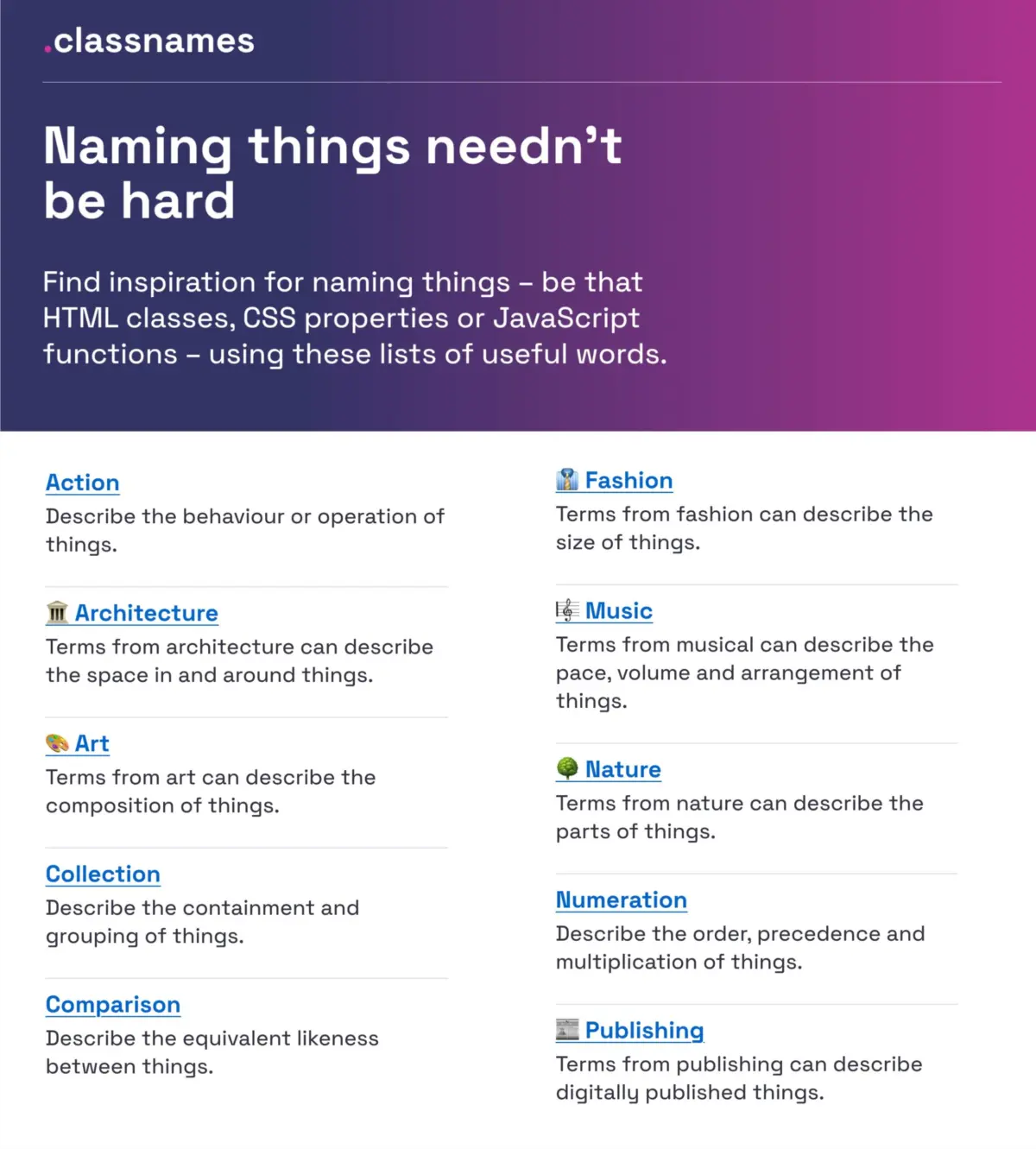
When naming HTML classes, CSS properties, or JavaScript functions, traditional vocabulary often runs dry. Paul Robert Lloyd’s Classnames resource provides thematically grouped lists of words designed to spark creative, non-obvious nomenclature. Moving beyond traditional technical terms, the site incorporates thematic collections drawn from nature, art, theater, music, architecture, fashion, and publishing—enabling teams to establish distinct semantic domains for complex applications.
2. Standardizing Color: Color Names Repository
Naming colors has historically been subjective and chaotic. David Aerne’s comprehensive Color Names Repository addresses this by indexing over 30,355 unique color names sourced from diverse references and thousands of user contributions. Integrated with tools like the Color Parrot picker, this repository serves as an authoritative dictionary for teams striving to establish predictable color tokens without resorting to arbitrary numerical scales.
3. Layer and Group Hygiene: Good Practices Design
In design tools like Figma, messy layer panels are notorious productivity killers. Javier Cuello’s Naming Best Practices outlines a definitive framework for structuring layers, groups, and components. According to Cuello, an effective name must possess a logical structure, remain concise, carry universal meaning within the team, and entirely divorce itself from transient visual properties.

4. Enterprise Token Taxonomies: Intuit and Vodafone UK
Scaling design tokens across massive product ecosystems requires rigorous architectural planning.
- Intuit’s Case Study: Facing the challenge of unifying disparate brands—including Mailchimp, QuickBooks, TurboTax, and Mint—Nate Baldwin and the Intuit design team developed a flexible token taxonomy. Their system moves beyond isolated brand themes to create a foundational architecture that serves wildly diverse product categories.
- Vodafone UK’s Variables Taxonomy Map: Available via the Figma Community, Vodafone’s taxonomy map breaks down design token anatomy across a multi-brand, multi-themed system. By mapping connections across four distinct collections—spanning brand primitives, semantics, and page-level implementations—the system ensures that any team member can trace the origin and destination of a token purely from its name.
5. UI Component Dictionaries: The Component Gallery
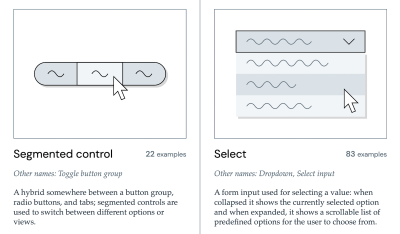
Reinventing the wheel—or worse, inventing a novel name for an established pattern—is a trap many teams fall into. Iain Bean’s Component Gallery aggregates real-world examples and variant names for more than 50 common UI components (ranging from accordions to visually hidden elements). Complementing this is Name That UI, an interactive visual dictionary designed to align cross-functional teams on standard component terminology.
6. Design Token Builders: Name Design Tokens Guide
Romina Kavcic’s Design Token Naming Guide and Builder provides an interactive framework for structuring tokens across components, categories, states, and roles. Paired with her Design Token Names Inventory spreadsheet, teams gain a bird’s-eye view of their entire token architecture, allowing for seamless filtering, scalability, and multi-theme management.
7. Product and Feature Naming: Onym and Feature Discovery
Naming internal design components is one challenge; naming user-facing features is another. Poor feature adoption is frequently a symptom of poor discoverability caused by opaque naming.
- Erin Gannon’s practical guide, “What Do We Call This Thing?”, stresses that feature names must be driven by user problems and outcomes (the "job-to-be-done"). By auditing the exact vocabulary users employ during discovery interviews, teams can craft feature names that seamlessly integrate into existing user workflows.
- For broader product nomenclature, Onym acts as an open-source repository of brainstorming tools, vetting frameworks, etymologies, and agency resources.
Future Outlook: The Next Generation of Semantic Governance
As artificial intelligence, automated design-to-code pipelines, and multi-platform design systems continue to mature, the discipline of naming is poised for a profound transformation.
AI-Assisted Semantic Consistency
In the near future, design systems will increasingly rely on AI-driven governance tools that automatically flag naming anomalies across Figma files and production codebases. If a designer introduces a new color token or UI component that violates established taxonomy rules—or duplicates an existing concept under a different alias—automated linters will suggest standardized alternatives derived from enterprise dictionaries.

The Convergence of Design and Code Vocabularies
The persistent friction between designer dialects and developer dialects will continue to dissolve through the universal adoption of design tokens as a single source of truth. As tools become more deeply synchronized, the act of naming a layer in a design tool will instantaneously propagate semantically identical, type-safe variables into the codebase, eliminating manual translation errors.
Conclusion: The Human Element
Ultimately, regardless of automated tooling, the success of any nomenclature system rests on human communication. The right name is, simply put, the one that is universally understood and actively utilized by both the product team and the end user. By auditing existing naming conventions, eliminating dialect silos, and leveraging community-driven resources like those from Smashing Magazine, Intuit, and Vodafone, organizations can transform naming from a source of daily frustration into a powerful engine of clarity, scalability, and seamless collaboration.