

Executive Overview
One of the most enduring biological riddles in neuroscience is the brain’s contralateral organization: why the left hemisphere of the brain dictates movement and processes sensory input from the right side of the body, while the right hemisphere manages the left. For centuries, this anatomical reversal has puzzled anatomists, physiologists, and evolutionary biologists alike. Traditional functional theories have attempted to justify this cross-wiring through various computational or hydrodynamic advantages, often assuming that this structural design provides a direct, localized survival mechanism.
However, a groundbreaking study published in Frontiers in Neuroanatomy by Dr. Martin Wessendorf, a neuroscientist and associate professor emeritus at the University of Minnesota, alongside cognitive neuroscientist Daniel Wang, challenges these teleological assumptions. The researchers propose a radical paradigm shift: the brain’s crossed connections did not necessarily evolve because they confer a specific functional advantage. Instead, they may represent an evolutionary inheritance—a profound architectural footprint handed down from ancient aquatic organisms that lived more than 500 million years ago.
By mapping neural pathways across four-limbed animals (tetrapods) and tracing their developmental origins, Wessendorf and Wang suggest that the central nervous system built newer sensory and motor circuits around a pre-existing, deeply conserved visual framework. This investigative report explores the historical development of this hypothesis, dissects the intricate sensory and motor tracts underpinning the research, evaluates the broader biological implications, and outlines the prospective avenues for validating a theory that stretches back to the Cambrian Period.
Detailed Chronology
To understand how modern humans inherited a nervous system that operates on a contralateral cross-wire, researchers had to look backward through the deep time of vertebrate evolution. The historical narrative of this neurological architecture spans several critical milestones across geological epochs:
- The Cambrian Period (Approx. 538 to 486 Million Years Ago): According to the researchers’ hypothesis, the foundational template for crossed wiring was established during this era of rapid evolutionary diversification. Primitive jawless fish developed the earliest iterations of an optic chiasm and an optic tectum (the midbrain region responsible for rapid, reflex-driven responses to visual stimuli). Because the lens of the eye naturally inverts incoming light—projecting right-side visual data onto the left retina—these primordial visual systems naturally organized sensory inputs across opposing spatial axes.
- The Rise of Tetrapods (Devonian Period, Approx. 419 to 359 Million Years Ago): As vertebrates transitioned from water to land and evolved four limbs, the ancient neural blueprint was preserved and co-opted. Major sensory tracts, such as the dorsal column pathway and the spinothalamic tract, emerged or solidified within this cross-wired framework, ensuring that tactile and nociceptive (pain) signals from the periphery crossed the midline to reach the contralateral hemisphere.
- The Evolution of Mammalian and Primate Circuitry: Millions of years later, the emergence of the six-layered cerebral cortex in mammals added advanced cognitive processing layers. In primates and humans, the corticospinal tract—crucial for fine motor control and dexterous finger movements—was superimposed upon these ancient, cross-wired conduits, effectively repurposing older sensory pathways for complex motor execution.
- Contemporary Neuroscience Breakthrough: In their recent publication in Frontiers in Neuroanatomy, Dr. Martin Wessendorf and Daniel Wang synthesized decades of comparative neuroanatomy. By examining how sensory and motor pathways align with ancient midbrain maps, they unified disparate neurological observations into a cohesive evolutionary timeline, effectively reframing the debate over contralateral organization from an issue of functional optimization to one of historical structural constraint.
Supporting Context & Metrics
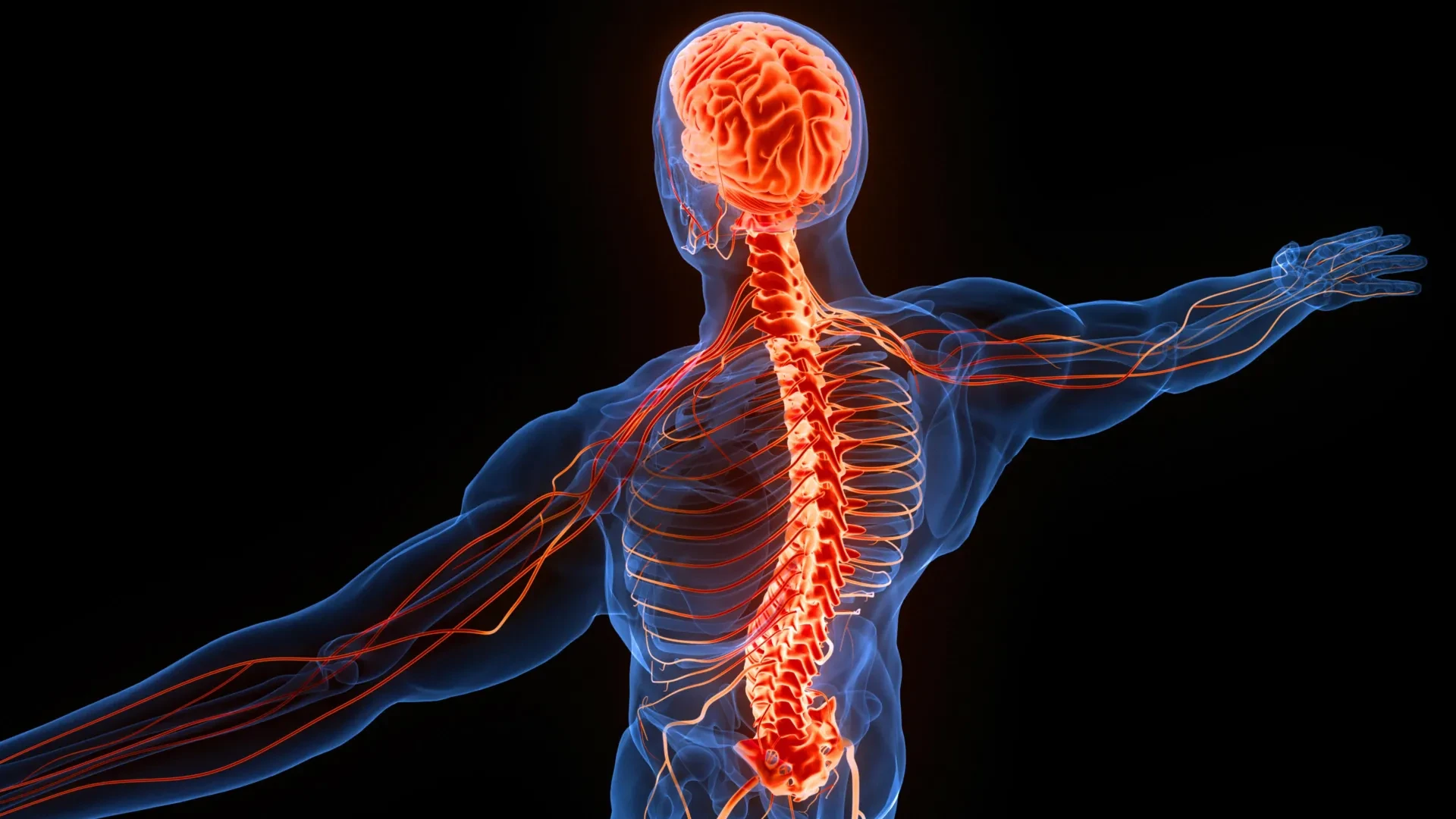
To appreciate the scale and anatomical complexity of Wessendorf and Wang’s hypothesis, one must examine the specific neural pathways that dictate how the brain communicates with the body. The nervous system is not a blank slate; it is a layered archaeological dig of functional tracts.
The Visual Foundation and the Optic Tectum
The journey begins at the sensory periphery. When photons enter the eye, the optical physics of the lens reverse the visual field: objects situated in the right visual field project onto the left side of the retina. This visual data streams along the optic nerve to the optic chiasm, where nerve fibers cross so that right-field information is routed to the left brain, and left-field information goes to the right.
These signals terminate heavily in the optic tectum (known in mammals as the superior colliculus). This midbrain structure is among the most evolutionarily ancient components of the vertebrate central nervous system, present in virtually every vertebrate species from sharks to humans. The tectum builds a spatial map of the external world, integrating visual, auditory, and somatosensory cues to orchestrate split-second survival behaviors—such as the instinctive turning of the head toward an object entering the peripheral vision.
Sensory Pathways Across the Midline
Beyond vision, the researchers evaluated two primary systems responsible for transmitting bodily sensations to the brain:
- The Dorsal Column Pathway: Responsible for transmitting fine touch, conscious proprioception (body position), and vibration. Sensory signals travel up the dorsal spinal cord, synapse in the brainstem, and then cross over to the contralateral side. While absent in modern fish, this pathway is ubiquitous across amphibians, reptiles, birds, and mammals, highlighting its early tetrapod origins.
- The Spinothalamic Tract: Responsible for processing pain, temperature, and crude touch. Unlike the dorsal column, these fibers cross the midline directly within the spinal cord before ascending to the thalamus. This tract appears not only in tetrapods but also in certain cartilaginous fish, pointing toward an even deeper evolutionary lineage.
Motor Control and the Corticospinal Tract
Motor pathways exhibit a similar cross-wired organization. The tectospinal pathway originates in the optic tectum and crosses to the opposite side of the spinal cord to mediate rapid reflex movements. Similarly, the rubrospinal pathway, originating in the red nucleus of the midbrain, extends contralaterally to assist in limb coordination.
Most complex of all is the corticospinal tract, which originates in the cerebral cortex. In most mammals, its fibers primarily regulate incoming sensory information at the level of the spinal cord. However, in primates and humans, the pathway extends directly to motor neurons, granting us the fine, dexterous finger movements essential for tool use and writing. Crucially, even this highly sophisticated, evolutionarily recent system maintains a crossed architecture—a testament to the enduring dominance of the ancient visual template.
Official Statements
The implications of this study extend far beyond comparative anatomy, touching on fundamental philosophies of how evolutionary biology operates.
Dr. Martin Wessendorf emphasizes that biological systems are bound by the constraints of their history. "Evolution does not typically tear down a complex, functioning system to build a better one from scratch," observations suggest. "Instead, it acts as a tinkerer, modifying structures that already exist and repurposing them to meet new environmental demands."
Co-author Daniel Wang highlights how this perspective challenges long-held assumptions regarding functional efficiency. "For generations, neuroscientists have searched for an optimal computational or survival advantage to explain why our brains are cross-wired," Wang notes. "Our findings suggest that we might be looking for a adaptive justification where none exists. The cross-wired organization of the human brain may simply be an evolutionary inheritance—a structural echo of how the earliest vertebrate visual systems happened to be mapped."
By decoupling biological structure from the strict requirement of immediate survival utility, the researchers open new dialogues regarding how genetic and developmental constraints shape complex organ systems.
Future Outlook
The hypothesis proposed by Wessendorf and Wang is not merely a theoretical exercise; it is scientifically testable. As paleontological and neuroanatomical techniques advance, researchers have unprecedented opportunities to look back into the fossil record to verify when and how these neural architectures took shape.
Potential Research Avenues
- Paleoneurological Fossil Analysis: Scientists can examine exceptionally well-preserved fossilized neurocrania (braincases) of ancient jawless fish and stem-gnathostomes from the Cambrian and Ordovician periods. Advanced micro-CT scanning and synchrotron imaging may reveal endochondral impressions indicating the presence of an optic chiasm and structural adaptations consistent with an optic tectum.
- Comparative Embryology: Further genetic and developmental tracking across modern basal vertebrates (such as lampreys and hagfish) can illuminate the molecular signaling pathways that dictate axonal crossing during embryonic development. Understanding the genetic switches that cause neural fibers to cross the midline may provide clues as to how inflexible these developmental programs are.
- Re-evaluating Neurological Pathologies: A deeper appreciation for the evolutionary baggage of the nervous system may also influence clinical perspectives on neural repair and spinal cord injuries. Recognizing that modern human motor tracts are built upon ancient sensory scaffolding could inform novel rehabilitative strategies or regenerative medicine approaches aiming to reconnect severed neural circuits.
Ultimately, this research serves as a humbling reminder of our biological origins. Every time a human hand reaches out to grasp an object, or turns instinctively toward a sudden movement in the periphery, it relies on a neurological architecture forged in the ancient oceans more than half a billion years ago. The brain’s crossed wiring is not a masterclass in optimal design, but rather a magnificent, enduring monument to evolutionary history.