

Executive Overview
In the grand pantheon of seasonal traditions, few rituals match the visceral, chaotic devotion of the annual heritage apple review cycle. Amidst a grueling multi-leg national book tour, the integration of a new domestic canine companion (Cooper), and the frantic final sprints of manuscript completion, one intrepid fruit chronicler has paused long enough to evaluate a fresh cross-section of pomological specimens.
Rather than executing exhaustive, monographs-per-cultivar, this season necessitates a sprawling, rapid-fire sequence of capsule reviews. Spanning heirloom curiosities sourced from historic New England sanctuaries like Vermont’s Scott Farm to the bountiful rows of Wisconsin’s Brightonwoods Orchard, this investigation explores a wild spectrum of flavors, textures, and outright anomalies.

Apples are, by their very nature, a chaos fruit. Subject to seasonal shifts, localized terroir, storage maturity, and genetic whimsy, no two harvests are identical. This report examines ten distinct cultivars—ranging from the vanilla-kissed warmth of the Danish Gravenstein to the ogre-canker aesthetics of the Golden Nugget—assigning hyper-specific, highly subjective decimal ratings. Furthermore, this document contextualizes these culinary evaluations within the broader ecosystem of orchard literature, notably the author’s own sinister, orchard-centric horror novel, Black River Orchard.
Detailed Chronology & Cultivar Breakdowns
To fully comprehend the breadth of the 2026 harvest, one must traverse the ideological and geographical landscape of American orchards. What follows is a chronological taxonomy of the specific specimens ingested, judged, and categorized for posterity.

1. Gravenstein (Rating: 7.5 / 10)
Originating as a beloved European import with deep roots in Danish history, the Gravenstein can occasionally prove to be a high-maintenance diva within American microclimates. However, a specimen procured from Vermont’s esteemed Scott Farm defied these anxieties.
- The Experience: Though falling slightly short of maximum structural crispness, the fruit compensated with an abundance of fluid vitality. The palate was dominated by profound, comforting notes of vanilla and rooibos tea, underscored by subtle whispers of honey and elderflower.
- Texture: Featuring a resilient, non-deleterious skin that offered a satisfying structural pop upon the bite, this iteration of the historic cultivar proved to be an unadulterated delight.
2. Hubbardston Nonesuch (Rating: 3.7 / 10)
Bearing a moniker reminiscent of a Depression-era swindler or a wandering purveyor of snake oil, the Hubbardston Nonesuch presented a confounding psychological and gustatory puzzle across two separate test subjects.

- The Experience: The initial encounter delivered a tongue-scrubbing astringency, quickly collapsing into a flat, bright white nothingness punctuated only by a fleeting ping of florality. A second tasting weeks later yielded a sweeter, sub-acid profile that completely abandoned its initial zip. True to form, the flavor vanished as quickly as a literary specter.
- Verdict: While the decimal rating (3.7) provides an illusion of rigorous mathematical precision, it ultimately reflects the subjective, deeply suspicious nature of backyard pomology.
3. Lamb Abbey Pearmain (Rating: 7.5 / 10)
Re-evaluated after a five-year hiatus—during which it was largely dismissed as a dull, unremarkable specimen—the Lamb Abbey Pearmain underwent a miraculous redemption arc this season.
- The Experience: Eschewing the conventional expectations of its namesake family, this cultivar delivered no overt pear notes. Instead, it presented the platonic ideal of an apple: an aggressively crunchy-crisp flesh balancing tart and sweet tones, kissed by a hint of tangerine and a bizarre, highly pleasing umami-adjacent savory profile.
- Takeaway: This dramatic seasonal glow-up underscores the fundamental truth of pomology: apples are living chaos. Tasting the same tree across different years is an absolute necessity.
4. Hewes Crab (Rating: 5.0 / 10)
Commonly known as the Virginia Crab, Malus huhensis and its wild brethren occupy a peculiar space in the orchard hierarchy. Historically utilized for hard cider production, jelly manufacturing, rootstock improvement, or the passive-aggressive assertion of social dominance via low-velocity projectile deployment at unruly children, the Hewes Crab is not ostensibly designed for casual raw consumption.

- The Experience: Mealy and virtually devoid of conventional juice, this diminutive wild card launched a bizarre sensory cascade. The palate registered an unexpected trinity of pear, pineapple, and savory tamarind, culminating in a complex, deeply disorienting butterscotch finish.
- Protocol: Recommended for brief intellectual amusement, followed immediately by child-directed propulsion.
5. Opalescent (Rating: 8.0 / 10)
In the annals of historical reviews, few cultivars have suffered a more ignominious defeat than the Opalescent, which earned a brutal 2.5 out of 10 score during the previous season.
- The Transformation: In a stunning reversal of culinary fortune, the current harvest yielded a batch that was nothing short of sublime. Dense, remarkably crisp, and bursting with a tart-sweet berry profile layered over a delicate floral undertone, the Opalescent achieved an unprecedented zero-to-hero trajectory.
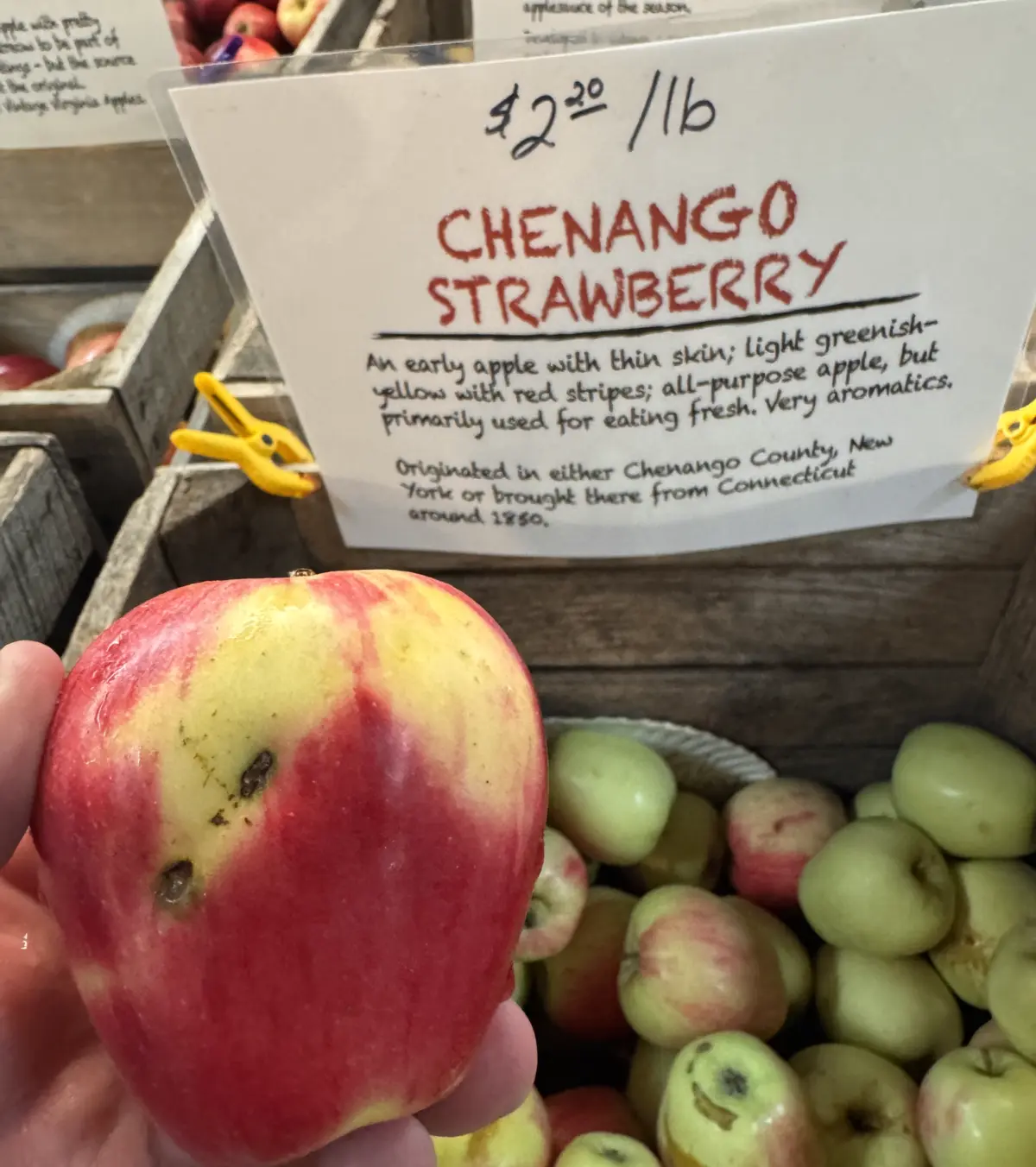
6. Chenango Strawberry (Rating: 4.0 / 10)
Harvested from Brightonwoods Orchard in Wisconsin, this theatrical cultivar boasts a name that sounds less like a fruit and more like a dramatic exclamation shouted just as a masked antagonist leaps from behind a parlor curtain.

- The Experience: Upon first inspection, the aromatic profile was aggressively, genuinely strawberry-scented—a rare instance where nomenclature matched reality. Unfortunately, the internal reality was severely compromised. The texture was a pre-masticated, gushy-mushy disaster zone that bypassed the necessity of human dental intervention altogether.
7. William’s Pride (Rating: 6.3 / 10)
Endowed with structural architecture featuring a pronounced, unorthodox basal cavity ("a juicy butt"), William’s Pride walks a delicate line between structural integrity and yielding softness.
- The Experience: Exceptionally juicy to the point of structural hazard, the fruit delivered heavy warming pie spices—cinnamon, clove, and nutmeg—in the primary aftertaste. Bizarrely, a tertiary aftertaste emerged resembling the distinct atmospheric terroir of a used bookstore. While lacking in sharp acidity, its sheer moisture content and unconventional charm secured a respectable middle-tier score.
8. Blenheim Orange (Rating: 7.0 / 10)
Encased in an exceptionally forbidding skin that forces the eater to wage a gladiatorial battle of dental attrition, the Blenheim Orange requires immense initial physical effort.

- The Experience: Once breached, the flesh reveals the sunny, vibrant disposition of a Cox’s Orange Pippin, complete with an electric lemon tickle and a bright floral zip. However, the density of the fruit is staggering; it presents the spatial mass and gravitational pull of an apple crushed at the event horizon of a miniature black hole.
9. Golden Nugget (Rating: 5.9 / 10)
Aesthetically, the Golden Nugget resembles an epidermal anomaly scraped from the back of a fantasy ogre and dropped into dark loam.
- The Experience: Visually repulsive and texturally demanding, this cultivar struck the palate with a green, unripened smack of tartness that rapidly evolved into an aggressively unripe banana profile—evoking the sensation of consuming the fruit while it remains anchored to forest flora. Despite its clear antagonistic qualities, its sheer strangeness commanded begrudging psychological respect.
10. Doctor Harvey (Rating: 5.1 / 10)
Categorized traditionally as a cooking apple intended for thermal breakdown into sauces or pastries, the ancient Doctor Harvey variety proved structurally vulnerable to the perils of "pie goop."

- The Experience: While too soft for standard baking deployment, the fruit delivered an unprecedented acoustic and sensory marvel. The skin featured a skin-pop of seismic proportions—an ASMR-level fracturing event that remains entirely unmatched in pomological history. Accompanied by a gushing, wine-cooler-esque berry profile that fled the scene of the crime faster than expected, it squeaked past mediocrity purely on the merit of its acoustic fireworks.
Supporting Context & Metrics
To contextualize the vast divergence in scores across this 2026 reporting period, the following analytical matrix summarizes the primary sensory vectors identified during the investigation:
| Cultivar | Geographic Source | Dominant Flavor Notes | Structural Integrity | Final Rating |
|---|---|---|---|---|
| Gravenstein | Scott Farm, VT | Vanilla, Rooibos, Elderflower | Juicy, Moderate Crisp | 7.5 / 10 |
| Hubbardston Nonesuch | Scott Farm, VT | Astringent, Floral Void | Soft, Fading | 3.7 / 10 |
| Lamb Abbey Pearmain | Historic Orchard Stock | Tangerine, Umami, Tart-Sweet | Crunchy-Crisp | 7.5 / 10 |
| Hewes Crab | Regional Stock | Pear, Tamarind, Butterscotch | Mealy, Dry | 5.0 / 10 |
| Opalescent | Regional Stock | Berry Tart, Floral Undertone | Dense, Crisp | 8.0 / 10 |
| Chenango Strawberry | Brightonwoods, WI | Strawberry Aroma, Berry | Gushy, Mushy | 4.0 / 10 |
| William’s Pride | Regional Stock | Pie Spices, Bookstore Air | Soft, Dripping | 6.3 / 10 |
| Blenheim Orange | Regional Stock | Lemon, Floral Zip | Super-Dense | 7.0 / 10 |
| Golden Nugget | Regional Stock | Green Tartness, Raw Banana | Tough, Gnarly | 5.9 / 10 |
| Doctor Harvey | Regional Stock | Berry Wine Cooler | Soft, Explosive Skin | 5.1 / 10 |
Official Statements & Cultural Philosophy
Pomological observers frequently inquire as to the methodology behind these subjective numerical metrics. As noted in the field, the decimal system utilized in these evaluations is deployed explicitly to project an illusion of scientific authority.

"I am not an appleologist," official internal sources maintain, "and any opinions I offer here should be viewed subjectively and honestly, suspiciously."
Furthermore, the transient nature of fruit consumption intersects directly with high-stress creative output. Navigating national book tours through New Hampshire, Vermont, Ottawa, and Rhinebeck, NY, while simultaneously managing canine domestication and manuscript deadlines, creates an environment where fruit is not merely sustenance—it is an anchor to reality.

Future Outlook & Literary Cross-Promotion
As the autumn chill deepens, the investigative pipeline remains fully saturated. Preparations are underway for an upcoming excursion into the heart of New England orchard country, where further specimens will undoubtedly be sacrificed to the arboreal deities (much to the quiet terror of traveling companions).
For readers seeking to channel this specific brand of seasonal dread into literary form, the investigation concludes with a mandatory reminder: true apple terror extends far beyond the kitchen counter. For a comprehensive fictional exploration of predatory agriculture, malevolent pomology, and sinister orchards, readers are directed to the nationally recognized horror novel Black River Orchard. Signed and personalized copies remain available through the Doylestown Bookshop for direct home delivery, ensuring that your autumn reading list carries the precise weight of a black-hole-dense Blenheim Orange.