

Executive Overview
In the grand pantheon of agricultural journalism, few subjects command the visceral passion, structural complexity, and sheer sensory unpredictability of the pomological world. As the autumn harvest reaches its zenith, the consumer market finds itself flooded not merely with the ubiquitous, uniform red globes of supermarket ubiquity, but with an eccentric vanguard of rare, heirloom, and experimental apple cultivars. For the dedicated orchardist, the casual taster, and the fervent member of the burgeoning "Apple Snack Gang," this season represents an unprecedented golden age of botanical diversity.
Yet, navigating this shifting landscape of pomological treasures and vegetative perils requires a discerning palate and an uncompromising investigative eye. From the dense, spice-laden anomalies of regional microclimates to the tannin-heavy crucible of historic cider apples, the modern fruit consumer faces an unpredictable gauntlet of textures, flavor profiles, and evolutionary quirks.

This comprehensive report delivers an exhaustive, unvarnished evaluation of a second batch of seasonal apple varieties. Combining sensory analysis, historical context, and uncompromising metric scoring, this audit aims to separate the botanical triumphs from the agricultural disasters. As our review subject prepares to embark on an extensive northern expedition spanning New York, New England, and Canada—issuing a standing invitation for local purveyors to present their finest pomological offerings—this investigation establishes a definitive benchmark for what makes an apple worthy of the human palate, and what belongs in the compost bin.
Detailed Chronology: The Field Testing of Batch Two
The evaluation of botanical specimens requires strict adherence to methodology: a deliberate bite, a careful assessment of skin resistance, an analysis of cellular structure upon fracture, and a patient waiting period for lingering aftertastes. Below is the chronological field log of the six distinct cultivars evaluated during this phase of the audit.

1. Kickapoo Spice
- Initial Impression: The nomenclature alone commands attention, invoking immediate auditory and cultural echoes of classic American rock anthems. Visually, the specimen presents as a compact, formidable orb.
- Texture & Structure: Described colloquially in the field notes as a "dense boy" and a "weird friend," this fruit lacks the characteristic hydraulic succulence expected of premier dessert apples. It is dry, structurally compact, and unyielding.
- Flavor Profile: High on the spice spectrum, exhibiting dominant notes of heavy nutmeg complemented by secondary layers of cinnamon and clove. However, the experience is marred by an intrusive, vegetative aftertaste reminiscent of freshly cut lawn clippings. Pomological experts note that storage duration plays a critical role here; this specimen may have suffered from premature harvesting or improper cellaring, illustrating the fickle nature of apples that either improve or decay off the tree.
- Rating: 6.9 / 10
2. St. Edmunds Pippin
- Initial Impression: Serving as the inaugural "proper" apple of the autumn season, this cultivar arrived with high expectations and immediately exceeded them. The skin presents a tactile challenge—rough to the touch, akin to stroking the dermal layer of a pelagic predator in reverse.
- Texture & Structure: Upon impact, the St. Edmunds Pippin delivers a deeply satisfying acoustic and tactile performance. It features a sharp, crisp pop and a vigorous crunch, providing an exceptionally dynamic mouthfeel.
- Flavor Profile: Exceptionally juicy, sharp-breaking, and bright. The flavor profile introduces a complex, herbal dimension bearing distinct structural similarities to fennel pollen, expertly harmonized with a foundational, natural sweetness. It stands as a masterclass in the delicate equilibrium between tart and sweet.
- Rating: 8.3 / 10
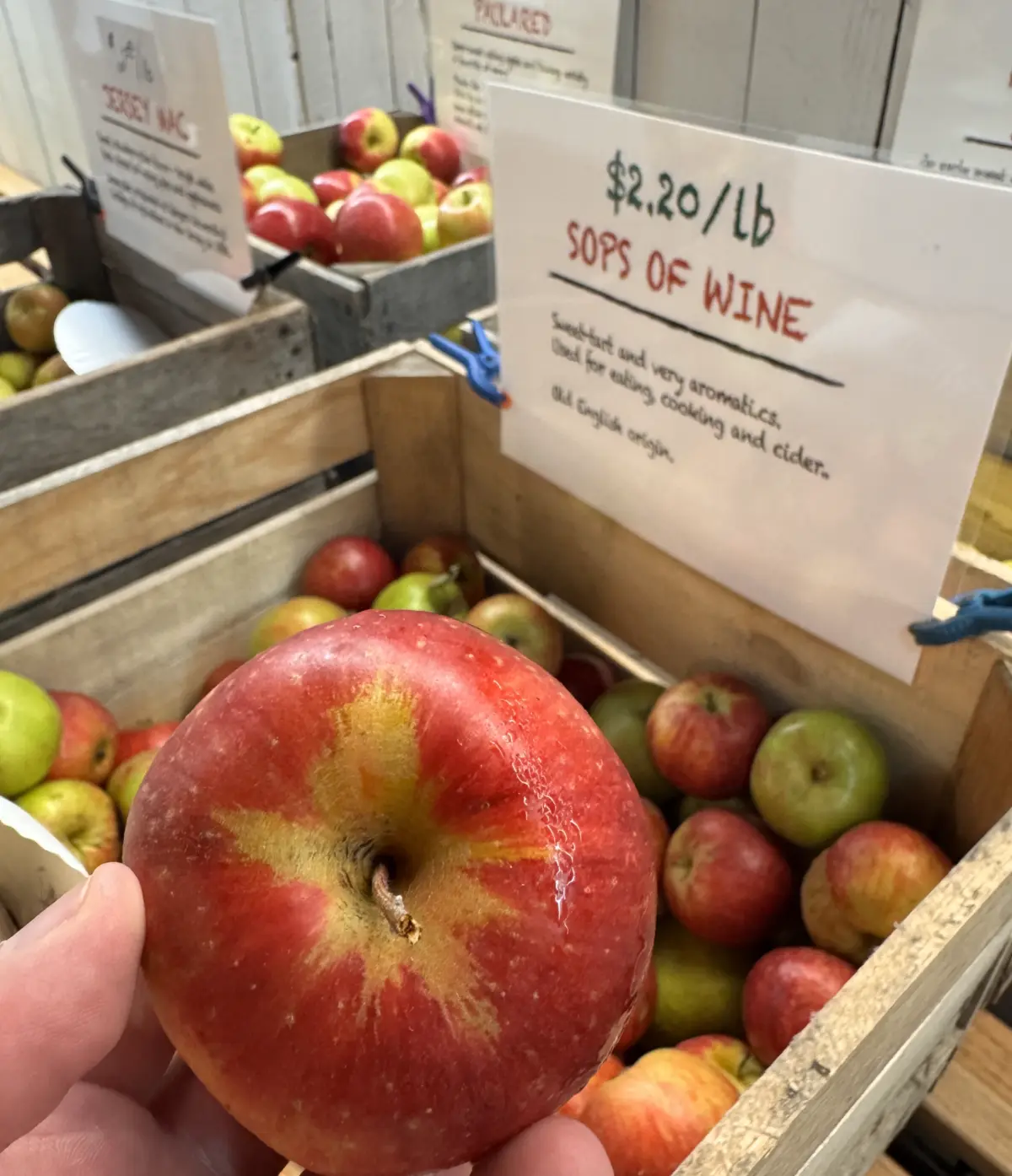
3. Sops of Wine
- Initial Impression: A fascinating psychological specimen before it even reaches the tongue, the very name of this historic variety triggers surreal, cinematic associations of tragic literary grief and epic fantasy cinematography within the subconscious of the reviewer.
- Texture & Structure: A catastrophic failure in mechanical properties. Despite consumption shortly after acquisition, the structural integrity of the flesh was compromised, yielding a mealy, gritty, and profoundly unpleasant mouthfeel.
- Flavor Profile: Paradoxically redeemable in flavor, offering a funky, complex interplay of sweet-dominant characteristics ("subacid" in professional parlance) accented by subtle notes of vanilla and spice. Rumors within pomological circles suggest true Sops of Wine should feature red-fleshed pigmentation or red-streaked interiors, though this particular specimen displayed neither. The debate over whether Sops of Wine represents a singular lineage or an umbrella term for miscellaneous historical types remains open.
- Rating: 3.5 / 10
4. Fenceline Surprise
- Initial Impression: The ultimate irony of botanical nomenclature. While one might be tempted to lend the name a sophisticated French pronunciation to match its aesthetic appeal, the reality of the fruit delivers a stark, disappointing awakening.
- Texture & Structure: Devoid of structural resilience, yielding a bland, mushy consistency that disintegrates into a sensation uncomfortably close to masticating beach sand. Although signage at the point of sale labeled the batch as "firm," the physical evidence suggests an advanced state of post-harvest degradation—effectively pre-digested cold matter long before reaching the consumer.
- Flavor Profile: Exhibited a fleeting, highly diluted micro-whisper of pear juice before dissolving entirely into an austere, chalky nothingness.
- Rating: 1.0 / 10 (Awarded a single point solely out of respect for its deceptive, high-class name and attractive visual presentation).
5. Americus Crab
- Initial Impression: A linguistic masterpiece that evokes the image of a Victorian steampunk inventor or a silver-age comic book defender of coastal waters. In reality, it belongs to the crabapple family.
- Texture & Structure: Unforgivingly tough, fibrous, and structurally engineered to resist casual consumption.
- Flavor Profile: A chaotic botanical cocktail. Highly savory, profoundly tart, and saturated with high levels of astringent tannins. This is not a fruit designed for hand-to-mouth snacking by the uninitiated; rather, it is a botanical dare meant for those who actively seek out culinary punishment.
- Rating: 2.5 / 10
6. Campfield (False?)
- Initial Impression: Labeled cryptically with the qualifier "(false)," this specimen invites paranoia. Is it an imposter? A deceitful trick meant to steal away one’s culinary peace of mind?
- Texture & Structure: Described vividly as possessing the consistency of a "chewy callused thumb." The flesh fights back, combining excessive sweetness with a tannin load so aggressive it feels less like eating an apple and more like the apple is actively consuming the consumer. As a noted cider apple, its hostility toward the human tongue is entirely explicable.
- Flavor Profile: Heavy, cloying, and unrefined for fresh eating. However, its historical footprint is undeniable. Archival research ties the lineage to Matthew Canfield (variously spelled Campfield), an anti-royalist Puritan emigrant from Harleston, England, who arrived during the Great Puritan Migration of 1637. A founding father of New Haven, Norwalk, and Newark—where he is reportedly interred beneath City Hall—Canfield established the New Jersey agricultural mandates requiring freeholders to cultivate four acres of land, heavily prioritizing hard cider production.
- Rating: 4.1 / 10
7. Graham
- Initial Impression: A physical titan among fruits. The Graham cultivar presents a visual and structural density so profound it appears to have spent its growing season in a rigorous athletic training regimen, boasting a protective exterior impervious to basic kinetic impact.
- Texture & Structure: Operating this apple requires intense mechanical effort. Upon finally breaching the exterior, the interior fractures with the dramatic, seismic suddenness of a calving glacial shelf.
- Flavor Profile: A miraculous sensory pivot. Beneath the near-impenetrable armor lies an explosion of unadulterated, high-octane flavor that defies botanical logic: an exact, unrestrained duplication of commercial Juicy Fruit gum.
- Rating: 8.0 / 10 (Penalized slightly only due to the mandatory jaw rehabilitation required post-consumption).
Supporting Context & Metrics
To provide a comprehensive overview of the agricultural spectrum evaluated in this audit, the following comparative metrics synthesize the performance of each variety across texture, flavor complexity, and consumer suitability:
| Cultivar Name | Structural Integrity (1-10) | Flavor Complexity (1-10) | Final Audit Score | Primary Botanical Characteristic |
|---|---|---|---|---|
| Kickapoo Spice | 6.0 | 7.5 | 6.9 | Heavy nutmeg/clove spice; dry finish |
| St. Edmunds Pippin | 9.0 | 8.5 | 8.3 | Crisp snap; herbal fennel notes |
| Sops of Wine | 3.0 | 5.5 | 3.5 | Mealy texture; historic subacid profile |
| Fenceline Surprise | 1.0 | 2.0 | 1.0 | Sandy mush; fleeting pear essence |
| Americus Crab | 5.0 | 4.0 | 2.5 | High tannin crabapple; astringent |
| Campfield (False?) | 4.0 | 4.5 | 4.1 | Historic cider apple; tannin-heavy |
| Graham | 9.5 | 9.0 | 8.0 | Glacier-like fracture; Juicy Fruit flavor |
Official Statements & Industry Perspectives
The pomological community remains divided on the influx of wild, heirloom, and experimental apples hitting regional markets. While mainstream commercial agriculture prioritizes shelf-life, uniform coloration, and disease resistance—often at the expense of flavor complexity (as observed in perennial critiques of industrial varieties)—artisanal orchardists and independent researchers champion the inclusion of eccentric, historical cultivars.

Prominent independent fruit reviewers and culinary investigators have consistently emphasized that the true measure of an apple cannot be reduced to its visual appeal on a supermarket shelf. As highlighted in field assessments, historical anomalies like the Campfield or the tannin-rich Americus Crab serve as vital links to early American agricultural history, preserving genetic lineages cultivated by colonial figures and early settlers for cider production rather than raw snacking.
Furthermore, expert consensus underscores the critical variable of post-harvest handling. The stark contrast between the vibrant triumph of the St. Edmunds Pippin and the degraded, sandy despair of the Fenceline Surprise underscores an urgent need for optimized cold-storage protocols and supply chain transparency within regional fruit distribution networks.

Future Outlook
As the autumn season progresses, the pomological landscape is poised for further exploration and geographic expansion. With upcoming field expeditions scheduled to sweep through New York, New England, and the wider expanse of Canada, the investigative scope of this audit is widening exponentially.
The upcoming deployment into the northeastern territories promises an influx of localized microclimate variants, frost-kissed heirloom drops, and regional specialties largely insulated from mass-market homogenization. Independent orchards and local growers across the Canadian border and the New England states have been formally put on notice: the palate of the modern fruit consumer is sharper, more demanding, and infinitely more adventurous than ever before.

Future reports will continue to monitor the intersection of historical arboriculture, genetic preservation, and sensory evaluation. Whether encountering the next mechanical marvel akin to the Graham cultivar or unearthing another botanical imposter hidden beneath a deceptive title, this investigative desk remains steadfast in its mission: to champion the exceptional, expose the fraudulent, and celebrate the unyielding diversity of the global apple harvest.