

Executive Overview
In the realm of modern pomology, few voices possess the irreverent authority and granular scrutiny of the internet’s premier accidental apple critic. Balancing the demanding rigors of an active book tour, the chaotic introduction of a new canine companion named Cooper, and the final stages of a manuscript deadline, the intrepid reviewer has returned from orchard and crate to deliver a sweeping, unfiltered evaluation of this season’s harvest.
Far from the uniform, waxy red globes dominating standard supermarket aisles, this latest dispatch dives deep into the erratic, complex, and occasionally distressing world of heirloom, rare, and specialty apple cultivars. Sourced primarily from esteemed agricultural institutions like Vermont’s Scott Farm and Wisconsin’s Brightonwoods Orchard, these ten distinct varieties offer a masterclass in the unpredictable nature of Malus domestica.

This report synthesizes sensory evaluations, historical context, textural anomalies, and quantitative scoring metrics (derived with deliberate, mathematical capriciousness) to provide a comprehensive look at the current state of autumn pomology.
Detailed Chronology: The 2026 Harvest Evaluations
Navigating a dense lineup of rare varieties requires patience, a strong jaw, and a tolerance for botanical chaos. Below is the chronological breakdown of the fruits sampled during this initial autumn round, detailing their flavor profiles, textural quirks, and definitive scores.

1. Gravenstein (Score: 7.5 / 10)
- Origin: Sourced from Scott Farm (Vermont) / Danish Heirloom
- Sensory Profile: A remarkably juicy specimen delivering profound tasting notes of vanilla, rooibos tea, subtle honey, and elderflower. While missing peak commercial crispness, its resilient skin provides an enjoyable pop rather than a culinary impediment. Despite its reputation for being a temperamental grower in North American climates, this iteration proved to be an unexpected delight.
2. Hubbardston Nonesuch (Score: 3.7 / 10)
- Origin: Scott Farm (Vermont)
- Sensory Profile: Bearing a moniker reminiscent of a Depression-era agrarian or a traveling elixirs salesman, this variety offered a polarizing experience across multiple tastings. Initial bites yielded a tongue-scrubbing astringency, transitioning rapidly from an initial splash of juice into a "bright white nothingness" touched by faint florality. A secondary tasting weeks later revealed a sub-acid, intensely sweet profile that similarly vanished ghost-like across the palate. Decimals were employed in scoring purely to project an illusion of empirical rigor.
3. Lamb Abbey Pearmain (Score: 7.5 / 10)
- Sensory Profile: Re-evaluated after a five-year hiatus that previously yielded underwhelming, pedestrian results, this year’s sample showcased a dramatic turnaround. Described as a "platonic ideal of an apple," it boasted a crunchy-crisp structure, a harmonious acid-sugar balance, and classic pomaceous notes laced with tangerine citrus and a surprisingly pleasant umami/savory MSG undercurrent. This dramatic seasonal shift underscores the fundamental instability of apples as nature’s ultimate "chaos fruit."
4. Hewes Crab (Score: 5.0 / 10)
- Origin: Virginia Crab cultivar
- Sensory Profile: Historically utilized for hard cider production, jelly-making, rootstock cross-pollination, or non-lethal projectile warfare directed at ill-mannered children, the Hewes Crab is an inherently bizarre entity. Lacking standard juiciness and exhibiting a somewhat mealy texture, it redeems itself through a deeply unexpected flavor trajectory: a complex triad of pear, pineapple, and savory tamarind, finishing with a distinct, thrilling burst of butterscotch.
5. Opalescent (Score: 8.0 / 10)
- Sensory Profile: Marking one of the most astonishing comebacks in recent tasting history—vaulting upward from a dismal 2.5 rating in the previous season—the Opalescent staged a monumental glow-up. This year’s crop presented a dense, hyper-crisp flesh bursting with a tart-sweet berry profile underpinned by delicate floral notes.
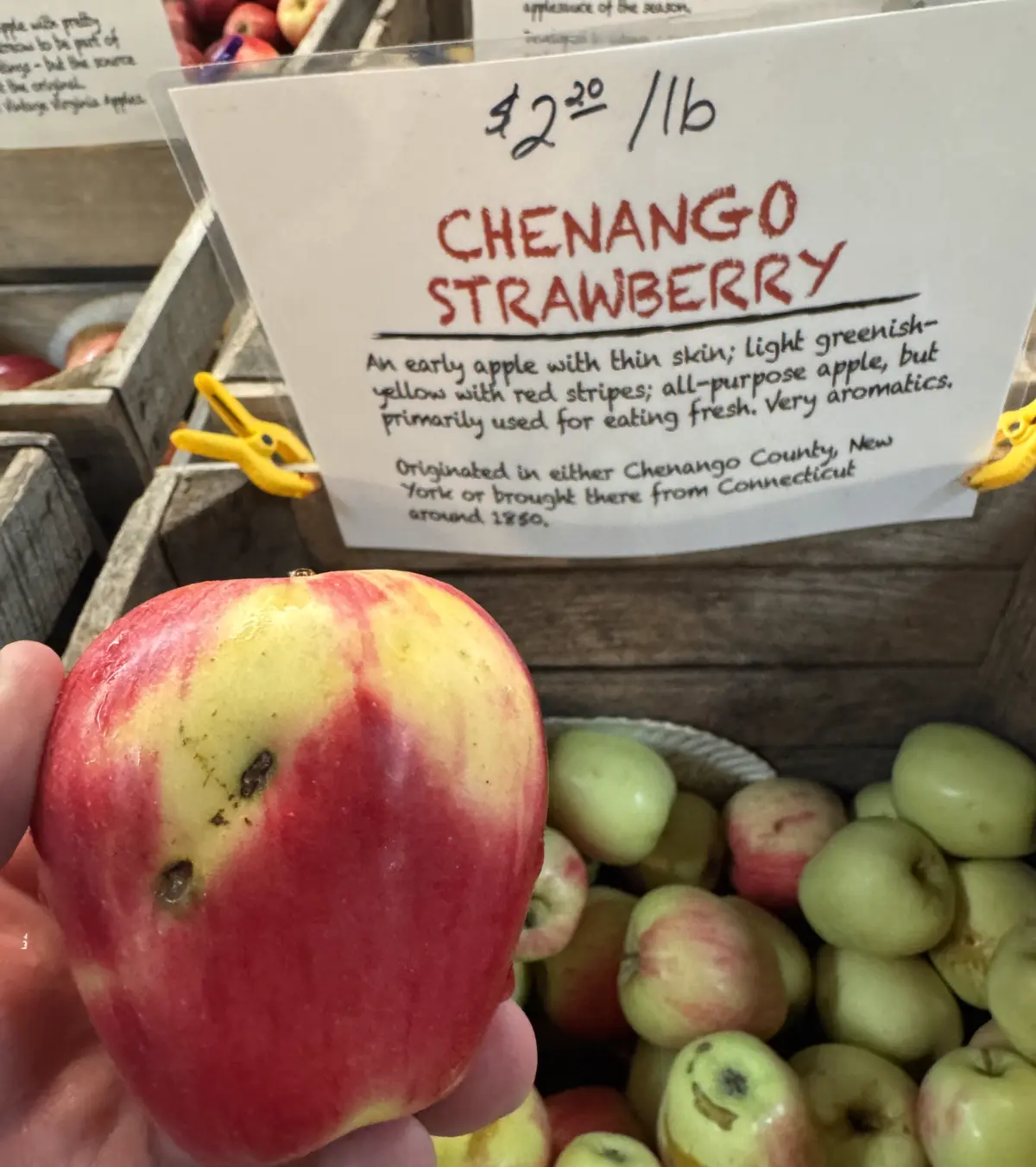
6. Chenango Strawberry (Score: 4.0 / 10)
- Origin: Brightonwoods Orchard (Wisconsin)
- Sensory Profile: Exhibiting an aromatic profile entirely faithful to its nomenclature, this Wisconsin-sourced fruit emitted a rich, unmistakable fragrance of fresh strawberries before a single bite was taken. Unfortunately, textural failure hindered the experience: the specimen was structurally compromised, existing in a pre-mushed state resembling a naturally occurring applesauce that bypassed the mechanical utility of teeth entirely.
7. William’s Pride (Score: 6.3 / 10)
- Sensory Profile: A softer-textured offering that managed to avoid the dreaded mealy trap, maintaining a baseline of pleasantness. It proved exceptionally drippy and juice-heavy, leaving an aftertaste redminiscent of warming pie spices (cinnamon, clove, nutmeg) followed by a surreal, tertiary note akin to the ambient atmosphere of a used bookstore.
8. Blenheim Orange (Score: 7.0 / 10)
- Sensory Profile: A fiercely dense, armored fruit featuring skin so formidable it mimics industrial plastic packaging. Once breached, the flesh delivers a sunny, vibrant disposition reminiscent of a Cox’s Orange Pippin—bursting with floral zip and an electric lemon tickle. However, its structural density approaches the gravitational parameters of a black hole, making it a taxing physical workout for the consumer.
9. Golden Nugget (Score: 5.9 / 10)
- Sensory Profile: Visually approximating a goblin’s discarded relic or a subterranean canker, the Golden Nugget is profoundly unappealing to the eye. Its flavor profile is equally defiant, featuring a green, unripened smack that transitions aggressively into the taste of an entirely un-fucking-ripe banana pulled straight from the botanical vine. Despite inspiring genuine revulsion, its sheer uniqueness commanded respect from the reviewer’s palate.
10. Doctor Harvey (Score: 5.1 / 10)
- Sensory Profile: Designated historically as a culinary or cooking apple rather than fresh-eating stock, this historic variety risked boiling down into structural "pie goop" due to its soft interior. Nevertheless, it secured a passing grade purely on the strength of its skin’s acoustic performance: a magnificent, ASMR-worthy pop matched with a gushing, wine-cooler-esque berry profile that unfortunately fled the palate as rapidly as a suspect abandoning a crime scene.
Supporting Context & Metrics
The evaluation of heirloom fruit relies heavily on subjective human metrics, environmental variables, and historical pomology. To contextualize the data gathered from Vermont and Wisconsin orchards, consider the following structural metrics observed during the 2026 trials:
- Total Cultivars Evaluated: 10 distinct regional varieties.
- Geographical Sourcing: Scott Farm (Dummerston, Vermont) and Brightonwoods Orchard (Burlington, Wisconsin).
- Score Range: Spanning from a low of 3.7 (Hubbardston Nonesuch) to a high of 8.0 (Opalescent).
- Average Palate Volatility: High. Environmental shifts between growing seasons demonstrate that a historically poor-performing apple (such as the Opalescent) can experience a dramatic renaissance, reinforcing the thesis that agricultural output remains fundamentally chaotic.
Official Statements & Authorial Disclaimers
In the interest of journalistic transparency, the critic issues the following official statements regarding the scope, limitations, and underlying intentions of these evaluations:

"I am not an appleologist and any opinions I offer here should be viewed subjectively and honestly, suspiciously. Using decimals makes it seem like math… [and] lets me get a more granular score, if anybody cares about that. Which you shouldn’t."
Furthermore, addressing the logistical constraints impacting the frequency of future formal deep-dives:

"This year, I am considerably daunted by the prospect of doing in-depth apple reviews… with our brand new dog, Cooper, and with one big leg of a book tour over and now a second, shorter leg coming up… oh and a whole book I gotta finish writing, I’ve been sorta maybe kinda busy."
Future Outlook & Literary Cross-Promotion
As the autumn season progresses, the apple-reviewing circuit continues unabated. The expedition moves next into the orchards of New England, promising further encounters with high-end pomology, unexpected agricultural anomalies, and tactical crabapple deployment against unruly youth.

For readers seeking to channel the eerie, atmospheric tension of prime apple season into their literary pursuits, the author highlights the ongoing availability of the acclaimed thriller Black River Orchard, a novel exploring the darker side of communal obsession, sinister groves, and malevolent fruit. Signed and personalized copies remain accessible directly through independent booksellers such as the Doylestown Bookshop for mail-order delivery.
Stay tuned for subsequent dispatches as the orchard harvest winds down and the winter frost begins to settle over the northern agricultural belt.