

Executive Overview
The traditional marketing playbook is effectively obsolete. For decades, the foundational architecture of B2B and B2C marketing has relied on a predictable, linear customer journey: a prospect encounters an advertisement, lands on a corporate website, fills out a lead capture form, enters an automated email nurture sequence, and is eventually handed off to a sales representative.
However, this mechanical framework assumes buyers behave predictably, moving at a pace dictated by the brand. According to industry leaders, that assumption is no longer valid.
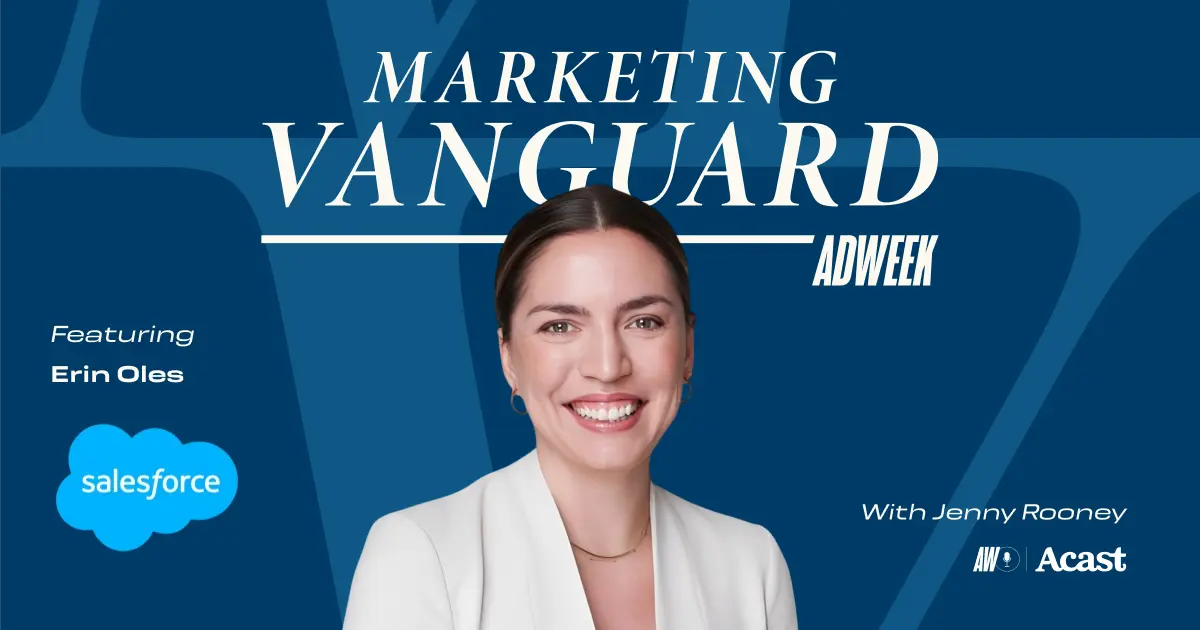
Recorded live at Advertising Week New York, a recent episode of the Marketing Vanguard podcast—hosted by Jenny Rooney and featuring Salesforce Chief Marketing Officer Erin Oles—delves directly into this seismic market shift. The conversation unpacks what happens when customer behavior accelerates far beyond the traditional funnels marketers have spent decades building.
Oles brings a uniquely pragmatic perspective to the table, informed by her early roots in enterprise sales. During their discussion, she dismantles outdated attribution models, exposes uncomfortable truths about how brands appear (or misbehave) inside Large Language Models (LLMs), and issues a call to action for marketing leaders: stop treating AI as a theoretical buzzword and start deploying it to solve concrete, operational bottlenecks.
This deep-dive analysis explores the core themes of Oles and Rooney’s conversation, breaking down the structural failures of legacy marketing models, the emerging imperative of AI-driven search visibility, and the strategic blueprint for what Salesforce terms "surround marketing."
Detailed Chronology: The Evolution of Modern Marketing Realities
To understand why modern marketing strategies are stalling, it is necessary to trace how buyer discovery mechanisms have evolved—and how corporate marketing structures have failed to keep pace.
Phase 1: The One-Week Shelf Life of the "Playbook"
During the opening segments of the Marketing Vanguard discussion ([02:40]), Oles makes a stark observation: using the term "marketing playbook" is practically an oxymoron in the current landscape.
Historically, marketing teams operated on quarterly or annual playbooks. They tested messages, optimized landing pages, locked in target audience segments, and ran programmatic campaigns for months at a time. Today, that operational cadence is a recipe for irrelevance.
Consumer and business buyer behaviors shift weekly, influenced by algorithmic updates, platform migrations, and changing economic pressures.
Oles argues that clinging to legacy playbook mechanics—such as obsessing over driving traffic exclusively to owned properties and forcing visitors into linear nurture streams—is fundamentally misaligned with how modern buyers navigate discovery. Instead of trying to control the path, marketers must learn to be useful, credible, and present wherever discovery naturally occurs.
Phase 2: The Comingling of Web Properties and LLM Results
As the conversation progresses ([05:38]), the focus shifts from general consumer behavior to the hidden mechanics of search. Oles shares a sobering finding from a private gathering of 30 enterprise CMOs.
During an exercise assessing how AI systems perceive their organizations, every single participant—including Oles herself—discovered that their own owned properties were actively working against them within LLM search results.
This revelation points to a wider crisis in modern marketing: a profound gap between CMOs who acknowledge that AI-driven search visibility matters and those actively auditing and modifying their digital footprints to account for how algorithms parse corporate content.
The uncomfortable reality for many brands is that their legacy SEO strategies, bloated site architectures, and outdated content repositories are confusing LLMs, ultimately harming their brand reputation in automated discovery loops.
Phase 3: Transitioning from "Use Cases" to Operational Problem-Solving
Moving from diagnosis to execution ([11:04]), Oles outlines her core philosophy regarding artificial intelligence: give AI a genuine operational problem, not a vague, theoretical "use case."
Too many organizations suffer from "AI fatigue," launching isolated pilot programs that yield little tangible ROI. Salesforce cut through this noise by deploying an automated SEO agent designed to solve a specific, tedious operational problem: auditing and fixing broken web links and pages across their massive digital footprint.
The agent successfully uncovered and cataloged 10,000 broken links and pages. Oles estimates that this undertaking would have required roughly 5,000 human hours if executed manually. The AI completed the audit in a matter of hours.
For Salesforce, the true victory was not simply checking a box for "using AI"; it was reclaiming thousands of hours of human capital, redirecting creative and strategic talent toward high-value work requiring genuine human judgment.
Phase 4: Abandoning the Forced Funnel for "Surround Marketing"
In the final segment of the episode ([13:47]), Oles attacks the legacy marketing funnel directly. The traditional funnel assumes that brands can easily intercept buyers, compel them to self-identify via gated content, and shepherd them through an orderly sales cycle.
Modern buyers reject this dynamic entirely. Today’s buyers conduct extensive, anonymous research through LLMs, consult peer networks on specialized forums, review third-party comparison sites, and synthesize opinions long before ever engaging with a brand’s sales team.
Oles’s antidote to this fragmented reality is "surround marketing." Rather than desperately attempting to herd autonomous buyers into a rigid, marketer-designed funnel, brands must establish pervasive relevance, trust, and credibility across the entire digital ecosystem. When a buyer searches via an LLM, reads an industry blog, or asks a peer group for recommendations, the brand must already occupy a trusted space in that ecosystem.
Supporting Context & Metrics: The Anatomy of the Shift
To fully contextualize Erin Oles’s insights at Advertising Week New York, it is helpful to examine the broader macroeconomic and technological shifts impacting enterprise marketing teams globally.
The Decline of Direct Traffic and Gated Content
For over two decades, the holy grail of B2B digital marketing was capturing direct traffic and securing email addresses through gated whitepapers and webinars. This data fueled marketing automation platforms (MAPs) like Salesforce Marketing Cloud and Marketo.
However, metrics across the digital marketing landscape indicate a steep decline in form-fill conversions. Modern buyers are protective of their data and increasingly frustrated by aggressive gating strategies.
Furthermore, the rise of zero-click searches—where search engines and LLM interfaces provide direct answers on the results page without requiring users to click through to an external website—has decimated organic traffic models. Brands that rely solely on driving traffic to owned landing pages are seeing diminishing returns.
The Rise of Generative Engine Optimization (GEO)
As search behavior migrates from traditional keyword-based engines to conversational AI models (such as ChatGPT, Claude, Microsoft Copilot, and Google Gemini), the rules of digital visibility are being rewritten.
Traditional Search Engine Optimization (SEO) focused on keyword density, backlink profiles, and technical site metadata. Generative Engine Optimization (GEO), by contrast, focuses on how Large Language Models synthesize brand sentiment, authority, and factual accuracy across the broader web.
As Oles highlighted in her discussion regarding the 30 CMOs, many corporate websites are poorly structured for LLM ingestion. Heavy JavaScript rendering, poorly structured data tables, and legacy content traps can render a site invisible or—worse—misrepresented within AI-generated summaries.
Quantifying the Human-AI Productivity Divide
The Salesforce SEO agent anecdote shared by Oles highlights a broader economic reality of enterprise AI adoption: the shift from substitution to augmentation.
| Metric / Operational Area | Legacy Manual Approach | AI-Augmented Approach | Impact / ROI |
|---|---|---|---|
| Site Audit & Link Repair | ~5,000 human hours (Manual crawling) | Hours (Automated LLM agent) | 99.9% reduction in execution time |
| Customer Discovery Routing | Rigid, form-fill linear funnels | Fluid, multi-channel "surround marketing" | Alignment with modern buyer preferences |
| Campaign Optimization | Periodic batch-and-blast reviews | Real-time conversational adjustments | Accelerated time-to-market for messaging |
This data illustrates why tactical AI adoption—focusing on heavy, repetitive data tasks—yields immediate operational efficiencies, freeing marketing professionals to focus on brand storytelling, empathy, and strategic positioning.
Official Statements & Industry Perspectives
The conversation between Jenny Rooney and Erin Oles underscores a broader philosophical transformation within corporate leadership. Here, we examine the underlying principles driving Oles’s approach at Salesforce.
From Sales Roots to Pragmatic Marketing
Erin Oles’s path to becoming the Chief Marketing Officer of Salesforce is unconventional. Her career began on the front lines of enterprise sales. This foundational experience instilled in her a deep skepticism for marketing fluff and an appreciation for direct, unambiguous communication.
In sales, messages either resonate immediately with a prospective buyer, or they fall flat. There is no hiding behind vanity metrics or complex attribution models.
This background directly informs Oles’s philosophy on modern marketing technology. Rather than viewing emerging tools through an academic or purely theoretical lens, she evaluates them through an operational filter: Does this solve a tangible customer problem, and does it respect the reality of how human beings make purchasing decisions?
The Salesforce Philosophy on AI Search and Agents
Salesforce has aggressively positioned itself at the forefront of the enterprise AI revolution through initiatives like Agentforce and advanced data cloud integration. For Oles, this technological shift requires marketing teams to mirror the agility of the products they sell.
Marketing is no longer just about creative campaign development; it is an engineering and data-driven discipline. Brands must actively manage their digital identity across machine-readable channels. If an LLM misinterprets a company’s product architecture or value proposition, that hallucination directly impacts pipeline generation. Consequently, managing brand presence inside AI models is now a core marketing imperative, not an IT side-project.
Future Outlook: Navigating the Post-Funnel Era
As we look toward the future of marketing, the lessons shared by Erin Oles on Marketing Vanguard point toward several inevitable transformations that every marketing leader must navigate.
1. The Redefinition of Attribution
Attribution modeling has long been the holy grail—and the perpetual headache—of marketing executives. Trying to assign a precise percentage of revenue to a specific touchpoint in a complex, multi-year B2B buying journey was already becoming impossible.
In an era defined by dark social, peer communities, and LLM-driven research, traditional last-touch or multi-touch attribution models are functionally obsolete. Future-focused marketers must transition from obsessive tracking of individual paths to measuring aggregate brand resonance, share of voice within AI models, and holistic ecosystem influence.
2. Content Built for Machines and Humans
The content strategies of tomorrow must satisfy two distinct audiences: human decision-makers seeking empathy, validation, and strategic insight; and AI algorithms indexing the web for synthesized answers.
Marketers must audit their owned properties not just for human user experience (UX) and conversion rates, but for machine readability. Ensuring that product documentation, thought leadership, case studies, and pricing models are structured, authoritative, and easily parsed by LLMs will determine whether a brand is recommended during a buyer’s initial AI-driven discovery phase.
3. Empathy Over Automation
Ironically, as artificial intelligence takes over repetitive operational workflows—such as site audits, data cleansing, and campaign optimization—the premium on distinctively human skills will skyrocket.
The marketers who thrive in the post-funnel era will be those who master empathy, creative storytelling, and strategic intuition. By shedding the administrative burden of managing rigid, outdated funnels, marketing teams can finally return to what they do best: deeply understanding customer pain points and building genuine, resonant human connections in a noisy digital world.
To watch the full conversation between Jenny Rooney and Erin Oles recorded live at Advertising Week New York, view the complete episode of Marketing Vanguard on YouTube.