

Executive Overview
In the rapidly evolving landscape of modern advertising, the traditional agency workflow—bogged down by endless pitch decks, sluggish approval cycles, and layers of bureaucratic sign-offs—has long been viewed as a necessary evil. But what happens when you strip away the paperwork and challenge the industry to "skip the deck and make the ad"?
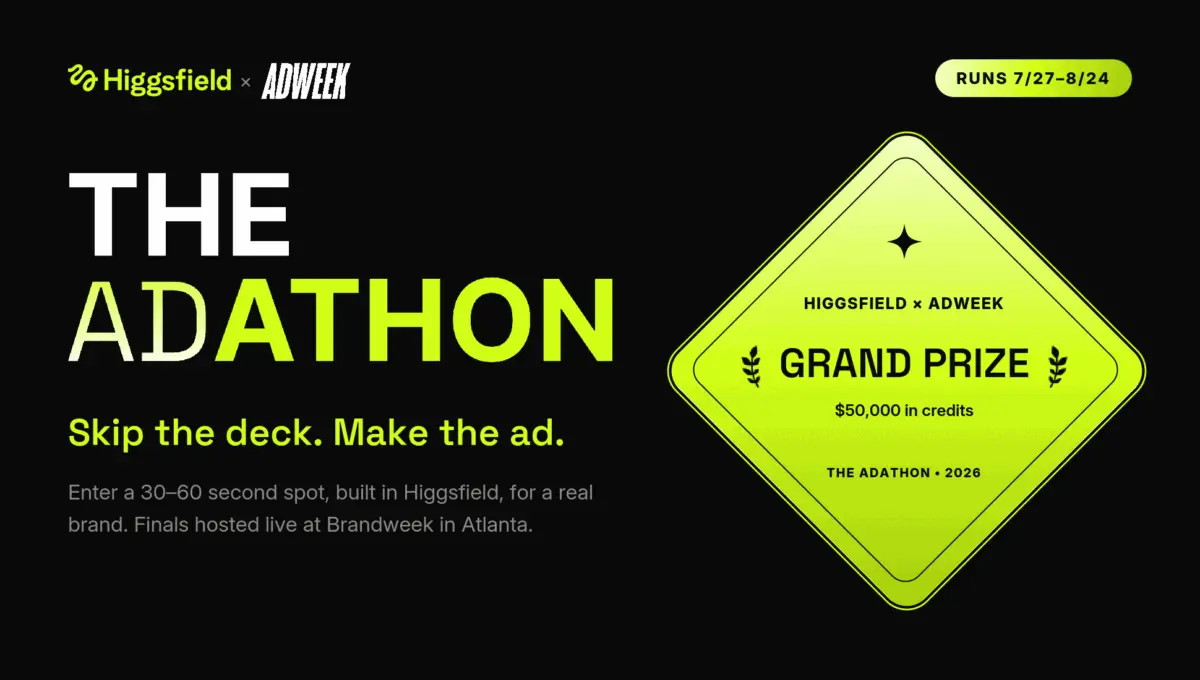
The answer was unveiled on Wednesday, September 16, 2026, at Brandweek in Atlanta, where AI-R Studio was crowned the winner of the inaugural Adathon contest. Hosted by Higgsfield in strategic partnership with ADWEEK, the month-long competition challenged elite agency teams and brand creatives to utilize generative artificial intelligence to take a concept from a blank page to a fully produced, broadcast-ready spot in just four weeks.
AI-R Studio—the specialized AI and hybrid production arm of Mexico-based creative tech ecosystem Pico.Love OS—seized the top prize with a brilliant, self-referential masterclass in meta-commentary. Their winning spot tackles the industry’s anxieties head-on, opening with photorealistic AI-generated footage of a toucan and a gorilla lounging in a lush jungle, only for a director to abruptly yell, "Cut! I’m so sorry guys, they no longer want AI." What follows is a comedic, high-production-value cascade of AI mishaps, human frustrations, and surreal juxtapositions scored to a lively rendition of The Buggles’ classic anthem, "Video Killed the Radio Star."
By blending sharp wit with state-of-the-art generative video techniques, AI-R Studio did not merely showcase technical proficiency; they delivered a profound commentary on the friction between traditional media methodologies and the relentless march of creative technology. For their triumph, the studio secured $50,000 in platform credits on Higgsfield’s premier media generation suite, cementing their status as pioneers in the burgeoning field of hybrid human-AI production.
Detailed Chronology: From Concept to Crown
The journey to the Brandweek 2026 stage began in July, when Higgsfield and ADWEEK officially pulled back the curtain on the inaugural Adathon. Designed to disrupt traditional advertising norms, the competition was built around a singular, provocative premise: bypass the tedious pre-production cycles that paralyze creative output and force teams to execute their visions directly using modern generative AI tools.
Phase 1: The Brief and the Blank Page (July 2026)
When the competition window opened, participating agencies and independent creative collectives were tasked with developing a compelling brand brief and executing a finished commercial entirely through AI-assisted pipelines. For AI-R Studio—operating under the umbrella of Pico.Love OS—this meant redefining the boundaries of studio production.
Rather than relying on conventional storyboarding software and physical camera rigs, the team leaned into the fluid capabilities of generative video. Recognizing that the industry was grappling with a cultural push-and-pull regarding artificial intelligence—caught between the desire for hyper-efficient scaling and fears over authenticity—the creative team chose to weaponize that very tension as the core of their narrative.
Phase 2: Production in the Age of Algorithms
Operating under tight deadlines, the studio deployed a specialized workflow that merged traditional directorial oversight with cutting-edge prompt engineering. The production credits listed a core creative prompt artist alongside a collaborative team of five additional prompt artists, highlighting a new paradigm of digital craftsmanship.
The resulting narrative arc of the commercial was carefully orchestrated:
- The False Start: The spot opens with immaculate, hyper-detailed AI-generated jungle visuals featuring exotic wildlife, instantly establishing high production value before violently subverting expectations.
- The Pivot: A director cuts the scene, introducing a layer of meta-narrative anxiety. The hyper-realistic AI gorilla is unceremoniously replaced by a disgruntled human actor crammed into a budget gorilla suit, groaning, "Bro, are you for real? I can’t breathe in this thing!"
- The Escalation: As The Buggles’ "Video Killed the Radio Star" kicks into gear, the screen floods with a rapid-fire montage of absurd AI-generated vignettes. A fish in a high-end sushi restaurant pleads for its life; heavily armored mechs fighting a brutal futuristic war suddenly freeze mid-combat to ask the camera crew, "Are we still shooting?"
- The Resolution: The spot concludes with a sharp, memorable tagline: "Don’t kill the AI stars. They’re just trying to improve your video."
Phase 3: The Atlanta Reveal (September 16, 2026)
The competition culminated on Wednesday, September 16, at Brandweek in Atlanta, Georgia. Amidst panels discussing the future of commerce, media, and technology, representatives from Higgsfield and ADWEEK took the stage to announce the winner. AI-R Studio’s clever execution resonated profoundly with the live audience and the elite judging panel alike, turning a technical showcase into a cultural touchstone for the event.
Supporting Context & Metrics: The Anatomy of a Disruptive Contest
The Adathon was not merely an artistic showcase; it was structured as a rigorous test of commercial viability, technical execution, and creative ingenuity.
The Evaluation Framework
To ensure fairness and industry-standard rigor, submissions were evaluated by an esteemed panel of top-tier judges. The judging roster included:

- Zoë Ruderman, Chief Content Officer, ADWEEK
- AJ Coyne, Chief Marketing Officer, Monzo
- Elav Horwitz, Global Chief Innovation Officer, WPP
- Michael Ventura, Strategic Advisor, Higgsfield
- Linda Bethea, Chief Marketing Officer and Board Member, Higgsfield
The panel judged entries across four core criteria, weighted with absolute equality to balance artistry with commercial impact:
- Creative Idea: The originality, conceptual depth, and cultural relevance of the core premise.
- Brand Storytelling and Effectiveness: How well the spot communicated its message and engaged the viewer within a concise runtime.
- Craft: Technical execution, including advanced camerawork, visual pacing, and sophisticated sound design.
- Realism: The visual fidelity and seamless integration of generated elements within the narrative framework.
The Prize: Fueling Future Innovation
As the undisputed winner, AI-R Studio was awarded $50,000 in credits on the Higgsfield AI media platform. This enterprise-grade platform grants users access to a comprehensive suite of advanced generative AI tools designed to streamline digital media production. Higgsfield’s underlying technology has already gained massive traction within the entertainment and music industries, having been utilized by heavyweights such as Snoop Dogg, Madonna, and Will Smith to produce boundary-pushing visual assets.
Official Statements and Industry Perspectives
The success of the Adathon has sparked wider conversations across the advertising ecosystem regarding the democratization of production and the evolution of agency workflows.
In an official statement shared with ADWEEK during the launch of the competition, a Higgsfield spokesperson highlighted the painful bottlenecks of traditional agency life:
"Anyone who has worked in agency new business knows how much has to happen before a single frame gets made: the deck, the approvals, the sign-offs, the rounds of refinement before anything ever ships. We wanted to see what becomes possible when creative teams can move directly from an idea to a finished, publishable spot."
This sentiment echoes the foundational philosophy of Pico.Love OS, the creative operating system behind AI-R Studio. Built by the creative tech agency Pico.Love, the system is designed to fuse human emotional intelligence with machine efficiency. Rather than viewing artificial intelligence as a replacement for human talent, Pico.Love champions the role of the "prompt artist"—a hybrid professional who leverages deep aesthetic judgment, narrative structuring, and technical prompt architecture to bring original characters, cinematic films, and entire fictional worlds to life.
By demonstrating that a small, agile team of prompt artists could conceptualize, produce, and polish a broadcast-quality spot in four weeks without the traditional overhead of a physical shoot, AI-R Studio provided a living proof-of-concept for the future of commercial production.
Future Outlook: What the Adathon Means for the Next Era of Advertising
The conclusion of the inaugural Adathon at Brandweek 2026 marks a watershed moment for the marketing and advertising sectors. For years, industry conferences have debated the theoretical implications of artificial intelligence. Events like the Adathon—and the triumphant execution by AI-R Studio—demonstrate that the industry has decisively moved past theory and into the realm of practical, high-stakes application.
1. The Redefinition of Agency Timelines
The traditional multi-month pipeline for commercial production faces an existential challenge. When brands and agencies realize that concept-to-execution cycles can be compressed from months to weeks—or even days—without sacrificing narrative wit or visual fidelity, client expectations will inevitably shift. The "death of the pitch deck" may no longer be hyperbole, but an operational necessity for agencies seeking to remain competitive.
2. The Rise of the Hybrid Creator
The success of AI-R Studio’s six-person prompt artist collective signals a structural transformation in agency hiring and talent development. The skills required to build a modern commercial now intersect computer science, traditional cinematography, creative writing, and prompt orchestration. As generative platforms like Higgsfield become more sophisticated, the value shifts away from manual execution toward conceptual brilliance and curation.
3. Embracing Meta-Narratives and Self-Awareness
AI-R Studio’s spot succeeded precisely because it refused to hide the seams. By leaning into the awkwardness, the software glitches, and the cultural anxieties surrounding artificial intelligence, the studio disarmed the audience. As generative media floods the cultural ether, campaigns that adopt a self-aware, meta-critical lens are likely to cut through the noise far more effectively than those attempting unearned photorealism.
Ultimately, the 2026 Adathon has set a new benchmark for what is possible when creative daring meets cutting-edge technology. As brands digest the lessons of AI-R Studio’s winning spot, one reality remains clear: the tools of creation have fundamentally changed, and the industry will never look at a pitch deck the same way again.