

Executive Overview
Every digital product shares a silent, unacknowledged tragedy: it is never better than the day it launches. The final code branch is merged, the staging environment is promoted to production, and the site goes live exactly as engineered. In that fleeting moment, it is optimized, pristine, and fully aligned with the brand it represents.
And then, the decay begins.
This deterioration does not stem from code breakage or server outages. The site remains operational, links resolve, and databases query successfully. Instead, the decay is environmental. The market shifts, competitor strategies pivot, design systems evolve, and the meticulously crafted digital flagship slowly falls out of sync with the living organization behind it. A year later, that once-cutting-edge platform is effectively a period piece—not technically broken, but functionally behind.
For decades, digital teams have treated this decay as an immutable law of nature. Maintenance is viewed as a persistent tax on innovation, a cycle of manual updates, ticket triage, and reactive patch-jobs. However, the maturation of autonomous artificial intelligence agents promises to fundamentally rewrite this paradigm. The vision of an autonomous website—one that continuously optimizes itself in the background while human creators focus on high-level strategy—is no longer confined to science fiction.
Yet, as platform builders and enterprise architects race toward full automation, they have collided with an unexpected psychological and operational barrier. As Pierre Burgy, co-founder of the autonomous website platform Fimo, discovered during the development of their system, a profound truth emerges when software hits reality: Almost nobody actually wants a website that changes entirely on its own.
This article explores the intricate design problems, psychological hesitations, and operational shifts required to successfully introduce autonomy to the web. By examining how we divide labor between human creators and machine agents, we can dismantle the myth of the frozen site and redefine how digital architecture evolves.
Detailed Chronology: The Anatomy of Website Decay and the Rise of AI Agents
To understand why autonomous web infrastructure is necessary, we must first trace the lifecycle of a traditional digital property from launch to obsolescence.
Phase 1: The Launch Day Peak
The lifecycle of a traditional website begins with a compressed burst of intense human effort. Designers, copywriters, frontend developers, and product managers converge to push a unified vision live. In this golden window, every asset is compressed, every accessibility token aligns with WCAG guidelines, and every piece of microcopy reflects the latest company positioning. It is an unsustainable peak achieved through sheer force of human concentration.
Phase 2: The Drift (Months 1–6)
Once the project teams disperse to new initiatives, the entropy begins. A developer pushes a quick fix to the pricing page, accidentally bypassing the global design system token. A marketing specialist uploads uncompressed hero images to meet a campaign deadline. Meanwhile, accessibility standards update, or a new browser rendering engine introduces subtle layout shifts. Individually, these are minor anomalies. Collectively, they compound into technical debt and brand drift.
Phase 3: The Reactive Redesign Cycle (Years 2–3)
Faced with a site that no longer represents the company, organizations typically wait years until the drift becomes impossible to ignore. They allocate a massive budget, halt product roadmaps, hire an external agency, and execute a costly, high-stress redesign. Within weeks of launch, the cycle resets.
Phase 4: The Autonomous Intervention
Recognizing the unsustainability of this multi-year cycle, platform architects began exploring continuous optimization. Rather than treating maintenance as an episodic human crisis, modern agentic systems introduce real-time, asynchronous governance.
When implemented correctly, this changes the day-to-day operational cadence:
- The Background Audit: While engineering teams sleep, autonomous agents scan the DOM for accessibility regressions introduced by recent component updates.
- Asset Hygiene: An agent detects oversized, uncompressed images uploaded during a frantic product launch and automatically generates modern WebP variants without altering layout parameters.
- Design System Propagation: When a global design token shifts (such as a primary brand accent adjustment), the agent propagates the change safely across legacy landing pages and dynamic templates alike.
Yet, bridging the gap between theoretical automation and real-world deployment required overcoming a paradox: while everyone hates maintenance, nobody trusts a black-box system to run their brand unchecked.
Supporting Context & Metrics: Decoding the Autonomy Paradox
When building Fimo, the engineering team initially operated under the assumption that the ultimate goal of autonomous web tooling was total abdication—handing the keys over entirely to the machine. Let the models write, edit, optimize, and publish without human intervention.
The market response was immediate and instructive: hesitation.
This hesitation did not stem from a lack of technical capability or fear of AI hallucinations. Instead, it exposed a fundamental organizational truth: A website has no single owner.
A modern digital property is an intersection point for multiple departments, each with distinct priorities, tolerances for risk, and definitions of success. When engineers, designers, copywriters, and executives look at the same website, they see entirely different jurisdictions of control.
+-----------------------------------------------------------------+
|                        THE WEBSITE SPECTRUM                     |
+--------------------------------+--------------------------------+
|           THE CHORES           |        THE UNTOUCHABLE         |
|      (Rule-Bound / 80%)        |     (Taste-Driven / <5%)       |
|                                |                                |
| - Alt-tag verification         | - Core brand identity          |
| - Broken link routing          | - Emotional resonance          |
| - Image compression            | - Strategic narrative shifts   |
| - Design token propagation     | - High-stakes creative vision  |
+--------------------------------+--------------------------------+
|                       THE GRAY AREA (The Line)                  |
|          (Per-Person, Per-Task Boundaries: Dark Mode, etc.)     |
+-----------------------------------------------------------------+
The Three Tiers of Web Work
To resolve this tension, teams must categorize website maintenance and evolution into three distinct operational piles:
- The Chores (The Rule-Bound 80%):
This constitutes the vast majority of day-to-day web maintenance. It includes checking contrast ratios, updating meta descriptions, pruning broken links, and executing design-token migrations. None of this work requires creative intuition or brand judgment; it is purely algorithmic and rule-bound. Delegating this to agents provides immense relief, offloading tedious tasks without threatening anyone’s creative agency. - The Untouchable Core (The Taste-Driven <5%):
At the opposite extreme lies work that human creators would never delegate at any price. An agent can verify whether code complies with a style guide, but it cannot determine whether a page feels right or whether a creative campaign hits the emotional note required to resonate with an audience. This is the domain of human taste and strategic intuition—the exact reason creative professionals are hired. - The Gray Area (The Individual Boundary):
Between routine chores and untouchable creative work lies a vast middle ground where no generic product setting can establish the right boundary. Here, the line is defined not by the task itself, but by the person executing it.
Case Study in Per-Person Boundaries: Dark Mode Default
Consider a seemingly straightforward modification: switching the site’s default presentation mode from light to dark based on seasonal campaigns or user analytics.
- To the developer, this is a logical, one-line configuration change with a clear technical rationale. They would gladly let an agent execute this and move on to complex architecture.
- To the brand designer, the default theme is an intentional artistic statement regarding how the company introduces itself to the world. They view this as a core aesthetic decision that demands human oversight.
The same task, executed on the same site, carries entirely different weights of judgment depending on the stakeholder. Consequently, a blanket toggle between "Fully Manual" and "Fully Autonomous" is fundamentally flawed. True autonomy requires granular, per-task, and per-person configuration.
Official Industry Perspectives & Expert Insights
Industry leaders are increasingly recognizing that the future of web architecture lies not in replacing human judgment, but in liberating it from operational drag.
In discussions surrounding the evolution of agentic platforms, software architects emphasize that trust cannot be demanded—it must be engineered through visibility. Pierre Burgy notes that the evolution of web agents mirrors the maturation of human teams:
"The point of autonomy was never to remove you from your website. It was to remove the decay."
This perspective reframes the utility of AI in web development. Rather than viewing agents as replacement workers designed to render human developers obsolete, industry consensus positions them as autonomous administrative assistants capable of holding the line against entropy.
Furthermore, enterprise usability studies indicate that successful agentic platforms share specific architectural characteristics:
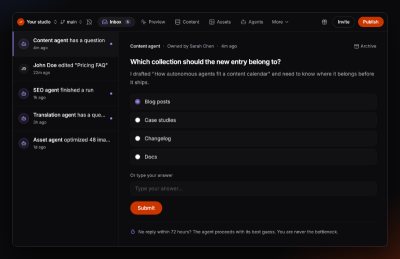
- Composable Autonomy: Users do not pick from a rigid binary menu of behaviors. Instead, they assemble specialized agents—such as a dedicated accessibility agent, an asset optimization agent, or a localized translation agent—and explicitly define the boundaries of each entity.
- Transparent Audit Trails: Trust scales proportionally with visibility. Modern platforms provide comprehensive execution histories, diff-logs, and before-and-after visual comparisons. When an agent quietly repairs a broken script or normalizes typography, the human administrator can inspect the exact mechanics of the intervention.
- Evolving Thresholds: Trust is dynamic. An agent that requires mandatory human approval for every content tweak in its first month may earn the autonomy to publish routine updates independently by its third month, based on a documented history of accurate execution.
Future Outlook: The Non-Frozen Web
As we look toward the remainder of the decade, the philosophical debate surrounding automated web management is shifting from whether we should delegate to agents, to how we define the boundary between machine efficiency and human intent.
The traditional website—static, rigid, and doomed to progressive decay from the moment of its launch—is becoming an obsolete model. In its place, organizations are adopting living digital architectures powered by supervised agentic networks.
+-----------------------------------------------------------------+
|                    THE NEW WEB LIFECYCLE                        |
|                                                                 |
|   [ Launch Day Peak ] ---> [ Autonomous Maintenance ]           |
|                                     |                           |
|                                     v                           |
|   [ Continuous Optimization ] <--- [ Human Governance ]         |
+-----------------------------------------------------------------+
In this future-state workflow:
- Deadlines Prevent Bottlenecks: Human oversight remains a safety valve, but creators no longer act as bottlenecks. If a designer or product manager fails to review a queued optimization within a specified window, the agent executes safely within its predefined boundaries, ensuring the site never stalls.
- Judgement is Rescued: By offloading structural hygiene, accessibility compliance, and design token propagation to autonomous agents, creative professionals reclaim hundreds of hours previously lost to administrative toil. They can redirect this cognitive surplus toward high-impact storytelling, experimental design, and brand innovation.
- Decay is Eradicated: The website ceases to be a temporal snapshot of a past fiscal quarter. Instead, it becomes a responsive, self-healing entity that adapts dynamically to market realities, technological standards, and user expectations.
Ultimately, the fear of an autonomous website changing without human permission misses the greater danger: the silent, invisible risk of a frozen site that slowly slips into irrelevance. By embracing granular, user-defined agentic control, the web industry is poised to move past the cycle of episodic redesigns—ensuring that our digital presence is always as sharp, responsive, and innovative as the day it was born.
