

Executive Overview
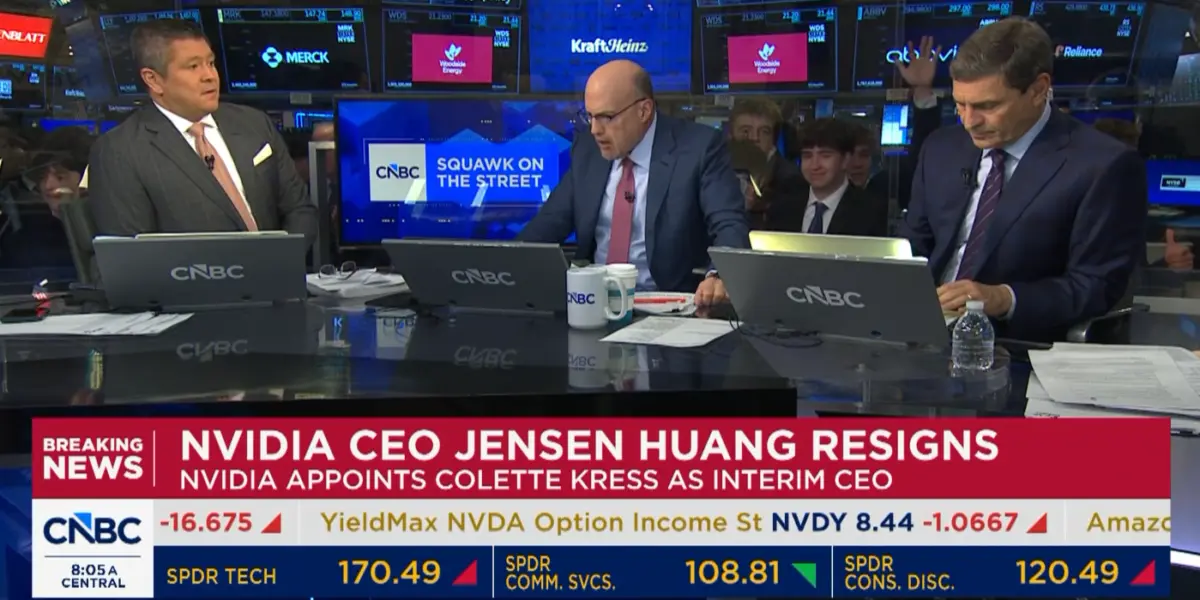
In a development that has sent seismic tremors through the global financial markets and the technology sector at large, Jensen Huang’s legendary 33-year reign as the chief executive officer of Nvidia has come to an abrupt, staggering end. Huang, who co-founded the Silicon Valley powerhouse in 1993 and subsequently engineered its evolution into the undisputed backbone of the artificial intelligence revolution, resigned effective immediately as president, CEO, and board member.
The resignation follows explosive allegations regarding multiple extramarital affairs, most notably involving a woman suspected of being a Chinese intelligence operative. This unfolding scandal threatens not only to dismantle the legacy of one of the most revered figures in modern corporate history but also to expose critical vulnerabilities in the semiconductor supply chain, national security apparatus, and corporate governance standards at the highest levels of the tech industry.
Nvidia’s board of directors moved swiftly to contain the immediate fallout, naming Chief Financial Officer Colette Kress as interim CEO while a global search committee is convened to find a permanent successor. However, the administrative continuity provided by Kress does little to soothe the anxieties of Wall Street. Nvidia stands as the primary architect of the hardware fueling the global generative AI boom, anchoring nearly half of recent American economic growth.
As regulatory bodies begin to circle and investigators parse the geopolitical implications of the alleged espionage connection, the fall of Jensen Huang is already being characterized by analysts as potentially the most consequential corporate scandal in decades—a modern tragedy of breathtaking proportions.
Detailed Chronology: How the News Broke
The unravelling of Jensen Huang’s career occurred at breathtaking speed, transitioning from hushed rumors within elite financial circles to a global breaking news event during peak morning broadcasting hours on Thursday.
The Morning Broadcast and the Breaking Wire
At approximately 8:50 a.m. Eastern Time, CNBC’s flagship morning program, Squawk Box, was live on air. The anchors were engaged in a standard interview with a guest discussing developments in the cryptocurrency markets when the official press release detailing Huang’s resignation hit the wire services.
Recalling the chaotic yet controlled atmosphere on set, CNBC co-host Carl Quintanilla noted that the production team had been bracing for a major development all week. "This thing had been building up to a crescendo all week," Quintanilla explained in an interview with TVNewser. "Our anchors interrupted the interview and got right to the details. It happened about ten minutes before the top of the hour, so we quickly rewrote our 9 a.m. lede copy."
Unlike the dramatic portrayals of newsroom pandemonium often seen in Hollywood, the actual vibe on the CNBC trading-floor set was described as acutely focused and urgent. Producers and anchors bypassed panic, immediately pivoting to synthesize the staggering array of legal, financial, and geopolitical implications associated with the sudden departure of the world’s most influential tech executive.
The Buildup and the Breaking Point
While the public announcement materialized on Thursday morning, investigative journalists and Wall Street insiders had spent the preceding days tracking swirling rumors regarding private investigations into Huang’s personal life and potential compromises regarding intellectual property. The convergence of corporate misconduct and national security concerns transformed what might have typically been handled as a standard executive ethics violation into a sprawling geopolitical thriller.
By mid-morning, the narrative had expanded far beyond the boardroom. As details emerged regarding the alleged foreign intelligence ties of one of Huang’s romantic partners, federal oversight committees in Washington D.C. began demanding briefings, and international stock exchanges braced for the opening bell.
Supporting Context & Metrics: The Magnitude of the Fall
To fully grasp the gravity of Huang’s departure, one must examine the staggering economic footprint that Nvidia occupies within the modern global ecosystem. Huang was not merely a corporate executive; he was the visionary helmsman of a company that dictates the pace of technological innovation worldwide.
Economic Gravity and Market Capitalization
Nvidia’s hardware—specifically its advanced graphics processing units (GPUs)—serves as the foundational computational layer for nearly every major artificial intelligence model deployed by tech giants such as Microsoft, Alphabet, Meta, and Amazon.
- Market Impact: In the immediate wake of the scandal, market panic and uncertainty erased nearly $2 trillion in market value, a contraction virtually unprecedented in corporate history over such a compressed timeframe.
- Economic Growth Catalyst: Analysts note that the broader AI ecosystem, heavily subsidized and catalyzed by Nvidia’s hardware dominance, has accounted for nearly 50% of overall American economic growth in recent quarters.
- The "Icarus" Analogy: Wall Street analysts have increasingly turned to classical mythology to describe the event, labeling Huang as the "Icarus of Silicon Valley"—a titan who flew too close to the sun, blinded by a sense of invincibility.
The Geopolitical and Security Dimension
Beyond the immediate financial losses, the most perilous aspect of the scandal centers on the allegations of espionage. Investigators are probing whether sensitive, restricted semiconductor technology or proprietary design architectures were illicitly funneled through private channels to foreign actors, specifically entities linked to the Chinese government.
If the ongoing investigations confirm that a multi-billion-dollar smuggling ring successfully bypassed U.S. export controls on advanced AI chips, the repercussions will extend far beyond Nvidia’s executive suite. It would represent a catastrophic failure of corporate compliance and potentially implicate federal regulators who may have possessed foreknowledge of the leaks but failed to act aggressively.
Official Statements and Industry Reactions
As the corporate apparatus of Nvidia scrambles to stabilize its operations, key stakeholders, media figures, and financial analysts have offered stark assessments of the crisis.
The View from the Financial Media
Reflecting on the psychological weight of the story, Carl Quintanilla emphasized the profound sense of disbelief shared by many who watched Huang’s rise over three decades.
"How does a guy squander his level of global influence, wealth, and stardom? And for what? For the affair? Was it recklessness? A false sense of invincibility? Or were there other motivations we don’t know about yet? I just don’t think we’ve ever seen an Icarus fall from this high an altitude."
Quintanilla also underscored the unique challenge journalists face when covering a narrative of this scale: the necessity of maintaining absolute objectivity while investigating figures who were, until very recently, universally revered as industrial demigods. "The company—and Jensen Huang—were revered," Quintanilla noted. "They made investors rich and have created some monumental technology. But as we get reminded every so often, business executives are fallible. Governments and politicians are fallible. We need to be prepared for all kinds of outcomes as the layers of this onion get peeled back."
Corporate Transition and Investor Relations
In its official communication, Nvidia sought to project stability by elevating Colette Kress. Kress, highly respected within the financial community for her steady hand during previous semiconductor supply crunches, stepped immediately into the role of interim CEO.
However, institutional investors are demanding absolute transparency regarding the board’s awareness of Huang’s personal conduct prior to the public disclosure. Institutional shareholder advisory firms have already signaled that they will scrutinize Nvidia’s internal governance controls, questioning how a chief executive could become compromised to such a degree without triggering internal compliance tripwires.
Future Outlook: Navigating the Post-Huang Era
The departure of Jensen Huang raises urgent questions about Nvidia’s operational trajectory, competitive positioning, and vulnerability to regulatory scrutiny in the months and years ahead.
Operational Resilience and Competitor Positioning
Despite the monumental nature of the leadership shakeup, immediate operational collapse is considered unlikely by macro-economists. Much of Nvidia’s financial landscape for the coming years is already insulated by pre-existing supply contracts.
- Forward Contracts: The majority of Nvidia’s enterprise delivery schedules and chip allocations through 2027 are contractually secured.
- Rise of Rivals: While Nvidia’s technological moat remains deep, competitors such as AMD, Broadcom, and Google have steadily advanced their own proprietary AI accelerators. A prolonged leadership vacuum or regulatory distraction at Nvidia could provide these rivals with the opening they need to capture lucrative market share.
Regulatory and Political Scrutiny
The overarching risk for Nvidia—and the broader tech sector—lies in Washington. The incoming administration and congressional oversight committees are expected to launch aggressive bipartisan inquiries into the security clearances, export controls, and supply chain oversight mechanisms that allowed potential espionage to occur under the radar.
If government investigations reveal systemic negligence, Nvidia could face crippling federal fines, temporary halts on international shipments, or restructured oversight mandates that could permanently alter how the company conducts business globally.
Conclusion
The abrupt termination of Jensen Huang’s tenure marks the definitive end of an era for Silicon Valley. It serves as a sobering reminder that even the most monumental technological achievements and unprecedented market dominance cannot insulate a leader from the destructive consequences of personal recklessness and ethical failure. As Nvidia attempts to chart a course forward under Colette Kress, the global financial markets watch with bated breath, acutely aware that the fallout from the fall of Jensen Huang has only just begun.
